
John Marcellus Huston ( HEW-stən; August 5, 1906 – August 28, 1987) was an American-Irish film director, screenwriter, and actor. In a career spanning more than five decades, he wrote the screenplays for many of the 37 feature films he directed, many of which are today considered classics. He received numerous accolades including two Academy Awards and three Golden Globe Awards. He also received the BAFTA Fellowship in 1980, a Special Lion for the Overall Work in 1985, and a Silver Lion in 1953.
The son and only child of actor Walter Huston, Huston studied and worked as a fine art painter in Paris. He then moved to Mexico and began writing, first plays and short stories, and later working in Los Angeles as a Hollywood screenwriter, and was nominated for several Academy Awards writing for films directed by William Dieterle and Howard Hawks, among others. His directorial debut came with The Maltese Falcon (1941), which despite its small budget became a commercial and critical hit; he continued to be a successful, if iconoclastic, Hollywood director for the next 45 years.
Huston directed acclaimed films such as The Treasure of the Sierra Madre (1948), Key Largo (1948), The Asphalt Jungle (1950), The African Queen (1951), Moulin Rouge (1952), Heaven Knows, Mr. Allison (1957), The Misfits (1961), The Night of the Iguana (1964), Fat City (1972), The Man Who Would Be King (1975), Annie (1982), Prizzi's Honor (1985) and The Dead (1987). During his 46-year career, Huston received 14 Academy Award nominations, winning twice. He was also an actor, acting in numerous films and receiving nominations for an Academy Award and a Golden Globe Award for The Cardinal (1963) and Chinatown (1974) respectively. He also acted in Casino Royale (1967), Myra Breckinridge (1970) and Battle for the Planet of the Apes (1973). He voiced the wizard Gandalf in The Hobbit (1977) and The Return of the King (1980).

Huston has been referred to as "a titan", "a rebel", and a "renaissance man" in the Hollywood film industry. He traveled widely, settling at various times in France, Mexico, and Ireland. Huston was a citizen of the United States by birth but renounced this to become an Irish citizen and resident in 1964. He eventually returned to the United States, where he lived the rest of his life. He was the father of actress Anjelica Huston, whom he directed to an Oscar win in Prizzi's Honor.
Early life
John Huston was born on August 5, 1906, in Nevada, Missouri. He was the only child of Rhea (née Gore) and Canadian-born Walter Huston. His father was an actor, initially in vaudeville, and later in films. His mother worked as a sports editor for various publications but stopped after John was born. Similarly, his father ended his stage acting career for steady employment as a civil engineer, although he returned to stage acting within a few years. He later became highly successful on both Broadway and then in motion pictures. He had Scottish, Scotch-Irish, English and Welsh ancestry.
Huston's parents divorced in 1913 when he was six years old. For much of his childhood, he lived and studied in boarding schools. During summer vacations, he traveled separately with each of his parents – with his father on vaudeville tours, and with his mother to horse races and other sports events. Young Huston benefited greatly from seeing his father act on stage, and he was later drawn to acting.

Some critics, such as Lawrence Grobel, surmise that his relationship with his mother may have contributed to his marrying five times, and seeming to have difficulty in maintaining relationships. Grobel wrote, "When I interviewed some of the women who had loved him, they inevitably referred to his mother as the key to unlocking Huston's psyche." According to actress Olivia de Havilland, "she [his mother] was the central character. I always felt that John was ridden by witches. He seemed pursued by something destructive. If it wasn't his mother, it was his idea of his mother."
As a child, Huston was often ill; he was treated for an enlarged heart and kidney ailments. He recovered after an extended bedridden stay in Arizona and moved with his mother to Los Angeles, where he attended Abraham Lincoln High School. He dropped out after two years to become a professional boxer. By age 15 he was a top-ranking amateur lightweight boxer in California. He ended his brief boxing career after suffering a broken nose.
He also engaged in many interests, including ballet, English and French literature, opera, horseback riding, and studying painting at the Art Students League of Los Angeles. Living in Los Angeles, Huston became infatuated with the new film industry and motion pictures, as a spectator only. To Huston, "Charlie Chaplin was a god."

Huston returned to New York City to live with his father, who was acting in off-Broadway productions, and had a few small roles. He later remembered that while watching his father rehearse, he became fascinated with the mechanics of acting:
What I learned there, during those weeks of rehearsal, would serve me for the rest of my life.
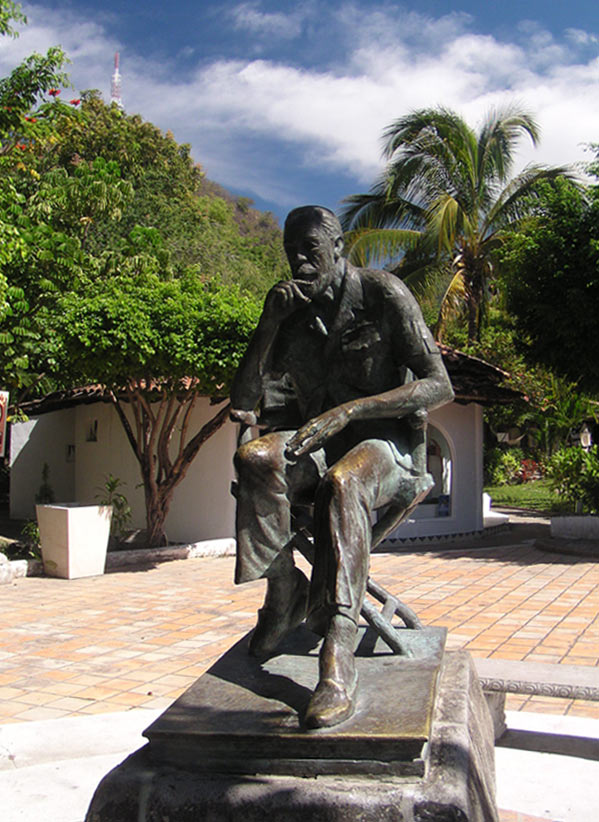
After a short period of acting on stage, and having undergone surgery, Huston travelled alone to Mexico. During two years there, among other adventures, he obtained a position as an honorary member of the Mexican cavalry. He returned to Los Angeles and married Dorothy Harvey, a girlfriend from high school. Their marriage lasted seven years (1926–1933).
Career
1930–1939: Early career and directorial debut
During his stay in Mexico, Huston wrote a play called Frankie and Johnny, based on the ballad of the same title. After selling it easily, he decided that writing would be a viable career, and he focused on it. His self-esteem was enhanced when H. L. Mencken, editor of the popular magazine American Mercury, bought two of his stories, "Fool" and "Figures of Fighting Men." During subsequent years, Huston's stories and feature articles were published in Esquire, Theatre Arts, and The New York Times. He also worked for a period on the New York Graphic. In 1931, when he was 25, he moved back to Los Angeles in hopes of writing for the blossoming film industry. The silent films had given way to "talkies", and writers were in demand. His father had earlier moved there and already gained success in a number of films.
Huston received a script editing contract with Samuel Goldwyn Productions but, after six months of receiving no assignments, quit to work for Universal Studios, where his father was a star. At Universal, he got a job in the script department, and began by writing dialogue for a number of films in 1932, including Murders in the Rue Morgue, A House Divided, and Law and Order. The last two also starred his father, Walter Huston. A House Divided was directed by William Wyler, who gave Huston his first real "inside view" of the filmmaking process during all stages of production. Wyler and Huston became close friends and collaborators on a number of leading films.
Huston gained a reputation as a "lusty, hard-drinking libertine" during his first years as a writer in Hollywood. Huston described those years as a "series of misadventures and disappointments". In 1933 he was in a romantic relationship with actress Zita Johann. While driving drunk, with Johann as passenger, he hit a parked car sending Johann through the glass windshield. She suffered head trauma and Huston was charged with driving while intoxicated. His brief career as a Hollywood writer ended suddenly when he struck and killed actress Tosca Roulien, wife of actor Raul Roulien, while driving. There is a rumor that actor Clark Gable was responsible for the accident, but that MGM general manager Eddie Mannix paid Huston to take the blame. Gable was on location filming a movie, however, proving that rumor untrue. A coroner's jury absolved Huston of blame, but the incident left him "traumatized". He moved to London and Paris, living as a "drifter."

By 1937, the 31-year-old Huston returned to Hollywood intent on being a "serious writer." He married again, to Lesley Black. His first job was as scriptwriter with Warner Brothers Studio, and he formed his personal longterm goal to direct his own scripts. For the next four years, he co-wrote scripts for major films such as Jezebel, The Amazing Dr. Clitterhouse, Juarez, Dr. Ehrlich's Magic Bullet, and Sergeant York (1941). He was nominated for Academy Awards for his screenplays for both Ehrlich and Sergeant York. Huston wrote that Sergeant York, which was directed by Howard Hawks, has "gone down as one of Howard's best pictures, and Gary Cooper had a triumph playing the young mountaineer."
Huston was recognized and respected as a screenwriter. He persuaded the Warners to give him a chance to direct, under the condition that his next script also became a hit.
Huston wrote:

They indulged me rather. They liked my work as a writer and they wanted to keep me on. If I wanted to direct, why, they'd give me a shot at it, and if it didn't come off all that well, they wouldn't be too disappointed as it was to be a very small picture.
His next script was High Sierra (1941), to be directed by Raoul Walsh. The film became the hit Huston wanted. It also made Humphrey Bogart a star with his first major role, as a gunman on the run. Warners kept their end of the bargain and gave Huston his choice of subject. For his first directing assignment, Huston chose Dashiell Hammett's detective thriller, The Maltese Falcon, a film which failed at the box office in two earlier versions by Warners. However, studio head Jack L. Warner approved of Huston's treatment of Hammett's 1930 novel, and he stood by his word to let Huston choose his first subject.
Huston kept the screenplay close to the novel, keeping much of Hammett's dialogue, and directing it in an uncluttered style, much like the book's narrative. He did unusual preparation for his first directing job by sketching out each shot beforehand, including camera positions, lighting, and compositional scale, for such elements as closeups.
He especially benefited by selecting a superior cast, giving Humphrey Bogart the lead role. Bogart was happy to take the role, as he liked working with Huston. The supporting cast included other noted actors: Mary Astor, Peter Lorre, Sydney Greenstreet (his first film role), and his own father, Walter Huston. The film was given only a small B-movie budget, and received minimal publicity by Warners, as they had low expectations. The entire film was made in eight weeks for only $300,000.
Warners was surprised by the immediate enthusiastic response by the public and critics, who hailed the film as a "classic", with many ranking it as the "best detective melodrama ever made." Herald Tribune critic Howard Barnes called it a "triumph." Huston received an Academy Award nomination for the screenplay. After this film, Huston directed all of his screenplays, except for one, Three Strangers (1946). In 1942, he directed two more hits, In This Our Life (1942), starring Bette Davis, and Across the Pacific, another thriller starring Humphrey Bogart.
1942–1946: Army years during World War II
In 1942 Huston served in the United States Army during World War II, making films for the Army Signal Corps. While in uniform with the rank of captain, he directed and produced three films that some critics rank as "among the finest made about World War II: Report from the Aleutians (1943), about soldiers preparing for combat; The Battle of San Pietro (1945), the story (censored by the Army) of a failure by America's intelligence agencies that resulted in many deaths, and Let There Be Light (1946), about psychologically damaged veterans. It was censored and suppressed for 35 years, until 1981.
Huston was promoted to the rank of major and received the Legion of Merit award for "courageous work under battle conditions." All of his films made for the Army were "controversial", and were either not released, were censored, or banned outright, as they were considered "demoralizing" to soldiers and the public. Let There Be Light was the most controversial as the Army banned the film from public viewing due to the ethics of filming the soldiers' recovery and the lack of written permission supplied by Huston. Years later, after Huston moved to Ireland, his daughter, actress Anjelica Huston, recalled that the "main movies we watched were the war documentaries." These war films thus had a major and lasting influence on John Huston and his work.
Huston performed an uncredited rewrite of Anthony Veiller's screenplay for The Stranger (1946), a film he was to have directed. When Huston became unavailable, the film's star, Orson Welles, directed instead; Welles had the lead role of a high-ranking Nazi fugitive who settles in New England under an assumed name.
1947–1951: Breakthrough and acclaim
The Treasure of the Sierra Madre (1948)
Huston's next picture, which he wrote, directed, and briefly appeared in as an American asked to "help out a fellow American, down on his luck", was The Treasure of the Sierra Madre (1948). It would become one of the films that established his reputation as a leading filmmaker. The film, also starring Humphrey Bogart, was the story of three drifters who band together to prospect for gold. Huston gave a supporting role to his father, Walter Huston.
Warners studio was initially uncertain what to make of the film. They had allowed Huston to film on location in Mexico, which was a "radical move" for a studio at the time. They also knew that Huston was gaining a reputation as "one of the wild men of Hollywood." In any case, studio boss Jack L. Warner initially "detested it." But whatever doubts Warners had were soon removed, as the film achieved widespread public and critical acclaim. Hollywood writer James Agee called it "one of the most beautiful and visually alive movies I have ever seen." Time magazine described it as "one of the best things Hollywood has done since it learned to talk." Huston won Oscars for Best Director and Best Adapted Screenplay; his father won for Best Supporting Actor. The film also won other awards in the U.S. and overseas.
Decades later, Film Comment magazine devoted four pages to the film in its May–June 1980 edition, with author Richard T. Jameson offering his impressions:
This film has impressed itself on the heart and mind and soul of anyone who has seen it, to the extent that filmmakers of great originality and distinctiveness like Robert Altman and Sam Peckinpah can be said to have remade it again and again ... without compromising its uniqueness.
Key Largo (1948)
Also in 1948, Huston directed Key Largo, again starring Humphrey Bogart. It was the story about a disillusioned veteran who clashes with gangsters on a remote Florida key. It co-starred Lauren Bacall, Claire Trevor, Edward G. Robinson, and Lionel Barrymore. The film was an adaptation of the stage play by Maxwell Anderson. Some viewers complained that it was still overly stage-bound. But the "outstanding performances" by all the actors saved the film, and Claire Trevor won an Oscar for best supporting actress. Huston was annoyed that the studio cut several scenes from the final release without his agreement. That, along with some earlier disputes, angered Huston enough that he left the studio when his contract expired.
The Asphalt Jungle (1950)
In 1950 he wrote and directed The Asphalt Jungle, a film which broke new ground by depicting criminals as somewhat sympathetic characters, simply doing their professional work, "an occupation like any other". Huston described their work as "a left-handed form of human endeavor." Huston achieved that effect by giving "deep attention" to the plot, involving a large jewelry theft, by examining the minute, step-by-step details and difficulties each of the characters had of carrying it out. Some critics felt that, by this technique, Huston had achieved an almost "documentary" style.
His assistant director Albert Band explains further:
I'll never forget it. We got on that set and he composed a shot in which ten elements were working all at the same time. Took half a day to do it, but it was fantastic. He knew exactly how to shoot a picture. His shots were all painted on the spot ... He had a great eye and he never lost his sense of composition.
Film critic Andrew Sarris considered it to be "Huston's best film", and the film that made Marilyn Monroe a recognized actress. Sarris also notes the similar themes in many of Huston's films, as exemplified by this one: "His protagonists almost invariably fail at what they set out to do." This theme was also expressed in Treasure of the Sierra Madre, where the group foundered on their own greed.
It starred Sterling Hayden and Sam Jaffe, a personal friend of Huston. Marilyn Monroe had her first serious role in this film. Huston said, "it was, of course, where Marilyn Monroe got her start." Monroe said Huston was the first genius she had ever met; and he made her feel that she finally had a chance of becoming a professional actress:
Even though my part was a minor one, I felt as if I were the most important performer in the picture—when I was before the camera. This was because everything I did was important to the director.
The film succeeded at the box office, and Huston was again nominated for an Oscar for best screenplay and best director, along with winning the Screen Directors Guild Award. This became a model for many similar movies by other filmmakers.
The Red Badge of Courage (1951)
Huston's next film, The Red Badge of Courage (1951), was of a completely different subject: war and its effect on soldiers. While in the army during World War II, he became interested in Stephen Crane's classic American Civil War novel of the same title. For the starring role, Huston chose World War II hero Audie Murphy to play the young Union soldier who deserts his company out of fear, but later returns to fight alongside them. MGM was concerned that the movie seemed too antiwar for the postwar period. Without Huston's input, they cut down the running time of the film from eighty-eight minutes to sixty-nine, added narration, and deleted what Huston felt was a crucial scene.
The film performed poorly at the box office. Huston suggests that it was possibly because it "brought war very close to home." Huston recalls that at the preview showing, before the film was halfway through, "damn near a third of the audience got up and walked out of the theater." Despite the "butchering" and weak public response, film historian Michael Barson describes the movie as "a minor masterpiece."
At the same time, the film was also the cause of a growing feud between MGM founder Louis B. Mayer and Producer Dore Schary to the point where Huston felt like stepping down to avoid growing the conflict. However, Mayer encouraged Huston to stay on telling him to fight for the picture regardless of what he thought of it.
The African Queen (1951)
Before The Red Badge of Courage opened in theaters, Huston was already in Africa shooting The African Queen (1951), a story based on C. S. Forester's popular novel. It starred Humphrey Bogart and Katharine Hepburn in a combination of romance, comedy and adventure. Barson calls it "one of the most popular Hollywood movies of all time." The film's producer, Sam Spiegel, urged Huston to change the ending to allow the protagonists to survive, instead of dying. Huston agreed, and the ending was rewritten. It became Huston's most successful film financially, and "it remains one of his finest works." Huston was nominated for two Academy Awards—Best Director and Best Adapted Screenplay. Bogart, meanwhile, won his only Oscar for Best Actor for his role as Charlie Allnut.
Hepburn wrote about her experiences shooting the film in her memoir, The Making of the African Queen: Or How I went to Africa with Bogart, Bacall, and Huston and almost lost my mind. Clint Eastwood directed and starred in the film White Hunter, Black Heart, based on Peter Viertel's novel of the same name, which tells a fictional version of the making of the film.
1952–1966: HUAC period
In 1952 Huston moved to Ireland as a result of his "disgust" at the "witch-hunt" and the "moral rot" he felt was created by investigation and hearings by the House Committee on Un-American Activities (HCUA), which had affected many of his friends in the movie industry. Huston had, with friends including director William Wyler and screenwriter Philip Dunne, established the "Committee for the First Amendment", as a response to the ongoing government investigations into communists within the film industry. The HCUA was calling numerous filmmakers, screenwriters, and actors to testify about any past affiliations.
He later described, in general, the types of people who were alleged communists:
The people who did get caught up in it were, for the most part, well-intentioned boobs from a poor background. A number of them had come from the Lower East Side of Manhattan, and out in Hollywood, they sort of felt guilty for living the good life. Their social conscience was more acute than the next fellow's.
Huston took producing, writing, and directing credits for his next two films: Moulin Rouge (1952); and Beat the Devil (1953); both of these were financed by the Woolf brothers for whom Huston had made African Queen. Moby Dick (1956), however, was written by Ray Bradbury, although Huston had his name added to the screenplay credit after the completion of the project. Although Huston had personally hired Bradbury to adapt Herman Melville's novel into a screenplay, Bradbury and Huston did not get along during pre-production. Bradbury later dramatized their relationship in the short story "Banshee". When this was adapted as an episode of The Ray Bradbury Theater, Peter O'Toole played the role based on John Huston. Bradbury wrote more poems, essays, and stories on his time in Ireland, but was reluctant to write a book because he did not want to gossip about Huston. It was not until after he read Katharine Hepburn's memoir, The Making of the African Queen, that he decided that he could write "a book which is fair, which presents the Huston that I loved along with the one that I began to fear on occasion." He published Green Shadows, White Whale, a novel about his time in Ireland with Huston, almost 40 years after he wrote the screenplay for Moby Dick.
Huston had been planning to film Herman Melville's Moby-Dick for the previous ten years, and originally thought the starring role of Captain Ahab would be an excellent part for his father, Walter Huston. After his father died in 1950, Huston chose Gregory Peck to play the role. The movie was filmed over a three-year period on location in Ireland, where Huston was living. The fishing village of New Bedford, Massachusetts, was recreated along the waterfront; the sailing ship in the film was fully constructed to be seaworthy; and three 100-foot whales were built out of steel, wood, and plastic. In the film, Huston's voice was dubbed for the voice of actor Joseph Tomelty and a Pequod lookout. But the film failed at the box office. Critics such as David Robinson suggested that the movie lacked the "mysticism of the book" and thereby "loses its significance."
Of Huston's next five films, only The Misfits (1961), gained critical approval. Critics have since noted the "retrospective atmosphere of doom" associated with the film. Clark Gable, the star, died of a heart attack a few weeks after the filming was completed; Marilyn Monroe never finished another film, and died a year later after being suspended during the filming of Something's Got to Give; and costars Montgomery Clift (1966) and Thelma Ritter (1969) also died over the next decade. But two of the Misfits stars, Eli Wallach and Kevin McCarthy, lived another 50 years. During the filming, Monroe was sometimes taking prescribed drugs, which led to her arriving late on the set. Monroe also sometimes forgot her lines. Monroe's personal problems eventually led to the breakup of her marriage to playwright Arthur Miller, the scriptwriter, "virtually on set." Miller dramatized the making of The Misfits in his final play, Finishing the Picture, where Huston is represented as the director. Huston later commented about this period in Monroe's career: "Marilyn was on her way out. Not only of the picture, but of life."