
The Geneva Conventions are a series of four international treaties (1949) and their three additional protocols that form the core of international humanitarian law. They establish legal standards for humanitarian treatment of non-combatants in war and protect people who are not or are no longer actively taking part in hostilities. This category includes not only civilians and civilian populations but also former combatants, such as prisoners of war and fighters rendered hors de combat due to injury, illness, shipwreck or those who have surrendered. The four 1949 Geneva Conventions, adopted in response to the inhumanities of World War II, updated and added to previous Geneva Conventions (1864, 1906, 1929). The 1949 Geneva Conventions address the treatment of sick and wounded soldiers in the field ("Geneva Convention I"), wounded, sick and shipwrecked soldiers at sea (“Geneva Convention II”), prisoners of war (“Geneva Convention III”), and civilians in time of war (“Geneva Convention IV”). In 1977, these rules were updated by two Additional Protocols, the first concerning international armed conflicts (“Additional Protocol I”) and the second, non-international armed conflicts (“Additional Protocol II”).
Aside from the UN Charter, the Geneva Conventions are among the most widely ratified international agreements. The four 1949 Geneva Conventions were ratified, in their entirety or with reservations, by 196 countries. Much of the international humanitarian law contained in the Geneva Conventions has become customary international law, and therefore would apply to all states and non-state armed groups, even those that are not a party to the Geneva Conventions. The legal obligations created under the Geneva Conventions are somewhat different from other international treaties in that a breach of the Geneva Conventions by one party does not furnish a directly affected party with the option to cease complying with its treaty obligations.
The Geneva Conventions define the basic rights and protections afforded to those non-combatants who fulfill the criteria of being protected persons. The Geneva Conventions define the rights of civilians, prisoners of war, and military personnel; establish protections for the wounded, sick, and shipwrecked; and provide humanitarian protections for civilians in and around war zones. The use of conventional weapons in wartime is addressed by the Hague Conventions of 1899 and 1907 and the 1980 Convention on Certain Conventional Weapons, while the use of biological and chemical weapons in international armed conflicts is addressed by the 1925 Geneva Protocol. Violations of these earlier conventions constituted some of the grounds for the judgments of the Nuremberg, Tokyo, and other war crimes tribunals.

Much of the 1949 Geneva Conventions, “have come to be recognized as customary law; hence they apply regardless of whether parties to the conflicts have ratified” the conventions.
History
The Swiss businessman Henry Dunant went to visit wounded soldiers after the Battle of Solferino in 1859. He was both outraged and shocked by the lack of facilities, personnel, and medical aid available to help these soldiers. As a result, he published his book, A Memory of Solferino, in 1862, on the horrors of war. His wartime experiences inspired Dunant to propose:
A permanent relief agency for humanitarian aid in times of war

A government treaty recognizing the neutrality of the agency and allowing it to provide aid in a war zone
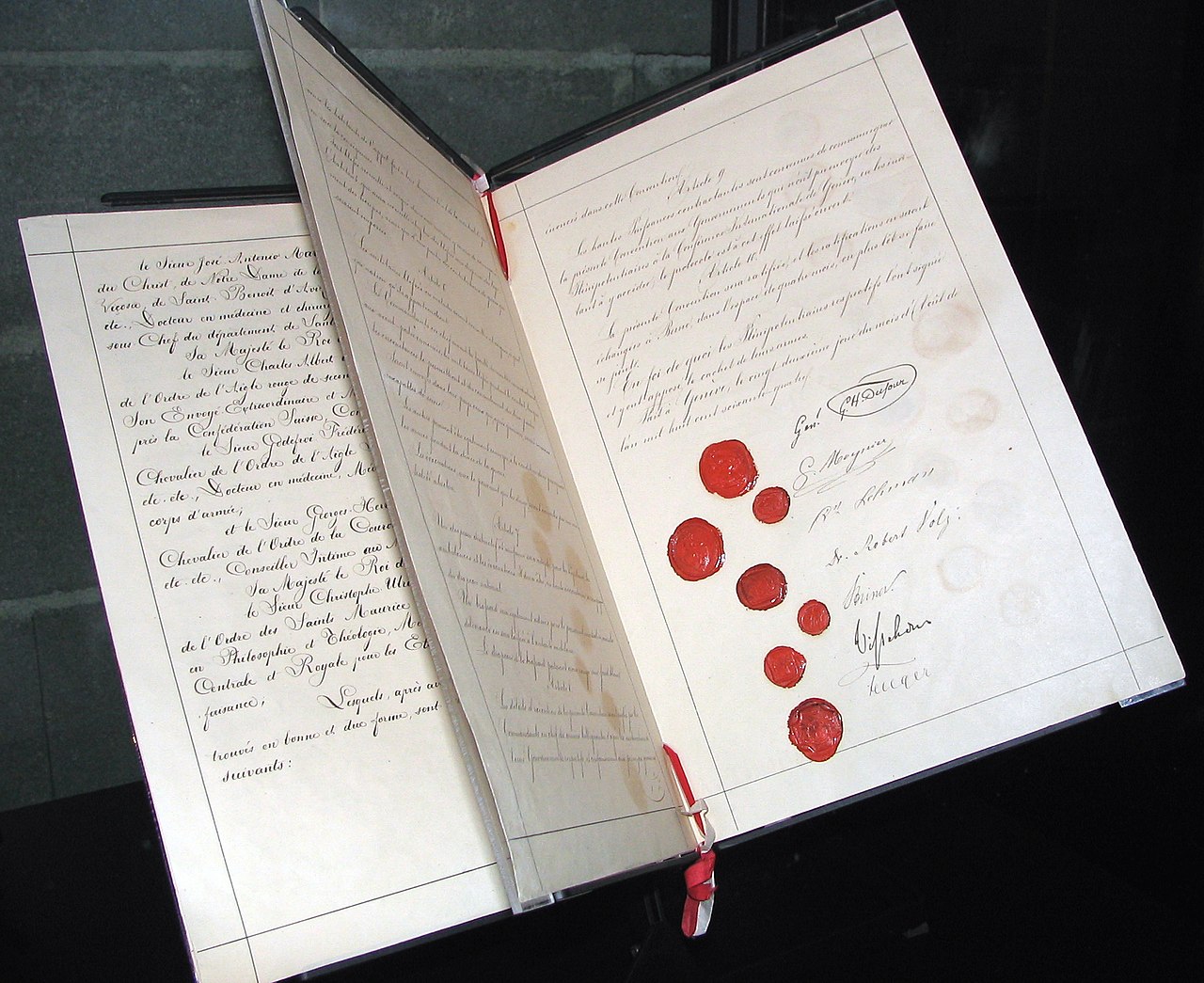
The former proposal led to the establishment of the International Committee of the Red Cross (ICRC) in Geneva. The latter led to the 1864 Geneva Convention, which was the first codified international treaty that covered the sick and wounded soldiers on the battlefield. On 22 August 1864, the Swiss government invited the governments of all European countries, as well as the United States, Brazil, and Mexico, to attend an official diplomatic conference. Overall, 16 countries sent a total of 26 delegates to Geneva. On 22 August 1864, the conference adopted the first Geneva Convention "for the Amelioration of the Condition of the Wounded in Armies in the Field.” Representatives of 12 states and kingdoms signed the convention:
For both of these accomplishments, Henry Dunant became corecipient of the first Nobel Peace Prize in 1901.
On 20 October 1868 the first unsuccessful attempt to expand the 1864 treaty was undertaken. With the 'Additional Articles relating to the Condition of the Wounded in War' an attempt was initiated to clarify some rules of the 1864 convention and to extend them to maritime warfare. The Articles were signed but were only ratified by the Netherlands and the United States of America. The Netherlands later withdrew their ratification. The protection of the victims of maritime warfare was later realized by the third Hague Convention of 1899 and the tenth Hague Convention of 1907.
In 1906, thirty-five states attended a conference convened by the Swiss government. On 6 July 1906 it resulted in the adoption of the "Convention for the Amelioration of the Condition of the Wounded and Sick in Armies in the Field", which improved and supplemented, for the first time, the 1864 Convention. It remained in force until 1970 when Costa Rica acceded to the 1949 Geneva Conventions.
The 1929 conference yielded two conventions that were signed on 27 July 1929. One, the "Convention for the Amelioration of the Condition of the Wounded and Sick in Armies in the Field," was the third version to replace the original convention of 1864. The other was adopted after experiences in World War I had shown the deficiencies in the protection of prisoners of war under the Hague Conventions of 1899 and 1907. The "Convention relative to the Treatment of Prisoners of War" was not to replace these earlier conventions signed at The Hague; rather it supplemented them.
There was considerable debate over whether the Geneva Convention should prohibit indiscriminate forms of warfare, such as aerial bombings, nuclear bombings and starvation, but no agreement was reached on those forms of violence.
Inspired by the wave of humanitarian and pacifistic enthusiasm following World War II and the outrage towards the war crimes disclosed by the Nuremberg and Tokyo trials, a series of conferences were held in 1949 reaffirming, expanding and updating the prior Geneva and Hague Conventions. It yielded four distinct conventions:
The First Geneva Convention "for the Amelioration of the Condition of the Wounded and Sick in Armed Forces in the Field" was the fourth update of the original 1864 convention and replaced the 1929 convention on the same subject matter.
The Second Geneva Convention "for the Amelioration of the Condition of Wounded, Sick and Shipwrecked Members of Armed Forces at Sea" replaced the Hague Convention (X) of 1907. It was the first Geneva Convention on the protection of the victims of maritime warfare and mimicked the structure and provisions of the First Geneva Convention.
The Third Geneva Convention "relative to the Treatment of Prisoners of War" replaced the 1929 Geneva Convention that dealt with prisoners of war.
The Fourth Geneva Convention "relative to the Protection of Civilian Persons in Time of War" was the first Geneva Convention not to deal with combatants. The 1899 and 1907 Hague Conventions had already contained some provisions on the protection of civilians and occupied territory. Article 154 specifically provides that the Fourth Geneva Convention is supplementary to these provisions in the Hague Conventions.
Despite the length of these documents, they were found over time to be incomplete. The nature of armed conflicts had changed with the beginning of the Cold War era, leading many to believe that the 1949 Geneva Conventions were addressing a largely extinct reality: on the one hand, most armed conflicts had become internal, or civil wars, while on the other, most wars had become increasingly asymmetric. Modern armed conflicts were inflicting an increasingly higher toll on civilians, which brought the need to provide civilian persons and objects with tangible protections in time of combat, bringing a much needed update to the Hague Conventions of 1899 and 1907.
In light of these developments, two Protocols were adopted in 1977 that extended the terms of the 1949 Conventions with additional protections. In 2005, a third brief Protocol was added establishing an additional protective sign for medical services, the Red Crystal, as an alternative to the ubiquitous Red Cross and Red Crescent emblems, for those countries that find them objectionable.
Commentaries
The Geneva Conventions of 12 August 1949: Commentary (The Commentaries) is a series of four volumes of books published between 1952 and 1958 containing commentaries to each of the four Geneva Conventions. The series was edited by Jean Pictet who was the vice-president of the ICRC. The Commentaries are often relied upon to provide authoritative interpretation of the articles.
Contents
The Geneva Conventions are rules that apply only in times of armed conflict and seek to protect people who are not or are no longer taking part in hostilities.
The First Geneva Convention dealt with the treatment of wounded and sick armed forces in the field. The Second Geneva Convention dealt with the sick, wounded, and shipwrecked members of armed forces at sea. The Third Geneva Convention dealt with the treatment of prisoners of war during times of conflict. The Fourth Geneva Convention dealt with the treatment of civilians and their protection during wartime.
Individuals who fulfill the criteria of protected persons in international armed conflicts are protected by the 1949 conventions. Those not listed as protected persons in such conflicts are instead protected by international human rights law and general treaties concerning the legal status of aliens in belligerent nations.
In addition, there are provisions such as Article 15 of the First Geneva Convention which provides that, "whenever circumstances permit, an armistice or a suspension of fire shall be arranged, or local arrangements made, to permit the removal, exchange and transport of the wounded left on the battlefield.” Another provision, such as Article 16 of the Fourth Geneva Convention, states that, “as far as military considerations allow, each Party to the conflict shall facilitate the steps taken to search for the killed and wounded, to assist the shipwrecked and other persons exposed to grave danger, and to protect them against pillage and ill-treatment.”
Geneva Conventions of 1949
In international law and diplomacy the term convention refers to an international agreement, or treaty.
First Geneva Convention "for the Amelioration of the Condition of the Wounded and Sick in Armed Forces in the Field" (first adopted in 1864, revised in 1906, 1929 and 1949);
Second Geneva Convention "for the Amelioration of the Condition of Wounded, Sick and Shipwrecked Members of Armed Forces at Sea" (first adopted in 1949, successor of the Hague Convention (X) of 1907);
Third Geneva Convention "relative to the Treatment of Prisoners of War" (first adopted in 1929, last revision in 1949);
Fourth Geneva Convention "relative to the Protection of Civilian Persons in Time of War" (first adopted in 1949 based on parts of the Hague Conventions (II and IV) of 1899 and 1907).
With two Geneva Conventions revised and adopted and two added in 1949, the whole is referred to as the "Geneva Conventions of 1949" or simply the "Geneva Conventions". Usually only the Geneva Conventions of 1949 are referred to as First, Second, Third or Fourth Geneva Conventions. The treaties of 1949 were ratified, in whole or with reservations, by 196 countries.
Protocols Additional to the 1949 Geneva Conventions
The 1949 Geneva Conventions have been amended with three optional protocols:
Protocol I (1977) relating to the Protection of Victims of International Armed Conflicts;
Protocol II (1977) relating to the Protection of Victims of Non-International Armed Conflicts;
Protocol III (2005) relating to the Adoption of an Additional Distinctive Emblem.
Application
The Geneva Conventions apply at times of war and armed conflict to governments who have ratified its terms. The details of applicability are spelled out in Common Articles 2 and 3.
Common Article 2 relating to international armed conflict (IAC)
Common Article 2 states that the Geneva Conventions apply to all the cases of international armed conflict (IAC), where at least one of the warring nations has ratified the Conventions. Primarily:
The Conventions apply to all cases of declared war between signatory nations. This is the original sense of applicability, which predates the 1949 version.
The Conventions apply to all cases of armed conflict between two or more signatory nations. This language was added in 1949 to accommodate situations that have all the characteristics of war without the existence of a formal declaration of war, such as a police action.
The Conventions apply to a signatory nation even if the opposing nation is not a signatory, but only if the opposing nation "accepts and applies the provisions" of the Conventions.
Article 1 of Protocol I to the Geneva Conventions further clarifies that armed conflict against colonial domination and foreign occupation also qualifies as an international conflict. When the criteria of international armed conflict have been met, the full protections of the Conventions are considered to apply.
Common Article 2 makes it clear that IHL applies not only to declared wars but also to all other armed conflicts.
Common Article 3 relating to non-international armed conflict (NIAC)
Common Article 3 states that the certain minimum rules of war apply to armed conflicts "not of an international character." The International Committee of the Red Cross has explained that this language describes non-international armed conflict (NIAC) "where at least one Party is not a State." For example, it would apply to conflicts between state forces and non-state actors (NSAs), or between two NSAs, or to other conflicts that have all the characteristics of war, whether carried out within the confines of one country or not.
There are two criteria to distinguish non-international armed conflicts from lower forms of violence. The level of violence has to be of certain intensity, for example when the state cannot contain the situation with regular police forces. Also, involved non-state groups need to have a certain level of organization, like a military command structure.
The other Geneva Conventions are not applicable in this situation but only the provisions contained within Article 3, and additionally within the language of Protocol II. The rationale for the limitation is to avoid conflict with the rights of Sovereign States that were not part of the treaties. When the provisions of this article apply, it states that:
Persons taking no active part in the hostilities, including members of armed forces who have laid down their arms and those placed hors de combat by sickness, wounds, detention, or any other cause, shall in all circumstances be treated humanely, without any adverse distinction founded on race, colour, religion or faith, sex, birth or wealth, or any other similar criteria. To this end, the following acts are and shall remain prohibited at any time and in any place whatsoever with respect to the above-mentioned persons:
violence to life and person, in particular murder of all kinds, mutilation, cruel treatment and torture;
taking of hostages;
outrages upon dignity, in particular humiliating and degrading treatment; and
the passing of sentences and the carrying out of executions without previous judgment pronounced by a regularly constituted court, affording all the judicial guarantees which are recognized as indispensable by civilized peoples.
The wounded and sick shall be collected and cared for.
During the negotiation of the Geneva Conventions, France and Britain were initially staunchly opposed to Common Article 3. However, to save face during negotiations and make strategic concessions, France and Britain deliberately introduced ambiguous language in the text of Common Article 3 that made it easy for states to avoid the obligations of the rule. As a consequence, Common Article 3 only concerns with humane treatment and does not deal with methods and means of hostilities, such as bombings committed by non-state armed groups or state forces against civilian targets in the Algerian War and the Troubles.