
The Finnish Defence Forces (FDF) (Finnish: Puolustusvoimat; Swedish: Försvarsmakten) are the military of Finland. The Finnish Defence Forces consist of the Finnish Army, the Finnish Navy, and the Finnish Air Force. In wartime, the Finnish Border Guard becomes part of the Finnish Defence Forces.
Universal male conscription is in place, under which all mentally and physically capable men serve for 165, 255, or 347 days, from the year they turn 18 until the year they turn 29. Alternative non-military service for men and voluntary service for women is available.
Finland's official policy states that a wartime military strength of 280,000 personnel constitutes a sufficient deterrent. The army consists of a highly mobile field army backed up by local defence units. The army defends the national territory and its military strategy employs the use of the heavily forested terrain and numerous lakes to wear down an aggressor, instead of attempting to hold the attacking army on the frontier.

Finland's defence budget for 2025 equals approximately €6.5 billion. The voluntary overseas service is highly popular and troops serve around the world in UN, NATO, and EU missions. With an arsenal of 700 howitzers, 700 heavy mortars and 100 multiple rocket launchers, Finland has the largest artillery capability in western Europe. Homeland defence willingness against a superior enemy is at 83%, one of the highest rates in Europe. The air force has 62 F/A-18 combat aircraft from 1995, to be replaced with 64 F-35 aircraft in 2026 by the HX Fighter Program.
The Finnish Defence Forces cooperate closely with the Finnish Border Guard. The Finnish Border Guard has its own yearly and long-term investment budget.
History
Civil War
After Finland's declaration of independence on 6 December 1917, the Civil Guards were proclaimed the troops of the government on 25 January 1918 and then Lieutenant General of the Russian Imperial Army Carl Gustaf Emil Mannerheim was appointed as Commander-in-Chief of these forces the next day. Fighting between the White Guards (as the Civil Guards were commonly known) and the Red Guards had already broken out about a week before around Viipuri, in what became known as the Finnish Civil War.

In the war, the Whites were victorious in large part thanks to the leadership of General Mannerheim and the lead by example offensive mindedness of 1,800 German-trained Finnish Jägers, who brought with them German tactical doctrine and military culture. The post-war years were characterized by the Volunteer Campaigns that came to an end in 1920 with the signing of the Treaty of Tartu, which ended the state of war between Finland and Soviet Russia and defined the internationally recognized borders of Finland.
Interwar years
After winning the Civil War, the Finnish peacetime army was organized as three divisions and a brigade by professional German officers. It became the basic structure for the next 20 years. The coast was guarded by former czarist coastal fortifications and ships taken as prizes of war. The Air Force had already been formed in March 1918, but remained a part of the Army and did not become a fully independent fighting force until 1928. The White Guard (Suojeluskunta) played a key role in interwar Finnish defence policy, as they essentially served as local/territorial militia forces, and some had higher readiness and training for quick mobilization.
The new government instituted conscription after the Civil War and also introduced a mobilization system and compulsory refresher courses for reservists. An academy providing basic officer training (Kadettikoulu) was established in 1919, the founding of a General Staff College (Sotakorkeakoulu) followed in 1924, and in 1927 a tactical training school (Taistelukoulu) for company-grade and junior officers and NCOs was set up. The requirement of one year of compulsory service was greater than that imposed by any other Scandinavian country in the 1920s and the 1930s, but political opposition to defence spending left the military badly equipped to resist an attack by the Soviet Union, the only security threat in Finnish eyes.

World War II
When the Soviets invaded in November 1939, the Finns, led by Marshal Mannerheim, defeated the Red Army on numerous occasions, including at the crucial Battle of Suomussalmi. These successes were in large part thanks to the application of motti tactics. Finland successfully defended its independence but ceded 9% of its territory per the Moscow Peace Treaty. During the war, the Finns lost 25,904 men, while the Soviet losses were 167,976 dead.
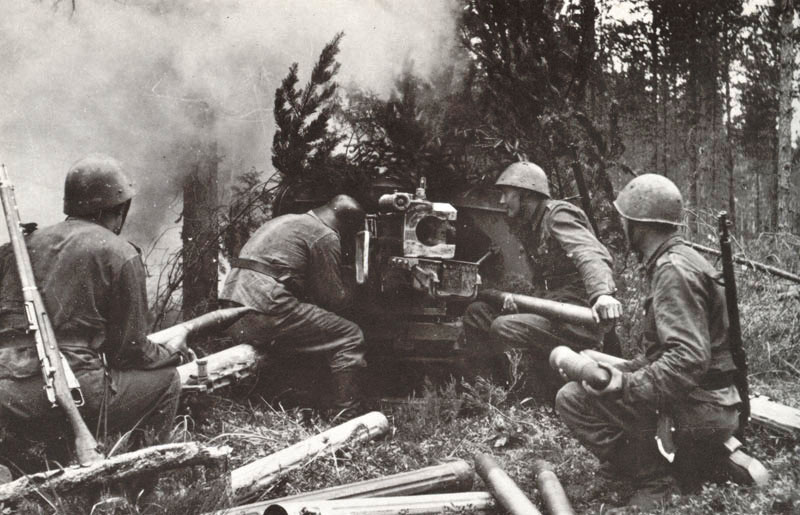
Finland fought in the Continuation War alongside Germany from 1941 to 1944. Thanks to Nazi-German aid, the army was much better equipped, and the period of conscription was increased to two years, making possible the formation of sixteen infantry divisions. Having initially deployed on the defensive, the Finns took advantage of the weakened Soviet positions as a consequence of Operation Barbarossa, swiftly recovering their lost territories and invading Soviet territory in Karelia, after settling into defensive positions in December 1941. The Soviet offensive of June 1944 undid these Finnish gains and, while failing in its objective of destroying the Finnish army and forcing Finland's unconditional surrender, forced Finland out of the war. The Finns were able to preserve their independence with key defensive victories over the Red Army, the Battle of Tali-Ihantala being very significant.
These conflicts involving Finland had a significant impact on the modern Finnish defence force. While other European militaries have reduced their forces, Finland has maintained a large conscript-based reserve army. As a Swedish report stated: "The reason why the FDF chose to maintain this model while its Nordic neighbors jumped on the expeditionary bandwagon is not hard to see. Sharing a 1340km border with Russia, the need for large ground forces is self-explanatory. Furthermore, memories of World War II – in which over 2 percent of the population perished in two brutal wars with the Soviet Union – are very much alive in Finland". This same aspect has been highlighted even more strongly after the Russian invasion of Ukraine and Finland's decision to join NATO. With quotes like; "After World War II, having thwarted the advance of the mighty Red Army in the Winter War of 1939-40 and then seeking to recapture the territory the Soviets eventually claimed, Finland had to settle for neutrality imposed by Moscow. But to almost everyone's surprise, it succeeded in this degrading task, too, building up armed forces that were highly capable and were energetically supported by civil society—while at the same time managing to maintain dialogue with Moscow.", "Finland still has compulsory military service. Finland would be in a position to mobilize an army of 280,000 soldiers. That's quite a big army in modern Europe", with similar views being expressed elsewhere as well, often referring to the fact that Finland has kept its conscript-based armed force or other readiness-related units, contrasting with other European countries that now have to re-arm, such as Germany as an example. During the events of 2022, all this has received attention internationally as well.
Cold War
The demobilization and regrouping of the Finnish Defence Forces were carried out in late 1944 under the supervision of the Soviet-dominated Allied Control Commission. Following the Treaty of Paris in 1947, which imposed restrictions on the size and equipment of the armed forces and required disbandment of the Civic Guard, Finland reorganized its defence forces. The fact that the conditions of the peace treaty did not include prohibitions on reserves or mobilization made it possible to contemplate an adequate defence establishment within the prescribed limits. The reorganization resulted in the adoption of the brigade -in place of the division- as the standard formation.
For the first two decades after the Second World War, the Finnish Defence Forces relied largely on obsolete wartime material. Defence spending remained minimal until the early 1960s. During the peak of the Cold War, the Finnish government made a conscious effort to increase defence capability. This resulted in the commissioning of several new weapons systems and the strengthening of the defence of Finnish Lapland by the establishment of new garrisons in the area. From 1968 onwards, the Finnish government adopted the doctrine of territorial defence, which requires the use of large land areas to delay and wear out a potential aggressor. The doctrine was complemented by the concept of total defence which calls for the use of all resources of society for national defence in case of a crisis. From the mid-1960s onwards, the Finnish Defence Forces also began to specifically prepare to defeat a strategic strike, the kind which the Soviet Union employed successfully to topple the government of Czechoslovakia in 1968. In an all-out confrontation between the two major blocs, the Finnish objective would have been to prevent any military incursions in Finnish territory and thereby keep Finland outside the war.
Post-1991
The collapse of the Soviet Union in 1991 did not eliminate the military threat perceived by the government, but the nature of the threat had changed. While the concept of total, territorial defence was not dropped, military planning has moved towards the capability to prevent and frustrate a strategic attack toward the vital regions of the country.

The end of the Cold War also allowed new opportunities which would have previously been seen as breaking Finland's stance of neutrality, such as participation in the War in Afghanistan and the Nordic Battlegroup.
With the change in the European security environment brought by the 2022 Russian invasion of Ukraine, Finnish government officials began voicing increasingly strong support for joining NATO, buttressed by polls showing a rapid increase in Finnish citizens' willingness to join NATO. NATO Secretary General Jens Stoltenberg voiced his support in April 2022 for the inclusion of Finland into the Euro-Atlantic defence alliance and stated that NATO member countries would likely enthusiastically support a Finland bid for membership.
On 11 May 2022, British Prime Minister Boris Johnson and Finnish President Sauli Niinistö signed a new mutual defence agreement "to reinforce their security and fortify northern Europe's defences, in the face of renewed threats." This has helped to address concerns within Finland that the delay between application and acceptance to NATO, during which time Finland would not yet be able to invoke NATO Article 5 and may present an opportunity for a Russian invasion.

On 12 May 2022, Niinistö and Prime Minister Sanna Marin issued a joint statement supporting Finland's application for membership of NATO, saying "As a member of NATO, Finland would strengthen the entire defence alliance. Finland must apply for NATO membership without delay." On 17 May 2022, the Parliament of Finland voted overwhelmingly to apply for membership of NATO, with 188 votes in favour of the motion and 8 against. The following morning, the Finnish ambassador to NATO, Klaus Korhonen, formally submitted Finland's application to NATO Secretary General Jens Stoltenberg. Sweden also submitted its application at the same time.
On 29 June 2022, thirty NATO countries invited Finland and Sweden to join NATO. Both countries received the status of aspiring members while attending the annual NATO summit in Madrid as guest nations. Finland became a full NATO member on 4 April 2023.
As of 2025, the Defence Forces are undergoing key procurement programmes for all the three branches. The Navy is scheduled to get its largest vessels since the WW2-era Väinämöinen class with the new Pohjanmaa class. The Air Force has made the decision to acquire the Lockheed Martin F-35A to replace all McDonnell Douglas F/A-18 Hornet fighter jets for €10 billion. Meanwhile, the Army is planning to complement the modernized Patria Pasi armoured vehicles with the Finnish Patria 6×6. The standard issue assault rifle RK 62 is also being upgraded to a new variant. A new high altitude air defence missile system was selected in April 2023, Rafael's David's Sling system.
Organization
The Finnish Defence Forces are under the command of the Chief of Defence, who is directly subordinate to the President of the Republic in matters related to the military command. Decisions concerning military orders are made by the President of the Republic in consultation with the Prime Minister and the Minister of Defence.
Apart from the Defence Command (Finnish: Pääesikunta, Swedish: Huvudstaben), the military branches are the Finnish Army (Finnish: Maavoimat, Swedish: Armén), the Finnish Navy (Finnish: Merivoimat, Swedish: Marinen) and the Finnish Air Force (Finnish: Ilmavoimat, Swedish: Flygvapnet). The Border Guard (Finnish: Rajavartiolaitos, Swedish: Gränsbevakningsväsendet) (including the coast guard) is under the authority of the Ministry of the Interior, but can be incorporated fully or in part into the defence forces when required by defence readiness. All logistical duties of the Defence Forces are carried out by the Defence Forces Logistics Command (Finnish: Puolustusvoimien logistiikkalaitos), which includes three logistics regiments.
The Army is divided into eight brigade-level units (Finnish: joukko-osasto). Under the brigades, there were 12 military districts, which were responsible for carrying out the draft, training and crisis-time activation of reservists and for planning and executing territorial defence of their areas. The military districts were disbanded in 2014, as a part of the 800 million euro savings the Finnish Defence Forces had to carry out. Their duties are now carried out by regional offices (Finnish: aluetoimisto).
The Navy consists of headquarters and four brigade-level units: Coastal Fleet (Finnish: Rannikkolaivasto), Coastal Brigade (Finnish: Rannikkoprikaati), Nyland Brigade (Finnish: Uudenmaan Prikaati, Swedish: Nylands Brigad), and Naval Academy (Finnish: Merisotakoulu). The Coastal Fleet includes all the surface combatants of the Navy, while Coastal Brigade and Nyland Brigade train coastal troops.
The Air Force consists of headquarters and four brigade-level units: Satakunta, Lapland and Karelian Air Wings (Finnish: lennosto) and Air Force Academy (Finnish: Ilmasotakoulu). They are responsible for securing the integrity of the Finnish airspace during peace and for conducting aerial warfare independently during a crisis.
The military training of the reservists is primarily the duty of the Defence Forces, but it is assisted by the National Defence Training Association of Finland (Finnish: Maanpuolustuskoulutusyhdistys). This association provides reservists with personal, squad, platoon and company level military training. Most of the 2,000 instructors of the association are volunteers certified by the Defence Forces, but when Defence Forces materiel is used, the training always takes place under the supervision of career military personnel. Annually, the Defence Forces requests the Association to run specialized exercises for some 8,500 personnel placed in reserve units, and an additional 16,500 reservists participate in military courses where the participants are not directly selected by the Defence Forces. The legislation concerning the association will require that the chairman and the majority of the members of its board are chosen by the Finnish Government. The other board members are chosen by NGOs active in the national defence.
General officers
The Finnish Defence Forces
Chief of Defence
General Janne Jaakkola
Defence Command
Chief of Defence Command Finland
Lieutenant General Vesa Virtanen
Deputy Chief of Staff, Logistics and Armaments
Lieutenant General Mikko Heiskanen
Deputy Chief of Staff, Strategy
Major General Sami Nurmi
Deputy Chief of Staff, Operations
Major General Kari Nisula
Deputy Chief of Staff, Personnel
Major General Rami Saari
Chief of Planning
Brigadier General Tero Ylitalo
Assistant Chief of Staff Operations
Commodore Janne Huusko
Defence Command Chief of C5
Brigadier General Jarmo Vähätiitto
Chief of Personnel (J1)
Commodore Tuomas Tiilikainen
Chief of Logistics
Brigadier General Timo Saarinen
Assistant Chief of Staff, Training (J7)