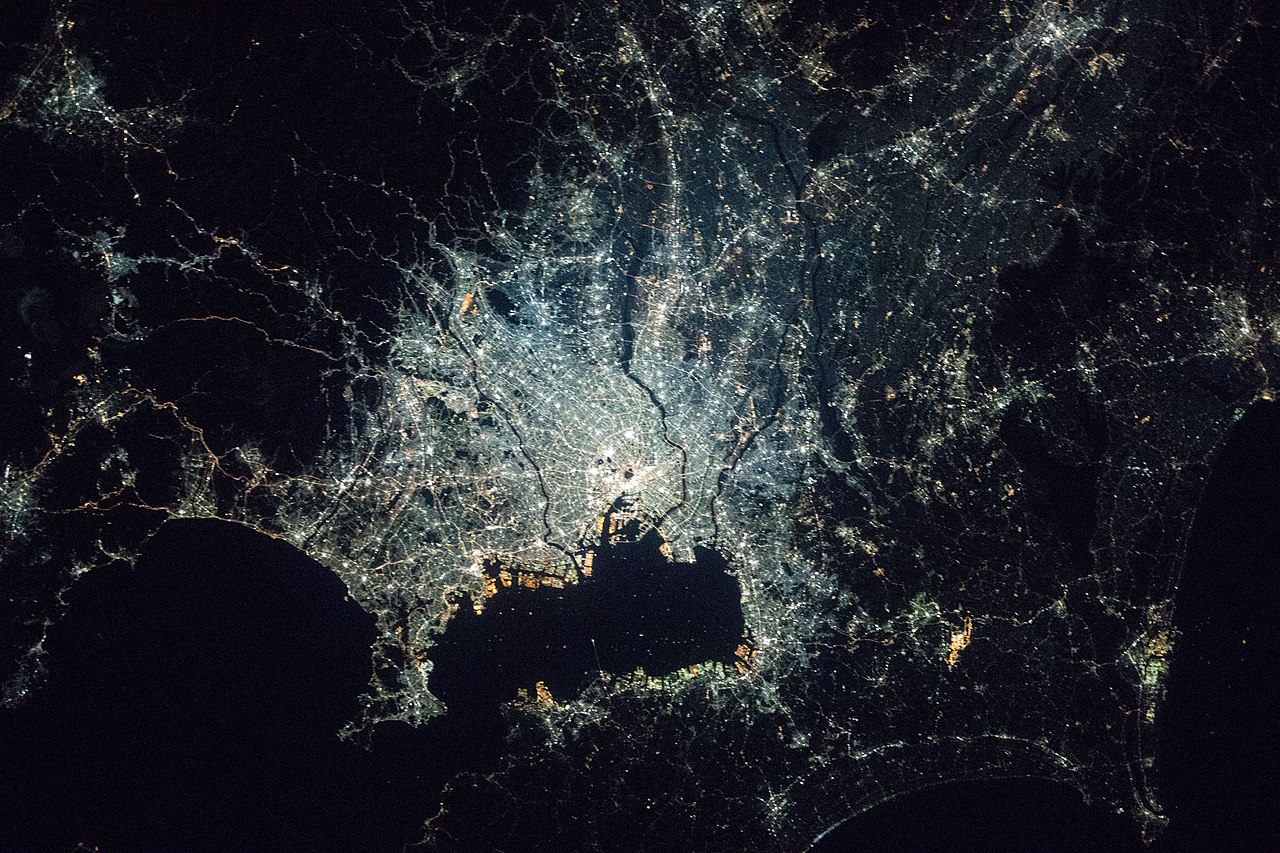
Tokyo Bay (東京湾, Tōkyō-wan) is a bay located in the southern Kantō region of Japan spanning the coasts of Tokyo, Kanagawa Prefecture, and Chiba Prefecture, on the southern coast of the island of Honshu. Tokyo Bay is connected to the Pacific Ocean by the Uraga Channel. The Tokyo Bay region is the most populous and the largest industrialized area in Japan.

Names

In ancient times, the Japanese knew Tokyo Bay as the uchi-umi (内海) , which means "inner sea". By the Azuchi–Momoyama period (1568–1600) the area had become known as Edo Bay (江戸湾, Edo-wan) after the city of Edo. The bay took its present name in modern times, after the Imperial court moved to Edo and renamed the city Tokyo in 1868.

Geography

Tokyo Bay juts prominently into the Kantō Plain. It is surrounded by the Bōsō Peninsula in Chiba Prefecture to the east and the Miura Peninsula in Kanagawa Prefecture to the west. The shore of Tokyo Bay consists of a diluvial plateau and is subject to rapid marine erosion. Sediments on the shore of the bay make for a smooth, continuous shoreline.

Tokyo Bay
U.S. Navy photo 80-G-421130 · Public domain via Wikimedia Commons

Boundaries

In a narrow sense, Tokyo Bay is the area north of the straight line from Cape Kannon on the west of Miura Peninsula to Cape Futtsu on the east Bōsō Peninsula. This area covers about 922 km2 (356 mi2) in 2012, reclamation projects continue to slowly shrink the bay.

In a broader sense, Tokyo Bay includes the Uraga Channel. By this definition the bay opens from an area north of the straight line from Cape Tsurugisaki on the east of Miura Peninsula to Cape Sunosaki on the west of the Boso Peninsula. This area covers about 1,100 km2 (420 mi2). The area of Tokyo Bay combined with the Uraga Channel covers 1,500 km2 (580 mi2).

Depth

The shoal between Cape Futtsu in Chiba Prefecture and Cape Honmaku in Yokohama is known as Nakanose, and has a depth of 20 m (66 ft). North of this area the bay has a depth of 40 m (130 ft) and an uncomplicated underwater topography. Areas south of Nakanose are significantly deeper moving towards the Pacific Ocean.