
The Dyatlov Pass incident (Russian: Гибель тургруппы Дятлова, romanized: Gibel turgruppy Dyatlova, lit. 'Death of the Dyatlov Hiking Group') was an event in which nine Soviet ski hikers died in the northern part of the Ural Mountains ridge in the Russian SFSR of the Soviet Union on 1 or 2 February 1959 under undetermined circumstances. The experienced trekking group from the Ural Polytechnical Institute, led by Igor Dyatlov, went on a hike of the highest difficulty level at that time, and had established a camp on the eastern slopes of Kholat Syakhl mountain. Overnight, the group cut their way out of their tent with knives and fled the campsite, inadequately dressed for the heavy snowfall, strong winds and extreme cold temperatures as low as −40 °C (−40 °F).
After the group's bodies were discovered, an investigation by Soviet authorities determined that six of them had died from hypothermia while the other three had been killed by physical trauma. One victim had major skull damage, two had severe chest trauma, and another had a small crack in his skull. Four of the bodies were found in May 1959 lying in running water in a creek, and three of them had damaged soft tissue of the head and face – two of the bodies had missing eyes, one had a missing tongue, and one had missing eyebrows. The investigation concluded that a "compelling natural force" (elemental force) had caused the deaths. Numerous theories have been put forward to account for the unexplained deaths, including animal attacks, an avalanche or loud slab avalanche to their tent, appearance of a UFO or ball lightning, katabatic winds, infrasound-induced panic, conflict with local ethnic groups or fugitive criminals, a botched spy meeting with representatives of the Western bloc, military rocket and nuclear-testing involvement, or some combination of these factors.
The Russian government reopened an investigation into the incident in 2019, concluding in 2020 that an avalanche had most likely forced survivors to suddenly leave their camp in low-visibility conditions with inadequate clothing before ultimately dying of hypothermia. Andrey Kuryakov, deputy head of the regional prosecutor's office, stated that "It was a heroic struggle. There was no panic, but they had no chance to save themselves under the circumstances." A study led by scientists from EPFL and ETH Zürich, published in 2021, suggested that a type of avalanche known as a slab avalanche could explain some of the injuries.
A mountain pass in the area later was named "Dyatlov Pass" in memory of the group, despite the incident occurring about 1,700 metres (5,600 ft) away on the eastern slope of Kholat Syakhl. A prominent rock outcrop in the area now serves as a memorial to the group. It is about 500 metres (1,600 ft) to the east-southeast of the actual site of the final camp.
Background
In 1959, a group was formed for a skiing expedition across the northern Urals in Sverdlovsk Oblast, Soviet Union. According to Prosecutor Tempalov, documents found in the tent of the expedition suggest the expedition was named for the 21st Congress of the Communist Party of the Soviet Union (CPSU), and possibly was dispatched by the local Komsomol organization. Igor Dyatlov, a 23-year-old radio engineering student at the Ural Polytechnical Institute (now Ural Federal University), the leader, assembled a group of nine others for the trip, most of whom were fellow students and peers at the university. The initial group consisted of eight men and two women, but one member later returned because of health issues. Each member of the group was an experienced Grade II-hiker with ski tour experience and would be receiving Grade III certification upon their return.
At the time, Grade III was the highest certification available in the Soviet Union and required candidates to traverse 300 km (190 mi). The route was designed by Dyatlov's group to reach the far northern regions of the Sverdlovsk Oblast and the upper streams of the Lozva river. The Sverdlovsk city route commission approved the route. This was a division of the Sverdlovsk Committee of Physical Culture and Sport, and they confirmed the group of 10 people 8 January 1959. The goal of the expedition was to reach Otorten (Отортен), a mountain 10 km (6.2 mi) north of the site where the incident occurred. This route, estimated as Category III, was undertaken in February, the most difficult time to traverse.

On 23 January 1959, the Dyatlov group was issued their route book, which listed their course following the No.5 trail. At that time, the Sverdlovsk City Committee of Physical Culture and Sport listed approval for 11 people. The 11th person listed was Semyon Zolotaryov, who had been certified to go with another expedition of similar difficulty (the Sogrin expedition group). The Dyatlov group left Sverdlovsk city (today Yekaterinburg) on the same day they received the route book.
Expedition
The group arrived by train at Ivdel (Ивдель), a town at the center of the northern province of Sverdlovsk Oblast in the early morning of 25 January 1959. The day after on 26 January, they took a lorry to Vizhai (Вижай), a village that is the last inhabited settlement to the north.
The next day on 27 January they began their trek toward Gora Otorten. On 28 January one member, Yuri Yudin, who had several health ailments (including rheumatism and a congenital heart defect), turned back because of knee and joint pain that made him unable to continue the hike. The remaining nine hikers continued the trek toward Gora Otorten by following the valley and river.

Diaries and cameras found around their last campsite made it possible to track the group's route up to the day preceding the incident. On 31 January the group arrived at the edge of a highland area and began to prepare for climbing. In a wooded valley, they cached surplus food and equipment that would be used for the trip back. The next day, the hikers started to move through the pass. It seems they planned to get over the pass and make camp for the next night on the opposite side, but because of worsening weather conditions – snowstorms and decreasing visibility – they lost their direction and deviated west, toward the top of Kholat Syakhl. When they realized their mistake, the group decided to set up camp there on the slope of the mountain, rather than move 1.5 km (1 mi) downhill to a forested area that would have offered some shelter from the weather. Yudin speculated, "Dyatlov probably did not want to lose the altitude they had gained, or he decided to practice camping on the mountain slope."
Search and discovery
Before leaving, Dyatlov had agreed he would send a telegram to their sports club as soon as the group returned to Vizhai. It was expected this would happen no later than 12 February, but Dyatlov had told Yudin, before he departed from the group, he expected it to be longer. When the 12th passed and no messages had been received, there was no immediate reaction. Delays of a few days were common with such expeditions. On 20 February, the travellers' relatives demanded a rescue operation, and the head of the institute sent the first rescue groups, consisting of volunteer students and teachers. Later, the army and militsiya (police) forces became involved, with planes and helicopters ordered to join the operation.
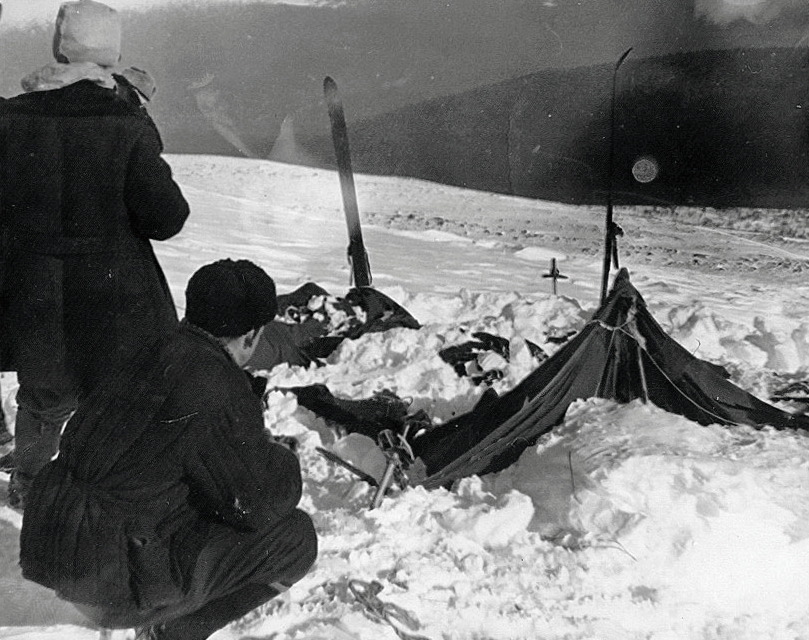
On 26 February the searchers found the group's abandoned and badly damaged tent on Kholat Syakhl. The campsite baffled the search party. Mikhail Sharavin, the student who found the tent, said "the tent was half torn down and covered with snow. It was empty, and all the group's belongings and shoes had been left behind." Investigators said the tent had been cut open from inside. Nine sets of footprints, left by people wearing only socks, a single shoe or even barefoot, could be followed, leading down to the edge of a nearby wood on the opposite side of the pass, 1.5 km (1 mi) to the north-east. After 500 m (1,600 ft) these tracks were covered with snow. At the forest's edge, under a large Siberian pine, the searchers found the visible remains of a small fire. There were the first two bodies, those of Krivonishenko and Doroshenko, shoeless and dressed only in underwear. The branches on the tree were broken up to five metres high, suggesting that one of the hikers had climbed up to look for something, perhaps the camp. On the mountain slope between the pine and the camp, the searchers found three more corpses: Dyatlov, Kolmogorova, and Slobodin, who died in poses suggesting they were attempting to return to the tent. They were found at distances of 300, 480, and 630 metres (980, 1,570, and 2,070 ft) from the tree.

Finding the remaining four travellers took more than two months. They finally were found on 4 May under four metres (13 ft) of snow in a ravine 75 m (246 ft) further into the woods from the pine tree. Three of the four were better dressed than the others, and there were signs that some clothing of those who had died first had been removed for use by the others. Dubinina was wearing Krivonishenko's burned, torn trousers, and her left foot and shin were wrapped in a torn jacket.
Investigation
A legal inquest started immediately after the first five bodies were found. A medical examination found no injuries that might have led to their deaths, and it was concluded that they had all died of hypothermia. Slobodin had a small crack in his skull, but it was not thought to be a fatal wound.
An examination of the four bodies found in May shifted the narrative of the incident. Three of the hikers had fatal injuries: Thibeaux-Brignolles had major skull damage, and Dubinina and Zolotaryov had major chest fractures. According to Boris Vozrozhdenny, the force required to cause such damage would have been extremely high, comparable to that of a car crash. Notably, the bodies had no external wounds associated with the bone fractures, as if they had been subjected to a high level of pressure.

All four bodies found at the bottom of the creek in a running stream of water had soft tissue damage to their head and face. For example, Dubinina was missing her tongue, eyes, part of the lips, as well as facial tissue and a fragment of skull bone, while Zolotaryov had his eyeballs missing, and Aleksander Kolevatov his eyebrows. V. A. Vozrozhdenny, the forensic expert performing the post-mortem examination, judged that these injuries happened post-mortem because of the location of the bodies in a stream.
Initial speculation suggested that the indigenous Mansi people, reindeer herders in the area, had attacked and killed the group for encroaching upon their lands. Several Mansi were interrogated, but the investigation indicated that the nature of the deaths did not support this hypothesis: only the hikers' footprints were visible, and they showed no sign of hand-to-hand struggle.
Although the temperature was low, about −25 to −30 °C (−13 to −22 °F) with a storm blowing, the dead were only partially dressed. Some had only one shoe, while others wore only socks.
Journalists reporting on the available parts of the inquest files claim that it states:
Six of the group members died of hypothermia and three of fatal injuries.
There were no indications of other people nearby on Kholat Syakhl apart from the nine travellers.
The tent had been ripped open from within.
The victims had died six to eight hours after their last meal.
Traces from the camp showed that all group members left the campsite of their own accord, on foot.
Some levels of radiation were found on one victim's clothing.
To dispel the theory of an attack by the indigenous Mansi people, Vozrozhdenny stated that the fatal injuries of the three bodies could not have been caused by human beings, "because the force of the blows had been too strong and no soft tissue had been damaged".
Released documents contained no information about the condition of the hikers' internal organs.
Related reports
Yuri Kuntsevich, who was 12 years old at the time and who later became the head of the Yekaterinburg-based Dyatlov Foundation, attended five of the hikers' funerals. He recalled that their skin had a "deep brown tan". However, skin colour ranging from brown to bright orange is very characteristic of those who died in severe frost.
Another group of hikers (about 50 kilometres (30 mi) south of the incident) reported that they saw strange orange spheres in the sky to the north on the night of the incident. Similar spheres were observed in Ivdel and adjacent areas continually during the period from February to March 1959, by various independent witnesses (including the meteorology service and the military). These sightings were not noted in the 1959 investigation, and the various witnesses came forward years later.
Conclusions
At the time, the official conclusion was that group members had died because of a compelling natural force. The inquest officially ceased in May 1959 as a result of the absence of a guilty party. The files were sent to a secret archive.
In February 2019, Russian authorities reopened the investigation into the incident, although only three possible explanations were being considered: an avalanche, a slab avalanche, or a hurricane. The possibility of a murder had been discounted.
Aftermath
The Dyatlov Foundation was founded in 1999 at Yekaterinburg, with the help of Ural State Technical University, led by Yuri Kuntsevich (Юрий Кунцевич). The foundation's stated aim is to continue investigation of the case and to maintain the Dyatlov Museum to preserve the memory of the dead hikers.
In 1997, it was revealed that the negatives from Krivonishenko's camera were kept in the private archive of one of the investigators, Lev Nikitich Ivanov. The film material was donated by Ivanov's daughter to the Dyatlov Foundation. The diaries of the hiking party fell into Russia's public domain in 2009.
On 1 July 2016, a memorial plaque was inaugurated in Solikamsk in Ural's Perm Krai, dedicated to Yuri Yudin (the sole survivor of the expedition group), who died in 2013.
Explanations and theories
Avalanche
On 11 July 2020, Andrey Kuryakov, deputy head of the Ural Federal District directorate of the Prosecutor-General's Office, announced an avalanche as the "official cause of death" for the Dyatlov group in 1959. Later independent computer simulation and analysis by Swiss researchers also suggest avalanche as the cause. Summarizing Kuryakov's report in The New Yorker, Douglas Preston writes:
The most appealing aspect of Kuryakov's scenario is that the Dyatlov party's actions no longer seem irrational. The snow slab, according to Greene, probably would have made loud cracks and rumbles as it fell across the tent, making an avalanche seem imminent. Kuryakov noted that although the skiers made an error in the placement of their tent, everything they did subsequently was textbook: They conducted an emergency evacuation to ground that would be safe from an avalanche, they took shelter in the woods, they started a fire, they dug a snow cave. Had they been less experienced, they might have remained near the tent, dug it out and survived. But avalanches are by far the biggest risk in the mountains in winter. The more experience you have, the more you fear them. The skiers' expertise doomed them.
Original explanation
Reviewing a sensationalist "Yeti" hypothesis, US skeptic author Benjamin Radford suggests an avalanche as more plausible:
that the group woke up in a panic (...) and cut their way out the tent either because an avalanche had covered the entrance to their tent or because they were scared that an avalanche was imminent (...) (better to have a potentially repairable slit in a tent than risk being buried alive in it under tons of snow). They were poorly clothed because they had been sleeping, and ran to the safety of the nearby woods where trees would help slow oncoming snow. In the darkness of night, they got separated into two or three groups; one group made a fire (hence the burned hands) while the others tried to return to the tent to recover their clothing given that the danger had passed. But it was too cold, and they all froze to death before they could find their tent in the darkness. At some point, some of the clothes might have been recovered or swapped from the dead, but at any rate, the group of four whose bodies was most severely damaged were caught in an avalanche and buried under 4 metres (13 ft) of snow (more than enough to account for the 'compelling natural force' the medical examiner described). Dubinina's tongue probably was removed by scavengers and ordinary predation.
Arguments against avalanche hypothesis
Arguments against an actual avalanche (and not the fear of an avalanche) include:
The location of the incident did not have any obvious signs of an avalanche having occurred. An avalanche would have left certain patterns and debris distributed over a wide area. The bodies found within a month of the event were covered with a shallow layer of snow, and had there been an avalanche of sufficient strength to sweep away the second party, these bodies would have been swept away as well; this would have caused more serious and different injuries in the process and would have damaged the tree line.
More than 100 expeditions to the region had been held since the incident, and none ever reported conditions that might create an avalanche. A study of the area using up-to-date terrain-related physics revealed that the location was entirely unlikely for such an avalanche. The "dangerous conditions" found in another nearby area (which had significantly steeper slopes and cornices) were observed in April and May when the snowfalls of winter were melting. During February, when the incident occurred, there were no such conditions.
An analysis of the terrain and the slope showed that even if there could have been a very specific avalanche in the area, its path would have gone past the tent. The tent had collapsed from the side but not in a horizontal direction.
Dyatlov was an experienced skier, and the much older Zolotaryov was studying for his master's certificate in ski instruction and mountain hiking. Neither of these two men would have been likely to camp anywhere in the path of a potential avalanche.
Footprint patterns leading away from the tent were inconsistent with someone, let alone a group of nine people, running in panic from either real or imagined danger. All the footprints leading away from the tent and toward the woods were consistent with individuals walking at a normal pace.
2015–2019 review of 1959 investigation
A review of the 1959 investigation's evidence completed 2015 to 2019 by experienced investigators from the Investigative Committee of the Russian Federation (ICRF) on request of the families confirmed the avalanche with several important details added. First of all, the ICRF investigators (one of them an experienced alpinist) confirmed that the weather on the night of the tragedy was harsh, with wind speeds up to hurricane force, 20–30 m/s (45–67 mph; 72–108 km/h), a snowstorm and temperatures reaching −40 °C (−40 °F). These factors were not considered by the 1959 investigators who arrived at the scene of the accident three weeks later when the weather had much improved and any remains of the snow slide had settled and been covered with fresh snowfall. The harsh weather at the same time played a critical role in the events of the tragic night, which have been reconstructed as follows:
On 1 February the group arrives at the Kholat Syakhl mountain and erects a large, nine-person tent on an open slope, without any natural barriers such as forests. On the day and a few preceding days, a heavy snowfall persisted, with strong wind and frost.
The group traversing the slope and digging a tent site into the snow weakened the snow base. During the night, the snowfield above the tent started to slide down slowly under the weight of the new snow, gradually pushing on the tent fabric, starting from the entrance. The group wakes up and starts evacuation in panic, with only some able to put on warm clothes. With the entrance blocked, the group escapes through a hole cut in the tent fabric and descends the slope to find a place perceived as safe from the avalanche only 1500 m down, at the forest border.
Because some of the members have only incomplete clothing, the group splits. Two of the group, only in their underwear and pyjamas, were found at the Siberian pine tree, near a fire pit. Their bodies were found first and confirmed to have died from hypothermia.