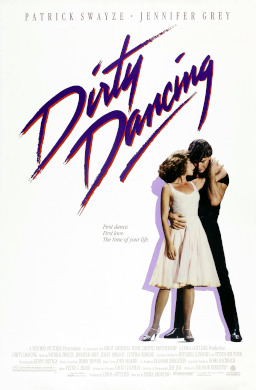
Dirty Dancing is a 1987 American romantic drama dance film written by Eleanor Bergstein, produced by Linda Gottlieb, and directed by Emile Ardolino. Starring Patrick Swayze and Jennifer Grey, it tells the story of Frances "Baby" Houseman (Grey), a young woman who falls in love with dance instructor Johnny Castle (Swayze) while vacationing at a resort in the 1963 Borscht Belt.
The film was based on screenwriter Bergstein's own childhood. She originally wrote a screenplay for the Michael Douglas 1980 film It's My Turn, but she ultimately ended up conceiving a story for a film which became Dirty Dancing. She finished the script in 1985, but management changes at Metro-Goldwyn-Mayer put the film in development hell. The production company was changed to Vestron Pictures with Emile Ardolino as director and Linda Gottlieb as producer. Filming took place in Lake Lure, North Carolina, and Mountain Lake, Virginia, with the film's score composed by John Morris and dance choreography by Kenny Ortega.
Dirty Dancing premiered at the Cannes Film Festival on May 12, 1987 and was released on August 21 in the United States, earning over $214 million worldwide—$64 million in the US and Canada and $150 million in other territories. It earned positive reviews from critics, who particularly praised the performances of Grey and Swayze, and its soundtrack, created by Jimmy Ienner, generated two multi-platinum albums, and multiple singles. "(I've Had) The Time of My Life", performed by Bill Medley and Jennifer Warnes, won the Academy Award for Best Original Song, the Golden Globe Award for Best Original Song, and the Grammy Award for Best Pop Performance by a Duo or Group with Vocals. In 2024, the film was selected for preservation in the United States National Film Registry by the Library of Congress as being "culturally, historically, or aesthetically significant".
The film's popularity successfully launched its titular franchise, including a 1988 television series, multiple reality competition shows, a 2004 prequel titled Dirty Dancing: Havana Nights, a stage production which has had sellout performances in multiple countries, a made-for-television musical adaptation in 2017, and an untitled sequel with Grey reprising her role.
Plot
In the summer of 1963, teenager Frances "Baby" Houseman is vacationing with her family—cardiologist father Jake, mother Marge, and older sister Lisa—at Kellerman's, an upscale Catskills resort in the Borscht Belt owned by Jake's sarcastic best friend Max.
Exploring one night, Baby secretly observes Max instructing the waiters, all Ivy League students, to romance the guests' daughters, no matter how unattractive. Max also demeans the working-class entertainment staff, including Johnny Castle, one of the dance instructors.
Baby is attracted to Johnny and dances briefly with him after his kindhearted cousin, Billy, introduces them at a secret "dirty dancing" party for resort staff. Max's grandson Neil flirts with Baby in the meantime.
Baby learns Johnny's dance partner Penny is pregnant by Robbie, a waiter and womanizer who attends the Yale School of Medicine and has turned his eye to Lisa. When Robbie refuses to help Penny, Baby borrows money from her father, without explaining why, to pay for Penny to have an abortion.
At first, Penny declines to accept the money for the abortion, as it would cause her and Johnny to miss a performance at a nearby resort, costing them the season's salary, but Baby volunteers to stand in for Penny. During her dance sessions with Johnny, they develop a mutual attraction, and despite their failure to execute a climactic lift, Johnny and Baby's performance is successful.

Back at Kellerman's, Penny is badly injured by the shady abortion, so Baby enlists her father's help to stabilize Penny. Angered by Baby's deception, and assuming it was Johnny who got Penny pregnant, Dr. Houseman commands Baby to stay away from them.
Baby sneaks off to apologize to Johnny for her father's treatment, but Johnny feels he deserves it due to his lower status; Baby reassures him of his worth, declaring her love. They begin secretly seeing each other, and her father refuses to talk to her.
Johnny rejects an indecent proposal by Vivian Pressman, an adulterous wife, who instead sleeps with Robbie, inadvertently foiling Lisa's plan to lose her virginity to him. When Vivian spots Baby leaving Johnny's cabin, she feels spurned and attempts revenge on Johnny by claiming he stole her husband's wallet.

Max is ready to fire Johnny, but Baby backs up his alibi, revealing she was with him the night of the theft. The real thieves, Sydney and Sylvia Schumacher, are caught, but he is still fired for mixing with Baby.
Before leaving, Johnny tries to talk to Dr. Houseman but is accused of only trying to get at Baby. She later apologizes to her father for lying, but not for her romance with Johnny, and then accuses him of classism.
At the end-of-season talent show, Dr. Houseman gives Robbie a recommendation letter for medical school. However, when Robbie admits he got Penny pregnant, and then insults her and Baby, Dr. Houseman angrily grabs the letter back.

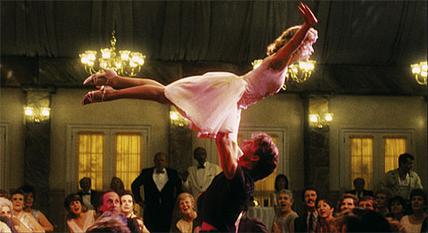
Johnny arrives and disrupts the final song by bringing Baby up on stage and declaring that she has made him a better person, and then they perform the dance they practiced all summer, ending with a successful climactic lift. Dr. Houseman admits he was wrong about Johnny and reconciles with Baby, and all the staff and guests join Baby and Johnny dancing to "(I've Had) The Time of My Life".
Cast
Cameos
"Cousin Brucie" Morrow appears as a magician
Also as a DJ's voice in parts of the film
Emile Ardolino
Matthew Broderick (who was dating Grey at the time and co-starred with her in Ferris Bueller's Day Off)
Production
Pre-production
Dirty Dancing is based in large part on screenwriter Eleanor Bergstein's own childhood: she is the younger daughter of a Jewish doctor from New York and had spent summers with her family in the Catskills where she participated in "Dirty Dancing" competitions; she was also nicknamed "Baby" herself as a girl. In 1980, Bergstein wrote a screenplay for the Michael Douglas film It's My Turn; however, the producers cut an erotic dancing scene from the script, prompting her to conceive a new story that took inspiration from her youth dance competitions. In 1984, she pitched the idea to Metro-Goldwyn-Mayer (MGM) executive Eileen Miselle, who liked it and teamed Bergstein with producer Linda Gottlieb. They set the film in 1963, with the character of Baby based on Bergstein's own life and the character of Johnny based on the stories of Michael Terrace, a dance instructor whom Bergstein met in the Catskills in 1985 while she was researching the story. She finished the script in November 1985, but management changes at MGM put the script into turnaround, or limbo.
Bergstein gave the script to other studios but was repeatedly rejected until she brought it to Vestron Pictures. While honing their pitch to Vestron, Gottlieb had agreed to cut the proposed budget in half. Bergstein and Gottlieb then chose Emile Ardolino as the film's director; Ardolino had never directed a feature film, but was extremely passionate about the project after reading the script while he was on jury duty. The team of Gottlieb, Bergstein, and Ardolino then presented their vision for the film to Vestron's president, Jon Peisinger, and the company's vice president for production, Mitchell Cannold. By the end of the meeting, Peisinger had greenlit the project to become Vestron's first feature film production. The approved film was budgeted at the relatively low amount of $5 million, at a time when the average cost for a film was $12 million.
For choreographer, Bergstein chose Kenny Ortega, who had been trained by Gene Kelly. For a location, they did not find anything suitable in the Catskills (as many of the Borscht Belt resorts had been shut down at that point), so they decided on a combination of two locations: Lake Lure, North Carolina, and the Mountain Lake Hotel near Pembroke, Virginia, and with careful editing made it look like all shooting was done in the same area.
Casting
Director Ardolino was adamant that they choose dancers, such as Swayze, who could also act, as he did not want to use the "stand-in" method that had been used with Flashdance (1983).
For the female lead of Frances "Baby" Houseman, Winona Ryder, Sarah Jessica Parker and Sharon Stone were considered. Bergstein chose the 26-year-old Jennifer Grey, daughter of the Oscar-winning actor and dancer Joel Grey (Cabaret (1972)). Grey was paid $50,000 (equivalent to $150,000 in 2025) for her role. The producers then sought a male lead, initially considering 20-year-old Billy Zane, though initial screen tests when he was partnered with Grey did not meet expectations. Val Kilmer and Benicio del Toro were also considered for Johnny. The next choice was 34-year-old Patrick Swayze, who appeared in Grandview, U.S.A. (1984) and had co-starred with Grey on Red Dawn (1984). He was a seasoned dancer, with experience from the Joffrey Ballet. The producers were thrilled with him, but his resume read "No dancing" after a knee injury. However, Swayze read the script, liked the multi-level character of Johnny, and took the part anyway. After this, Johnny's heritage was changed from being Italian to Irish. Grey was initially not happy about the choice, as she and Swayze had difficulty getting along on Red Dawn, but when they did their dancing screen test, the chemistry between them was obvious. Bergstein described it as "breathtaking". Other casting choices were Broadway actor Jerry Orbach as Dr. Jake Houseman, Baby's father; and Jane Brucker as Lisa Houseman, her older sister.
Bergstein, as the film's writer, also attempted to cast her friend, sex therapist Dr. Ruth Westheimer, to play Mrs. Schumacher (and Joel Grey as Dr. Ruth's husband). However, Westheimer backed out when she learned the role involved her playing a thief. The role went instead to 89-year-old Paula Trueman.
Another role went to Bergstein's friend, New York radio personality "Cousin Brucie" Morrow. She initially wanted him to portray the social director, but then later asked him to play the part of the magician. Morrow himself could be heard at different parts of the movie as a New York area DJ (at the time of the film's setting he was working at WABC, a top 40 station), and served as period music consultant. The role of the social director went to the then-unknown Wayne Knight (later of Seinfeld and 3rd Rock from the Sun fame).
The part of Baby's mother was originally given to Lynne Lipton, who is briefly visible in the beginning, when the Houseman family first pulls into Kellerman's (she is in the front seat for a few seconds; her blonde hair is the only indication), but she became ill during the first week of shooting and was replaced by actress Kelly Bishop, who had already been cast to play resort guest Vivian Pressman. Bishop moved into the role of Mrs. Houseman, and the film's assistant choreographer Miranda Garrison took on the role of Vivian. (When Baby is dancing in the final scene, the line that her mother says to Jerry Orbach, "She gets that from me ..." is a wink to the fact that Kelly Bishop was in the original cast of A Chorus Line winning a 1976 Tony Award for Best Featured Actress in a Musical for her performance, using the name at that time of Carole Bishop, and had been a professional dancer.)
Filming
Principal photography for Dirty Dancing took place in Lake Lure, North Carolina, and Mountain Lake, Virginia. Scenes in Lake Lure were filmed at a former Boy Scout Camp called Camp Chimney Rock, which is now a private, residential community known as Firefly Cove where only the stone steps where Baby practiced still exist. These scenes included the interior dancing scenes, Baby carrying the watermelon and practicing on the signature stairs, Johnny's cabin, the staff cabins and the dances on a log. The final dance scene was filmed at the camp gymnasium, which no longer stands. The golf scene where Baby asks her father for $250 was filmed at Rumbling Bald Golf Course. Scenes filmed at Mountain Lake included dining scenes, Kellerman's Hotel, the beach games, the Houseman family's cabins, the water lift scene and Penny crying in the kitchen.
Filming started for Dirty Dancing on September 5, 1986, and lasted just 43 days. The production had to battle bad weather, including outside temperatures of 105 °F (41 °C). With the camera and lighting equipment needed for filming, the temperature inside could be as high as 120 °F (49 °C). According to choreographer Kenny Ortega, 10 people passed out within 25 minutes of shooting one day. Paula Trueman collapsed and was taken to the local emergency room to be treated for dehydration. Patrick Swayze also required a hospital visit; insisting on doing his own stunts, he repeatedly fell off the log during the "balancing" scene and injured his knee so badly he had to have fluid drained from the swelling.
Delays in the shooting schedule pushed filming into the autumn, which required the set decorators to spray-paint the autumn leaves green. The weather became cold, causing the lake's temperatures to drop to near 40 °F (4 °C) for the famous swimming scene, which was filmed in October. Despite her character's enjoyment, Grey later described the water as "horrifically" cold, and she might not have gone into the lake, except that she was "young and hungry".
Relations between the two main stars varied throughout production. They had already had trouble getting along in their previous project, Red Dawn (1984), and worked things out enough to have an extremely positive screen test, but that initial cooperation soon faded, and they were soon "facing off" before every scene. To address this, producer Bergstein and director Ardolino forced the stars to re-watch their initial screen-tests—the ones with the "breathtaking" chemistry. This had the desired effect, and Swayze and Grey were able to return to the film with renewed energy and enthusiasm.
Some of the scenes in the film are improvised. For example, the scene where Grey was to stand in front of Swayze with her back to him and put her arm up behind his head while he trailed his fingers down her arm. Grey was exhausted at the time and found the move ticklish, and could not stop giggling each time Swayze tried it, and he became annoyed. The footage was found in the editing room and the producers decided the scene worked as it was and put it into the film, complete with Grey's giggling and Swayze's annoyed expression. It became one of the most famous scenes in the movie, turning out, as choreographer Kenny Ortega put it, "as one of the most delicate and honest moments in the film." Grey has stated that the final climactic lift was never rehearsed and only ever done on the day the scene was shot.
During production, the film dailies kept getting held up by authorities at the Canadian border, who thought the film was a pornographic production due to the title, leading Bergstein to consider renaming it to I Was a Teenage Mambo Queen.
Post-production
The shooting wrapped on October 27, 1986, both on-time and on-budget. No one on the team, however, liked the rough cut that was put together, and Vestron executives were convinced the film was going to be a flop. In May 1987, the film was screened for producer Aaron Russo. According to Vestron executive Mitchell Cannold, Russo's reaction at the end was to say simply, "Burn the negative, and collect the insurance."
Further disputes arose over whether a corporate sponsor could be found to promote the film. Marketers of the Clearasil acne product liked the film, seeing it as a vehicle to reach a teen target audience. However, when they learned the film contained an abortion scene, they asked for that part of the plot to be cut. As Bergstein refused, the Clearasil promotion was dropped. Consequently, Vestron promoted the film themselves and initially aimed for a July premiere before setting the premiere on August 16, 1987. The Vestron executives had planned to release the film in theaters for a weekend, and then home video, since Vestron had been in the video distribution business before film production.
Reception
Critical response
Review aggregator Rotten Tomatoes gives the film a rating of 73% based on reviews from 80 critics. The site's critical consensus reads, "Like its winsome characters, Dirty Dancing uses impressive choreography and the power of song to surmount a series of formidable obstacles." Metacritic, another review aggregator, assigned the film a weighted average score of 65 out of 100, based on 20 critics, indicating "generally favorable" reviews. Audiences polled by CinemaScore gave the film an average grade of "A−" on an A+ to F scale.
The New York Times described the film as "a metaphor for America in the summer of 1963— orderly, prosperous, bursting with good intentions, a sort of Yiddish-inflected Camelot." Other reviews were more mixed: Gene Siskel gave the film a "marginal Thumbs Up" as he liked Jennifer Grey's acting and development of her character, while Roger Ebert gave it "Thumbs Down" due to its "idiot plot", calling it a "tired and relentlessly predictable story of love between kids from different backgrounds." Time magazine was lukewarm, saying, "If the ending of Eleanor Bergstein's script is too neat and inspirational, the rough energy of the film's song and dance does carry one along, past the whispered doubts of better judgment." In a retrospective review, Jezebel's Irin Carmon called the film "the greatest movie of all time" as "a great, brave movie for women" with "some subtle, retrospectively sharp-eyed critiques of class and gender."
Abortion rights advocates have called the film the "gold standard" for cinematic portrayals of abortion, which author Yannis Tzioumakis described as offering a "compassionate depiction of abortion in which the woman seeking an abortion was not demonized with the primary concerns being her health and preserving her capacity to bear children at a future time rather than the ethical dilemma that might or might not inform her decision, a portrayal that is not necessarily available in current films."
The film drew adult audiences instead of the expected teens, with viewers rating the film highly. Many filmgoers, after seeing the film once, went back into the theater to watch it a second time. Word-of-mouth promotion took the film to the number one position in the United States, and in 10 days it had broken the $10 million mark. By November, it was also achieving international fame. Within seven months of release, it had brought in $63 million in the US and boosted attendance in dance classes across America. It was one of the highest-grossing films of 1987, earning $170 million worldwide.
The film's popularity continued to grow after its initial release. It was the number one video rental of 1988 and became the first film to sell a million copies on video. When the film was re-released in 1997, ten years after its original release, Swayze received his own star on the Hollywood Walk of Fame, and videos were still selling at the rate of over 40,000 per month. As of 2005, it was selling a million DVDs per year, with over ten million copies sold as of 2007.
A May 2007 survey by Britain's Sky Movies listed Dirty Dancing as number one on "Women's most-watched films", above the Star Wars trilogy, Grease, The Sound of Music, and Pretty Woman. The film's popularity has also caused it to be called "the Star Wars for girls."
The film's music has also had considerable impact. The closing song, "(I've Had) The Time of My Life", has been listed as the "third most popular song played at funerals" in the UK.
In October 2021, amid a dispute over abortion in Texas, magazine The Hollywood Reporter recommended the film as one to revisit on abortion in the cinema industry. Angie Han, writing for the magazine, highlighted Eleanor Bergstein's writing of the film.
Accolades
The film is recognized by American Film Institute in these lists:
2002: AFI's 100 Years...100 Passions – #93
2004: AFI's 100 Years...100 Songs:
"(I've Had) The Time of My Life" – #86
2005: AFI's 100 Years...100 Movie Quotes: