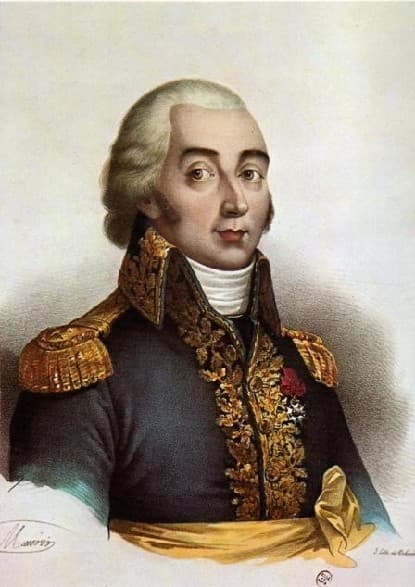
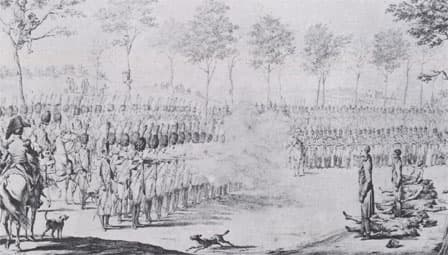
Claude François de Malet (28 June 1754 – 31 October 1812) was born in Dole to an aristocratic family. He was executed by firing squad, six days after staging a failed republican coup d'état as Emperor Napoleon I returned from the disastrous Russian campaign in 1812.
Before and during the French Revolution
Malet enlisted as a Musketeer at age seventeen as was common for a young nobleman of the ancien régime, but King Louis XVI disbanded the musketeer regiments in 1776 for budgetary reasons.
In 1790 Malet's family disinherited him for supporting the French Revolution, when he became commander of his home town's National Guard and celebrated the anniversary of the storming of the Bastille. Malet volunteered for the Revolutionary army when war broke out and was assigned to the 50th infantry regiment of the Army of the Rhine as a captain.
He was discharged in 1795, but reenlisted again in March 1797, first as Chief of Staff of the 6th division, then in 1799 as Chief of Staff of the Army of the Alps under the command of general Jean Étienne Championnet. After receiving honourable citations from both Championnet and general André Masséna for defending the Little St. Bernard Pass in August 1799, Malet was promoted to Brigadier General on October 19, 1799. He fought in the Helvetian Republic throughout 1801, until the fighting ended with the Second Coalition in 1802 by the treaties of Lunéville and Amiens.
After the Directory
After the coups of the 30 Prairial and 18 Brumaire of year VIII that replaced the French Directory with the French Consulate, Malet voted against the referendum confirming Napoléon Bonaparte as First Consul. Malet was relegated to Bordeaux, then to Les Sables d'Olonne, as his opposition to Bonaparte became even more vehement, although he became Commander of the Légion d'honneur during these years.
In 1805 he was discharged from active duty; Malet then resigned after Napoleon seized total power and crowned himself emperor. He was appointed Governor of Pavia in the Napoleonic Kingdom of Italy. Viceroy Eugène de Beauharnais expelled him on allegations of black activities and propaganda, and he was interned in the La Force Prison from July 1, 1807, to May 30, 1808. Released without trial, he was jailed again the next year on suspicion of belonging to the Philadelphes, a republican and anti-Bonapartist Masonic society. He remained under house arrest in Paris from July 1810, until his escape on October 23, 1812.