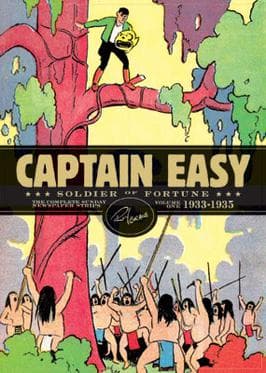
Captain Easy, Soldier of Fortune is an American action-adventure comic strip created by Roy Crane that was syndicated by Newspaper Enterprise Association beginning on Sunday, July 30, 1933. The strip ran for more than five decades until it was discontinued on October 1, 1988.
Characters and story
Originally, Captain Easy was a supporting character in the daily comic strip Wash Tubbs, which focused on the adventures of the zany Washington Tubbs II. On February 26, 1929, Crane introduced taciturn toughguy Captain Easy, who soon took over the strip. On July 30, 1933, Crane launched Captain Easy, Soldier of Fortune as a Sunday page starring Easy.
Captain Easy was a chivalrous Southern adventurer in the classic adventure-hero mold. After a series of globe-trotting adventures, Easy enlisted in the U.S. Army during World War II, afterwards becoming a private detective.

Sunday strips
The Sunday adventures were initially unconnected to those of the Wash Tubbs strip and dealt with Easy's adventures prior to meeting Tubbs. They are considered a tour-de-force by Crane, who crafted layouts intended to be seen as a coherent whole rather than a disparate collection of panels.
Comics historian R. C. Harvey described Crane's Sunday page innovation:
On Sundays, Crane concentrated on Easy, and these pages soon absorbed him. The art chores on the dailies were assigned to others in the NEA bullpen so that Crane could pour his imagination into the weekly installments of Easy's adventures. Crane loved the spacious potential of the Sunday page—as would any graphic artist; and he spent most of his energy here rather than on the less visually challenging dailies. And on the Sunday pages, Crane did some of his finest work. Since he was drawing for the addition of color, Crane shaded these pages very little, so his artwork here is refined to its unembellished essence. And in its essence, Crane's work demonstrates the marvelous precision and telling efficacy of a line so simple it seems naive. But appearances in art are as often deceiving as they are in life. The simplicity of Crane's linework is the ultimate sophistication of irreducible economy, the absolute in purity of graphic expression.