
Boulder is a home rule city that is the county seat of, and the most populous municipality in, Boulder County, Colorado, United States. With a population of 108,250 at the 2020 census, it is the 12th-most populous city in Colorado. Boulder is the primary city of the Boulder, CO Metropolitan Statistical Area, which had 330,758 residents in 2020, and is part of the Front Range Urban Corridor.
Boulder is located at the base of the foothills of the Rocky Mountains, at an elevation of 5,430 feet (1,655 m) above sea level. The city is 25 miles (40 km) northwest of the Colorado state capital of Denver. Boulder is a college town, hosting the University of Colorado Boulder, the flagship and largest campus of the University of Colorado system, as well as numerous research institutes. Starting in 2027, Boulder will become the new home of the Sundance Film Festival.
History
Archaeological evidence shows that Boulder Valley has been continuously inhabited by Native American tribes for over 13,000 years, beginning in the late Pleistocene era. Throughout the Paleo-Indian, Archaic, and Late Prehistoric periods, indigenous peoples moved seasonally between the mountains and plains, taking shelter in winter along the Front Range trough where Boulder now lies. By the 1500s, the Ute people held primary occupation of Boulder Valley. In the early 1800s, the Arapaho migrated to the region. Additional Native American nations with historical ties to the broader Front Range include the Apache, Arapaho, Cheyenne, Comanche, Kiowa, Pawnee, Shoshone, Sioux, and Ute peoples. In the 1800s, European Americans settled in the area.

Boulder was founded in late 1858 when prospectors led by Thomas Aikins arrived at Boulder Canyon during the Colorado Gold Rush. According to historical accounts, they initially camped in an area historically associated with Arapaho leader Chief Niwot, though the Arapaho's stable settlement had been displaced by earlier treaty obligations. Under the Treaty of Fort Wise (1861), the Arapaho were formally forced to relocate to the Cheyenne-Arapaho Reservation. Some of these early settlers later participated in the 1864 Sand Creek massacre, where Niwot himself was killed. In early 1859, gold was discovered along Boulder Creek, drawing more miners and merchants to the area. The Boulder City Town Company was formed in February 1859 to establish a settlement at the canyon mouth. The Boulder, Nebraska Territory, post office opened on April 22, 1859.
On August 24, 1859, voters of the Pike's Peak mining region approved the formation of the Provisional Government of the Territory of Jefferson, and on November 28, 1859, the extralegal Jefferson Territory created Jackson County with Boulder City as its seat. By 1860, Boulder City had 70 cabins, occupied mainly by Anglo families. Chinese miners and Black residents lived in early Boulder but experienced systematic marginalization and were largely absent from contemporary photographs and official records, reflecting the racial hierarchies of the era.
The free Territory of Colorado was organized on February 28, 1861, and Boulder County was created on November 1, 1861, with Boulder City as its seat. The Arapaho were forced to relocate by the Treaty of Fort Wise. With declining numbers, Niwot's band soon moved to the Cheyenne-Arapaho Reservation. By 1862, the creek had yielded $100,000 in gold, and Boulder's population exceeded 300.
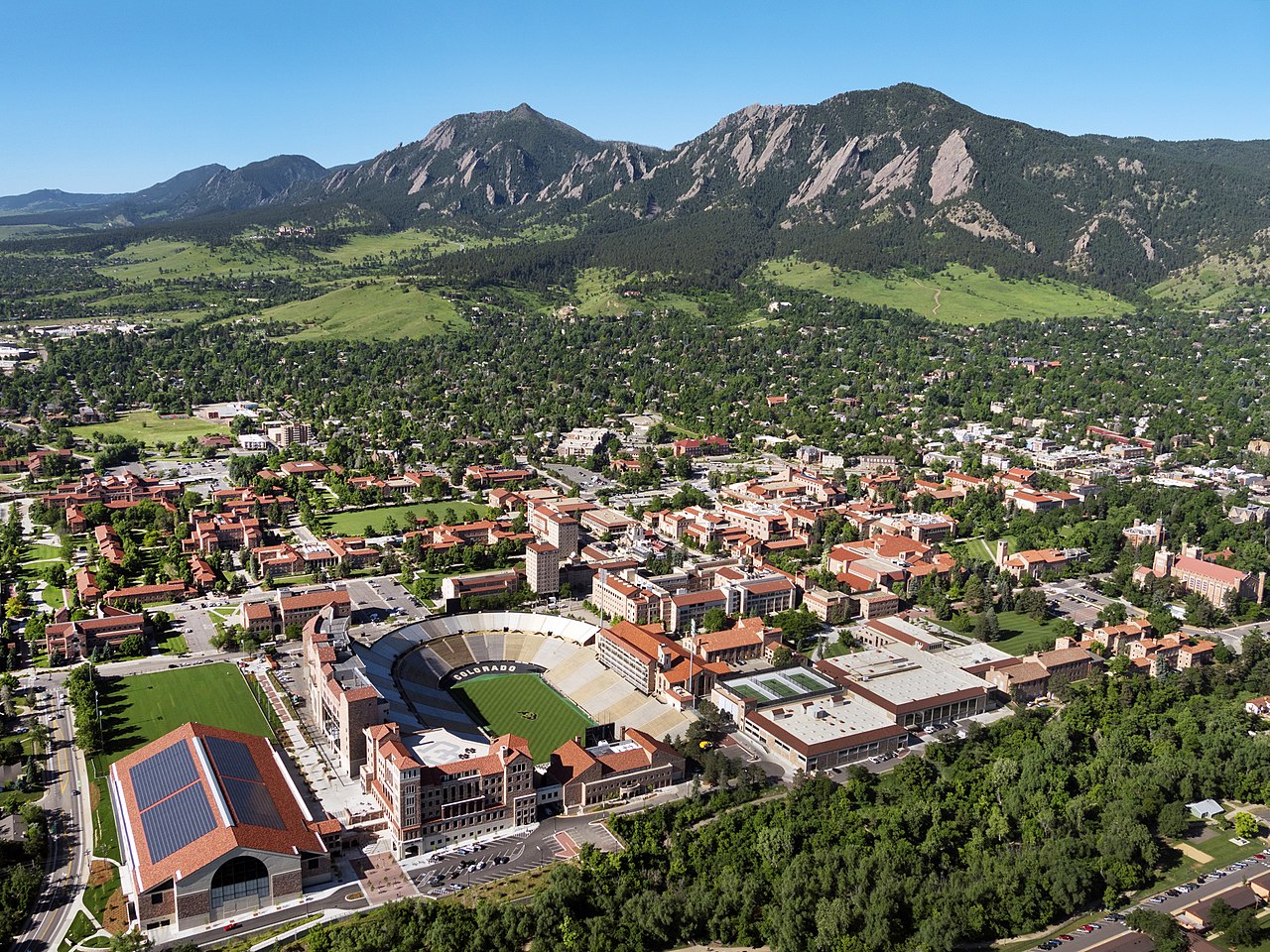
On November 7, 1861, the Colorado General Assembly passed legislation to locate the University of Colorado in Boulder. The City of Boulder City was incorporated on November 4, 1871. On September 20, 1875, the first cornerstone was laid for the first building (Old Main) on the CU campus. Colorado became a state on August 1, 1876, and the university officially opened on September 5, 1877. The City of Boulder City shortened its name to the City of Boulder.
In 1907, Boulder adopted an anti-saloon ordinance. In 1916, statewide prohibition started in Colorado, and ended with the repeal of national prohibition in 1933.
Housing
Median home prices rose 60% from 2010 to 2015 to $648,200. In 2024, the City Council of Boulder repealed a long-standing law that prevented Boulder from increasing new residential units by more than 1% in a year.

In 1959, city voters approved the "Blue Line" city-charter amendment, which restricted city water service to altitudes below 5,750 feet (1,750 m), to protect the mountain backdrop from development. In 1967, city voters approved a dedicated sales tax to acquire open space to contain urban sprawl. In 1970, Boulder created a "comprehensive plan" to dictate future zoning, transportation, and urban planning decisions. In 1972, the city enacted a height-limiting ordinance for buildings to preserve views of the Flatirons and surrounding mountains. This ordinance remains in effect and continues to shape Boulder's skyline and downtown development patterns. In 1974, a Historic Preservation Code was passed. In 1976, a residential-growth management ordinance, the Danish Plan, was passed.
Geography
The city of Boulder is located in the Boulder Valley, where the Rocky Mountains meet the Great Plains. The Flatirons, slabs of sedimentary stone tilted up on the foothills, are located west of the city and are a widely recognized symbol of Boulder.
Boulder Creek is the primary flow of water through Boulder. The creek was named before the city's founding and its etymology is unknown. It is from Boulder Creek that the city is believed to have taken its name. Boulder Creek has significant water flow, derived primarily from snow melt and minor springs west of the city. The creek flows into St. Vrain Creek east of Longmont, which is a tributary of the South Platte River.

At the 2020 United States census, the city had a total area of 17,514 acres (70.877 km2), including 664 acres (2.689 km2) of water.
The 40th parallel, 40 degrees north latitude, runs through Boulder and can be easily recognized as Baseline Road today.
Boulder lies in a wide basin beneath Flagstaff Mountain just a few miles east of the continental divide and about 25 miles (40 km) northwest of Denver. Arapahoe Glacier provides water for the city, along with Boulder Creek, which flows through the center of the city.

Denver International Airport is located 33 miles (53 km) east-southeast of Boulder.
Environment
In 1899, government preservation of open space around Boulder began, with the Congress of the United States approving the allocation of 1,800 acres (7.3 km2) of mountain backdrop and watershed extending from South Boulder Creek to Sunshine Canyon.
Wildlife protection
Boulder has created an Urban Wildlife Management Plan which sets policies for managing and protecting urban wildlife. The city's Parks and Recreation and Open Space and Mountain Parks departments have volunteers who monitor parks, including wetlands, lakes, etc., to protect ecosystems. From time to time, parks and hiking trails are closed to conserve or restore ecosystems.

Traditionally, Boulder has avoided using chemical pesticides to control the insect population. However, with the threat of West Nile virus, the city began an integrative plan to control the mosquito population in 2003 that includes chemical pesticides. Residents can opt out of the program by contacting the city and asking that their areas not be sprayed.
Under Boulder law, exterminating prairie dogs requires a permit.
In 2005, the city experimented with using goats for weed control in environmentally sensitive areas. Goats naturally consume diffuse knapweed and Canada thistle, and although the program was less effective than expected, goats will still be considered in future weed control projects. In 2010, goats were used to keep weeds under control at the Boulder Reservoir.
The city's Open Space and Mountain Parks department manages approximately 8,000 acres (32 km2) of protected forest land west of the city, in accordance with a 1999 Forest Ecosystem Management Plan. The plan aims to maintain or enhance native plant and animal species, their communities, the ecological processes that sustain them and to reduce the wildfire risk to forest and human communities.
Climate
Boulder has a temperate climate typical for much of the state and receives many sunny or mostly sunny days each year. Boulder is considered semi-arid (Köppen: BSk) or humid subtropical (Köppen: Cfa) within the Köppen climate classification due to its relatively high yearly precipitation and average temperatures remaining above 32 °F (0 °C) year-round.
Winter conditions range from generally mild to the occasional bitterly cold. Highs average in the mid to upper 40s °F (7–9 °C). There are 4.6 nights annually where the temperature drops to 0 °F (−18 °C). Because of orographic lift, the mountains to the west often dry out the air passing over the Front Range, shielding the city from precipitation in winter, though heavy snowfalls may occur. Snowfall averages 88 inches (220 cm) per season. Snow depth is usually shallow. Due to the high elevation, a strong warming sun can quickly melt snow cover during the day and Chinook winds bring rapid warm-ups throughout the winter months.
Summers are warm, with frequent afternoon thunderstorms. There are roughly 30 days of 90 °F (32 °C) or above each year. Diurnal temperature variation is typically large due to the high elevation and semi-arid climate. Daytime highs are generally cooler than those of most Colorado cities with similar elevations.
The highest recorded temperature of 104 °F (40 °C) was on June 25, 2012. The record low was −33 °F (−36 °C) on January 17, 1930. The coldest high temperature, −12 °F (−24 °C), was on February 4, 1989. The warmest overnight low was on July 20, 1998, with a temperature of 82 °F (28 °C)
Demographics
Boulder is the principal city of the Boulder, CO Metropolitan Statistical Area.
2020 census
In the 2010 census, there were 97,385 people, 41,302 households, and 16,694 families in the city. The population density was 3,942.7 inhabitants per square mile (1,522.3/km2). There were 43,479 housing units at an average density of 1,760.3 units per square mile (679.7 units/km2). The racial makeup of the city was 88.0% White, 0.9% Black or African American, 0.4% Native American, 4.7% Asian, 0.1% Pacific Islander, 3.2% some other race, and 2.6% from two or more races. 8.7% of the population were Hispanic or Latino of any race.
There were 41,302 households, of which 19.1% had children under 18 living with them, 32.2% were headed by married couples living together, 5.5% had a female householder with no husband present, and 59.6% were non-families. 35.8% of all households comprised individuals, and 7.1% were someone living alone who was 65 or older. The average household size was 2.16, and the average family size was 2.84.
Boulder's population is younger than the national average, largely due to the presence of university students. The median age at the 2010 census was 28.7 years compared to the U.S. median of 37.2 years. In Boulder, 13.9% of the residents were younger than 18, 29.1% from 18 to 24, 27.6% from 25 to 44, 20.3% from 45 to 64, and 8.9% were 65 or older. For every 100 females, there were 105.5 males. For every 100 females age 18 and older, there were 106.2 males.
In 2011, the estimated median household income in Boulder was $57,112, and the median family income was $113,681. Male full-time workers had a median income of $71,993 versus $47,574 for females. The per capita income for the city was $37,600. 24.8% of the population and 7.6% of families were below the poverty line. Out of the total population, 17.4% of those under 18 and 6.0% of those 65 and older were living below the poverty line.
Economy
In 2010, the Boulder MSA had a gross metropolitan product of $18.3 billion, the 110th largest metropolitan economy in the United States.
In 2007, Boulder became the first city in the United States to levy a carbon tax.
In 2013, Boulder appeared on Forbes magazine's list of Best Places for Business and Careers.
Top employers
In the city's 2022 Annual Comprehensive Financial Report, the top employers are:
Arts and culture
Bolder Boulder
Boulder has hosted a 10 km road run, the Bolder Boulder, on Memorial Day every year since 1979. The race involves over 50,000 runners, joggers, walkers, and wheelchair racers, making it one of the largest road races in the world. It has the largest non-marathon prize purse in road racing. The race culminates at Folsom Field with a Memorial Day Tribute. The 2007 race featured over 54,000 runners, walkers, and wheelchair racers, making it the largest race in the US in which all participants are timed and the fifth largest road race in the world.
Music
Founded in 1958, the Boulder Philharmonic Orchestra is a professional orchestra under the leadership of its Music Director Michael Butterman.
Founded in 1976 by Giora Bernstein, the Colorado Music Festival presents a summer series of concerts in Chautauqua Auditorium.
Founded in 1981, the Boulder Bach Festival is an annual festival celebrating the life, legacy, and music of J.S. Bach. The festival is led by Executive Director Zachary Carrettin and Artistic Director Mina Gajić.
Founded in 1988, Colorado MahlerFest celebrates the legacy of composer Gustav Mahler through an annual festival. Under Artistic Director Kenneth Woods, The Colorado MahlerFest Orchestra draws together young professionals, conservatory and university students, and advanced amateurs.
Dance
Boulder is home to multiple dance companies and establishments. Boulder Ballet was founded by former American Ballet Theatre dancer Larry Boyette in the 1970s as part of the Ballet Arts Studios. Lemon Sponge Cake Contemporary Ballet was founded in 2004 by Robert Sher-Machherndl, former principal dancer of the Dutch National Ballet and Bavarian State Ballet.
Conference on World Affairs
The Conference on World Affairs, started in 1948, is an annual one-week conference featuring dozens of discussion panels on contemporary issues.
eTown
The internationally syndicated radio program eTown has its headquarters at eTown Hall, at the intersection of 16th and Spruce Streets, in downtown Boulder. Most tapings of this weekly show are done at eTown Hall.
Polar Bear Plunge
Beginning in 1983, hundreds of people head to the Boulder Reservoir on New Year's Day to take part in the annual polar bear plunge. With rescue teams standing by, participants use a variety of techniques to plunge themselves into the freezing reservoir.