
William Henry Pratt (23 November 1887 – 2 February 1969), known professionally as Boris Karloff (), was an English actor. His portrayal of Frankenstein's monster in the horror film Frankenstein (1931), his 82nd film, established him as a horror icon, and he reprised the role for the sequels Bride of Frankenstein (1935) and Son of Frankenstein (1939). He also appeared as Imhotep in The Mummy (1932), and voiced the Grinch in, as well as narrating, the animated television special of Dr. Seuss' How the Grinch Stole Christmas! (1966), which won him a Grammy Award.
Aside from his numerous film roles (174 films), Karloff acted in many live stage plays and appeared on dozens of radio and television programs as well. For his contribution to film and television, Karloff was awarded two stars on the Hollywood Walk of Fame on 8 February 1960.
Early life
William Henry Pratt was born on 23 November 1887, at 36 Forest Hill Road, East Dulwich, London. His parents were Edward John Pratt of the Indian Civil Service (where he worked for the salt revenue service), and his wife Eliza Sara Millard. Both his parents died when Karloff was young, and he was primarily raised by a half-sister and his elder siblings. His brother Sir John Thomas Pratt was a British consul-general in China, while two other brothers, Frederick Greville Pratt and Edward Millard Pratt, followed their father into the Indian Civil Service. Their father, Edward John Pratt, was an Anglo-Indian, with a British father and an Indian mother, and Karloff was more than a quarter Indian, as his mother also had some Indian ancestry; Karloff had a complexion darker than that of most of his peers. His mother's maternal aunt was Anna Leonowens, whose tales about life in the royal court of Siam (now Thailand) were the basis of the novel Anna and the King of Siam. Pratt was bow-legged, had a lisp, and stuttered as a young boy. He learned how to manage his stutter, but not his lisp, which was noticeable throughout his career in the film industry.
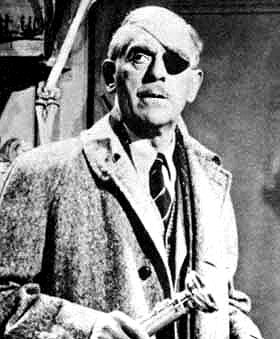
Pratt spent his childhood years in Enfield, in the County of Middlesex. He was the youngest of nine children, and following his mother's death was brought up by his elder siblings. After first attending Enfield Grammar School in London, he received a private education at Uppingham School and Merchant Taylors' School, which was then occupying the London Charterhouse. Following this, he attended King's College London, where his studies were aimed at a career with the British Government's Consular Service. However, in 1909, he left university without graduating and drifted, departing England on a ship for Canada. There, he worked as a farm labourer and truck driver and did various odd jobs in Saskatchewan and British Columbia until he happened upon stage acting in Prince Albert, Saskatchewan, which eventually led to a later film career.
Professional career
Adoption of stage name
Pratt began appearing in theatrical performances in Canada in 1911. He was present in Regina, Saskatchewan, in June 1912, the day the Regina Cyclone destroyed much of the city. The theatre group he was with gave a benefit performance that night at the Regina Theatre to assist in relief efforts. The next week, appearing in Saskatoon, they donated half of the receipts from their performances to Regina relief.
During this period, he chose Boris Karloff as his stage name. Karloff always said he chose the first name "Boris" simply because it sounded foreign and exotic, and that "Karloff" was a family name. Karloff's daughter, Sara, publicly denied any knowledge of Slavic forebears, "Karloff" or otherwise. It has been speculated by film historians that he took the stage name from a mad scientist character named "Boris Karlov" in the novel The Drums of Jeopardy by Harold MacGrath, but the novel was not published until 1920, at least eight years after Karloff had been using the name on stage and in films. (Warner Oland played "Boris Karlov" in a film version in 1931.) Another possible influence was thought to be a character in the Edgar Rice Burroughs fantasy novel The Rider, which features a "Prince Boris of Karlova", but, because the novel was not published until 1915, the influence may be backward, that Burroughs saw Karloff in a play and adapted the name for the character.

One reason for the name change was to prevent embarrassment to the Pratt family. Whether or not his brothers, all dignified members of the Indian Civil Service or His Majesty's Diplomatic Service, actually considered young William the "black sheep of the family" for having become an actor, Karloff worried they felt that way. He did not reunite with his brothers until he returned to Britain to make The Ghoul (1933), worried that they would disapprove of his new, macabre claim to world fame. Instead, his brothers jostled for position around him and happily posed for publicity photographs upon their reunion with him. After the photo was taken, the brothers immediately started asking about getting copies of their own. The story of the photo became one of Karloff's favorites.
Canadian and American stage work
Karloff joined the Jeanne Russell Company in 1911 and performed in towns including Kamloops (British Columbia) and Prince Albert (Saskatchewan). After the devastating tornado in Regina on 30 June 1912, Karloff, who was in the midst of an engagement at the Regina Theatre, and other performers helped with clean-up efforts. He later took a job as a railway baggage handler and joined the Harry St. Clair Company that performed in Minot, North Dakota, for a year in an opera house above a hardware store.
While he was trying to establish his acting career, Karloff had to perform years of manual labour in Canada and the United States to make ends meet. Among this work, he spent one year laying track, digging ditches, shoveling coal, clearing land, and working with surveying parties for the B.C. Electric Railway Company, at the rate of $2.50 per day. From this gruelling work with the BCER and other employers, Karloff was left with back problems for the rest of his life. Because of his health, he did not serve in World War I.

During this period, Karloff worked in various theatrical stock companies across the U.S. to hone his acting skills. Some acting companies mentioned were the Harry St. Clair Players and the Billie Bennett Touring Company. By early 1918, he was working with the Maud Amber Players in Vallejo, California, but because of the Spanish flu outbreak in the San Francisco area and the fear of infection, the troupe was disbanded. He was able to find work with the Haggerty Repertory for a while (according to the 1973 obituary of Joseph Paul Haggerty, he and Boris Karloff remained lifelong friends).
Early Hollywood career
Once Karloff arrived in Hollywood, he appeared in small roles in dozens of silent films, but the work was sporadic and he often had to take up manual labour such as digging ditches or delivering construction plaster to make ends meet. (According to Karloff, his first film was a Frank Borzage picture at Universal for which he received $5 as an extra; the title of this film has never been traced.)
His first certain screen role was in a film serial, The Lightning Raider (1919) with Pearl White. He was in another serial that same year, The Masked Rider (1919), the earliest of his film appearances that has survived. Karloff could also be seen in His Majesty, the American (1919) with Douglas Fairbanks, The Prince and Betty (1919), The Deadlier Sex (1920) with Blanche Sweet, and The Courage of Marge O'Doone (1920). He played an Indian in The Last of the Mohicans (1920) with Wallace Beery and he would often be cast as an Arab or Indian in his early films.

Karloff's first major role came in a film serial, The Hope Diamond Mystery (1920). He was Indian in Without Benefit of Clergy (1921) and an Arab in Cheated Hearts (1921) and villainous biracial hired hand in The Cave Girl (1921). He was a maharajah in The Man from Downing Street (1922), a Nabob in The Infidel (1922) and had roles in The Altar Stairs (1922), Omar the Tentmaker (1922) (as an Imam), The Woman Conquers (1922), The Gentleman from America (1923), The Prisoner (1923) and the serial Riders of the Plains (1923).
Karloff did a Western, The Hellion (1923), and a drama, Dynamite Dan (1924). He could be seen in Parisian Nights (1925), Forbidden Cargo (1925), The Prairie Wife (1925) and the serial Perils of the Wild (1925). Karloff went back to bit part status in Never the Twain Shall Meet (1925), directed by Maurice Tourneur, but he had a good support part in Lady Robinhood (1925) starring Evelyn Brent in the titular role.
Karloff went on to be in The Greater Glory (1926), Her Honor, the Governor (1926), The Bells (1926) (as a mesmerist), The Nickel-Hopper (1926) with Mabel Normand, The Golden Web (1926), The Eagle of the Sea (1926), Flames (1926), Old Ironsides (1926) with Wallace Beery and Esther Ralston, Flaming Fury (1926), Valencia (1926), The Man in the Saddle (1926) with Hoot Gibson, Tarzan and the Golden Lion (1927) (as an African), Let It Rain (1927), The Meddlin' Stranger (1927), The Princess from Hoboken (1927), The Phantom Buster (1927) with Buddy Roosevelt, and Soft Cushions (1927).

Karloff had roles in Two Arabian Knights (1927), The Love Mart (1927) with Noah Beery Sr., The Vanishing Rider (1928) (a serial), Burning the Wind (1928), Vultures of the Sea (1928), and The Little Wild Girl (1928).
He was in The Devil's Chaplain (1929), The Fatal Warning (1929) for Richard Thorpe, The Phantom of the North (1929), Two Sisters (1929), Anne Against the World (1929), Behind That Curtain (1929) with Warner Baxter, and The King of the Kongo (1929), a serial directed by Thorpe.
One day while he was sitting at a bus stop in the pouring rain, Lon Chaney Sr., 'The Man of a Thousand Faces', spotted Karloff and offered him a ride. Chaney told him to "find something different that will set you apart and is different from anything someone else has done or is willing to do and do it better".

Karloff had an uncredited bit part in The Unholy Night (1930) directed by Lionel Barrymore, and bigger parts in The Bad One (1930), The Sea Bat (1930) starring Charles Bickford and directed by Lionel Barrymore and Wesley Ruggles, and The Utah Kid (1930) directed by Thorpe.
A film which brought Karloff recognition was The Criminal Code (1931), a prison drama directed by Howard Hawks in which he reprised a dramatic part he had played on stage. In the same period, Karloff had a supporting role as a mob boss in Hawks' gangster film Scarface starring Paul Muni and George Raft, but the film was not released until 1932 because of censorship problems.
He did another serial for Thorpe, King of the Wild (1931), then had support parts in Cracked Nuts (1931) with Wheeler and Woolsey, Young Donovan's Kid (1931) with Jackie Cooper, Smart Money (1931) with Edward G. Robinson and James Cagney in their only film together, The Public Defender (1931) with Richard Dix, I Like Your Nerve (1931) with Douglas Fairbanks Jr. and Loretta Young, and Graft (1931) with Regis Toomey and future agent Sue Carol.
Another significant role in the autumn of 1931 saw Karloff play a key supporting part as an unethical newspaper reporter in Five Star Final with Edward G. Robinson, a film about tabloid journalism which was nominated for the Academy Award for Best Picture.
He could also be seen in The Yellow Ticket (1931) with Elissa Landi, Lionel Barrymore and Laurence Olivier during Olivier's memorable first round in Hollywood, The Mad Genius (1931) with John Barrymore, The Guilty Generation (1931) with Robert Young and Tonight or Never (1931) with Gloria Swanson.
Stardom
Karloff acted in eighty-one films before being discovered by James Whale and cast in Frankenstein (1931). Karloff's role as Frankenstein's monster was physically demanding – it necessitated a bulky costume with four-inch platform boots – but the costume and extensive makeup produced an iconic image. The costume was a job in itself for Karloff with the shoes weighing 11 pounds (5.0 kg) each, which further aggravated his back problems. Universal Studios quickly copyrighted the makeup design for the Frankenstein monster that Jack P. Pierce had created.
It took a while for Karloff's stardom to be established with the public – he had small roles in Behind the Mask (1932), Business and Pleasure (1932) and The Miracle Man (1932). As receipts for Frankenstein and Scarface flooded in, Universal gave Karloff third billing in Night World (1932), with Lew Ayres, Mae Clarke and George Raft.
Karloff was reunited with Whale at Universal for The Old Dark House (1932), a horror film based on the novel Benighted by J. B. Priestley, in which he finally enjoyed top billing above Melvyn Douglas, Charles Laughton, Raymond Massey and Gloria Stuart; he was billed simply as "KARLOFF", a custom that Universal continued for several years. He was loaned to MGM to play the titular role in The Mask of Fu Manchu (also 1932), for which he had top billing.
Back at Universal, he was cast as Imhotep who is revived to life in The Mummy (1932), an original story inspired by the unsealing of Tutankhamun's tomb, conceived to continue the success of the Dracula and Frankenstein adaptations. The Mummy was as successful at the box-office as his other two films and Karloff was now established as a star of horror films. Like Frankenstein, The Mummy would spawn a line of sequels, although Karloff would not reprise the iconic 1932 role.
Karloff returned to England to star in The Ghoul (1933), then made a non-horror film for John Ford, The Lost Patrol (1934), for which his performance was highly acclaimed.
Karloff was third billed in the Twentieth Century Pictures historical film The House of Rothschild (1934) with George Arliss, which was highly popular.
Horror had become Karloff's primary genre, and he gave a string of lauded performances in Universal's horror films, including several with Bela Lugosi, his main rival as heir to Lon Chaney's status as the leading horror film star. While the long-standing, creative partnership between Karloff and Lugosi never led to a close friendship, it produced some of the actors' most revered and enduring productions, beginning with The Black Cat (1934) and continuing with Gift of Gab (1934), in which both had cameos. Karloff reprised the role of Frankenstein's monster in Bride of Frankenstein (1935) for James Whale. Then he and Lugosi were reunited for The Raven (1935). Billed only by his last name during this period, Karloff had top billing above Lugosi in all their films together despite Lugosi having the larger role in The Raven.
For Columbia, Karloff made The Black Room (1935) then he returned to Universal for The Invisible Ray (1936) with Lugosi, more a science fiction film. Karloff was then cast in a Warner Bros. horror film, The Walking Dead (1936).
Because the Motion Picture Production Code (known as the Hays Code) began to be seriously enforced in 1934, horror films declined in the second half of the 1930s. Karloff worked in other genres, making two films in Britain, Juggernaut (1936) and The Man Who Changed His Mind (1936) which was released in the U.S. as The Man Who Lived Again.
He returned to Hollywood to play a supporting role in Charlie Chan at the Opera (1936), then starred in a crime drama, Night Key (1937). At Warners, he did two films with John Farrow, playing a Chinese warlord in West of Shanghai (1937) and a murder suspect in The Invisible Menace (1938).
Karloff went to Monogram to play the title role of a Chinese detective in Mr. Wong, Detective (1938), which led to a series. Karloff's portrayal of the character is an example of Hollywood's use of yellowface and its portrayal of East Asians in the earlier half of the 20th century. He had another heroic role in Devil's Island (1939).
Universal found reissuing Dracula and Frankenstein led to success at the box-office and began to produce horror films again starting with Son of Frankenstein (1939). Karloff reprised his role, with Lugosi also starring as Ygor and top-billed Basil Rathbone as Dr. Frankenstein. This was Karloff's first Universal film since the original Frankenstein in which Karloff was not top billed as "KARLOFF", a custom that the studio had used for eight films in a row while Karloff was at the height of his career. Basil Rathbone held top billing for Son of Frankenstein, and since Rathbone, Karloff and Lugosi were all billed above the title, billing Basil, Boris and Bela was hard to resist. Karloff was never billed by simply his last name again. Regarding Son of Frankenstein, the film's director Rowland V. Lee said his crew let Lugosi "work on the characterization; the interpretation he gave us was imaginative and totally unexpected ... when we finished shooting, there was no doubt in anyone's mind that he stole the show. Karloff's monster was weak by comparison."
After The Mystery of Mr. Wong (1939) and Mr. Wong in Chinatown (1939) he signed a three-picture deal with Columbia, starting with The Man They Could Not Hang (1939). Karloff returned to Universal to make Tower of London (1939) with Rathbone, playing Mord, the murderous henchman of King Richard III.
Karloff made a fourth Mr Wong film at Monogram The Fatal Hour (1940). At Warners he was in British Intelligence (1940), then he went to Universal to do Black Friday (1940) with Lugosi.
Karloff's second and third films for Columbia were The Man with Nine Lives (1940) and Before I Hang (1940). In between he did a fifth and final Mr Wong film, Doomed to Die (1940).
Karloff appeared at a celebrity baseball game as Frankenstein's monster in 1940, hitting a gag home run and making catcher Buster Keaton fall into an acrobatic dead faint as the monster stomped into home plate.
Karloff finished a six-picture commitment with Monogram with The Ape (1940). He and Lugosi appeared with Peter Lorre in a comedy at RKO, You'll Find Out (1941), then he went to Columbia for The Devil Commands (1941) and The Boogie Man Will Get You (1941).
Professional expansion and further success
An enthusiastic performer, he returned to the Broadway stage in the original production of Arsenic and Old Lace in 1941, in which he played a homicidal gangster enraged to be frequently mistaken for Karloff. Frank Capra cast Raymond Massey in the 1944 film, which was shot in 1941, while Karloff was still appearing in the role on Broadway. The play's producers allowed the film to be made conditionally: it was not to be released until the production closed. (Karloff reprised his role on television in the anthology series The Best of Broadway (1955), and with Tony Randall and Tom Bosley in a 1962 production on the Hallmark Hall of Fame. He also starred in a radio adaptation produced by Screen Guild Theatre in 1946.)
In 1944, he underwent a spinal operation to relieve a chronic arthritic condition.
Karloff returned to film roles in The Climax (1944), an unsuccessful attempt to repeat the success of Phantom of the Opera (1943). More liked was House of Frankenstein (1944), marking Karloff's "retirement" from playing the Monster, where instead, he comes full circle to play the villainous Dr. Niemann, a mad scientist fixated on life-experiments much like Henry Frankenstein, and pass the torch to actor Glenn Strange, who would play the Monster in subsequent films.
Karloff made three films for producer Val Lewton at RKO: The Body Snatcher (1945), his last teaming with Lugosi, Isle of the Dead (1945) and Bedlam (1946).
In a 1946 interview with Louis Berg of the Los Angeles Times, Karloff discussed his arrangement with RKO, working with Lewton and his reasons for leaving Universal. Karloff left Universal because he thought the Frankenstein franchise had run its course; the entries in the series after Son of Frankenstein were B-pictures. Berg wrote that the last installment in which Karloff appeared—House of Frankenstein—was what he called a " 'monster clambake,' with everything thrown in—Frankenstein, Dracula, a hunchback and a 'man-beast' that howled in the night. It was too much. Karloff thought it was ridiculous and said so." Berg explained that the actor had "great love and respect for" Lewton, who was "the man who rescued him from the living dead and restored, so to speak, his soul."
Horror films experienced a decline in popularity after the war, and Karloff found himself working in other genres.
For the Danny Kaye comedy The Secret Life of Walter Mitty (1947), Karloff appeared in a brief but starring role as Dr. Hugo Hollingshead, a psychiatrist. Director Norman Z. McLeod shot a sequence with Karloff in the Frankenstein monster make-up, but it was deleted from the finished film.
Karloff appeared in a film noir, Lured (1947) with Lucille Ball, and as an Indian in Unconquered (1947). He had support roles in Dick Tracy Meets Gruesome (1947), Tap Roots (1948), and Abbott and Costello Meet the Killer, Boris Karloff (1949).
During this period, Karloff was a frequent guest on radio programmes, whether it was starring in Arch Oboler's Chicago-based Lights Out productions (including the episode "Cat Wife") or spoofing his horror image with Fred Allen or Jack Benny. In 1949, he was the host and star of Starring Boris Karloff, a radio and television anthology series for the ABC broadcasting network.
He appeared as the villainous Captain Hook in Peter Pan in a 1950 stage musical adaptation which also featured Jean Arthur.
Karloff returned to horror films with The Strange Door (1951) and The Black Castle (1952) co-starring Lon Chaney Jr.
He was nominated for a Tony Award for his work opposite Julie Harris in The Lark, by the French playwright Jean Anouilh, about Joan of Arc, which he reprised years later on TV's Hallmark Hall of Fame.
During the 1950s, he appeared on British television in the series Colonel March of Scotland Yard, in which he portrayed John Dickson Carr's fictional detective Colonel March, who was known for solving apparently impossible crimes. Christopher Lee appeared alongside Karloff in the episode "At Night, All Cats are Grey" broadcast in 1955. A little later, Karloff co-starred with Lee in the film Corridors of Blood (1958).