
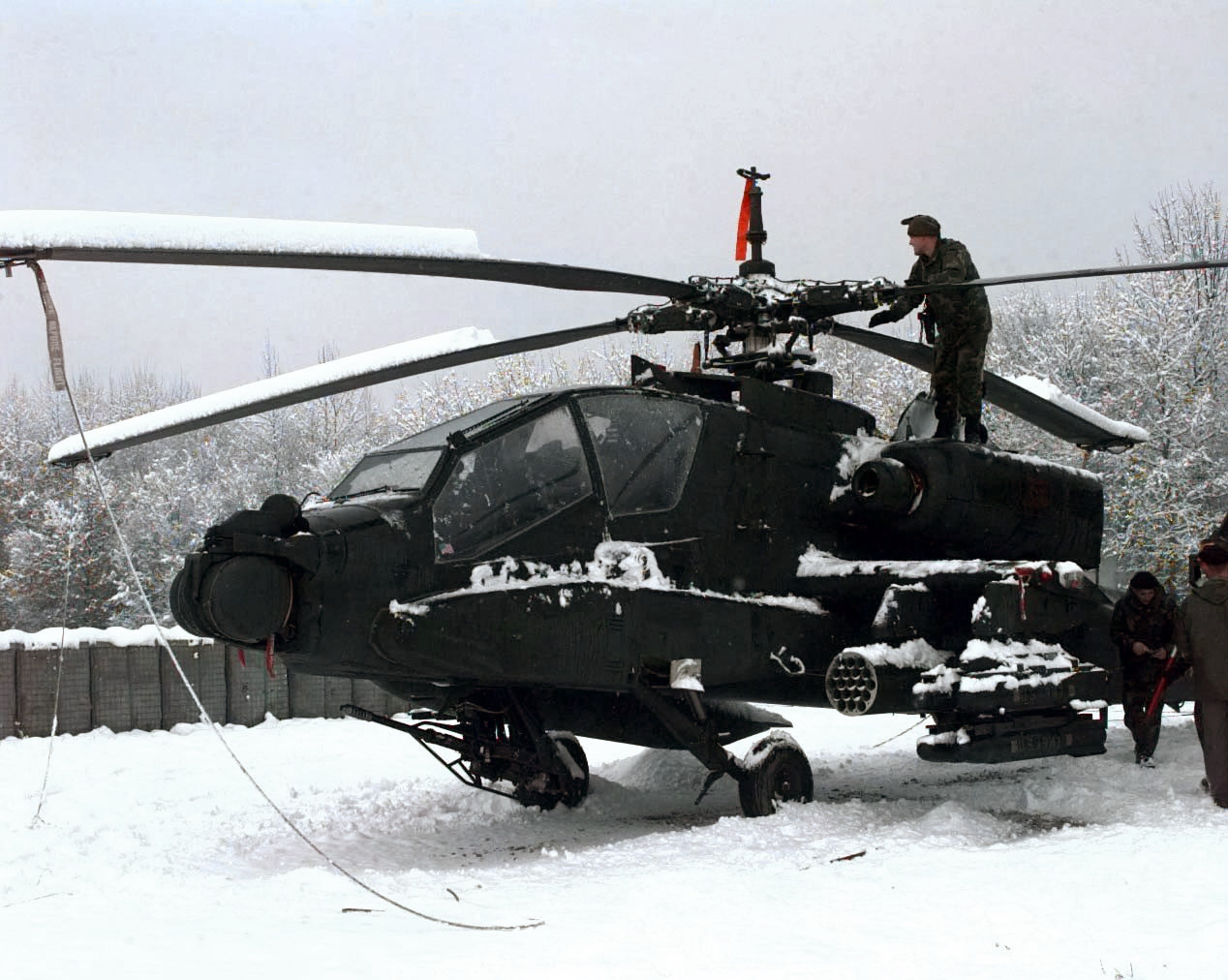
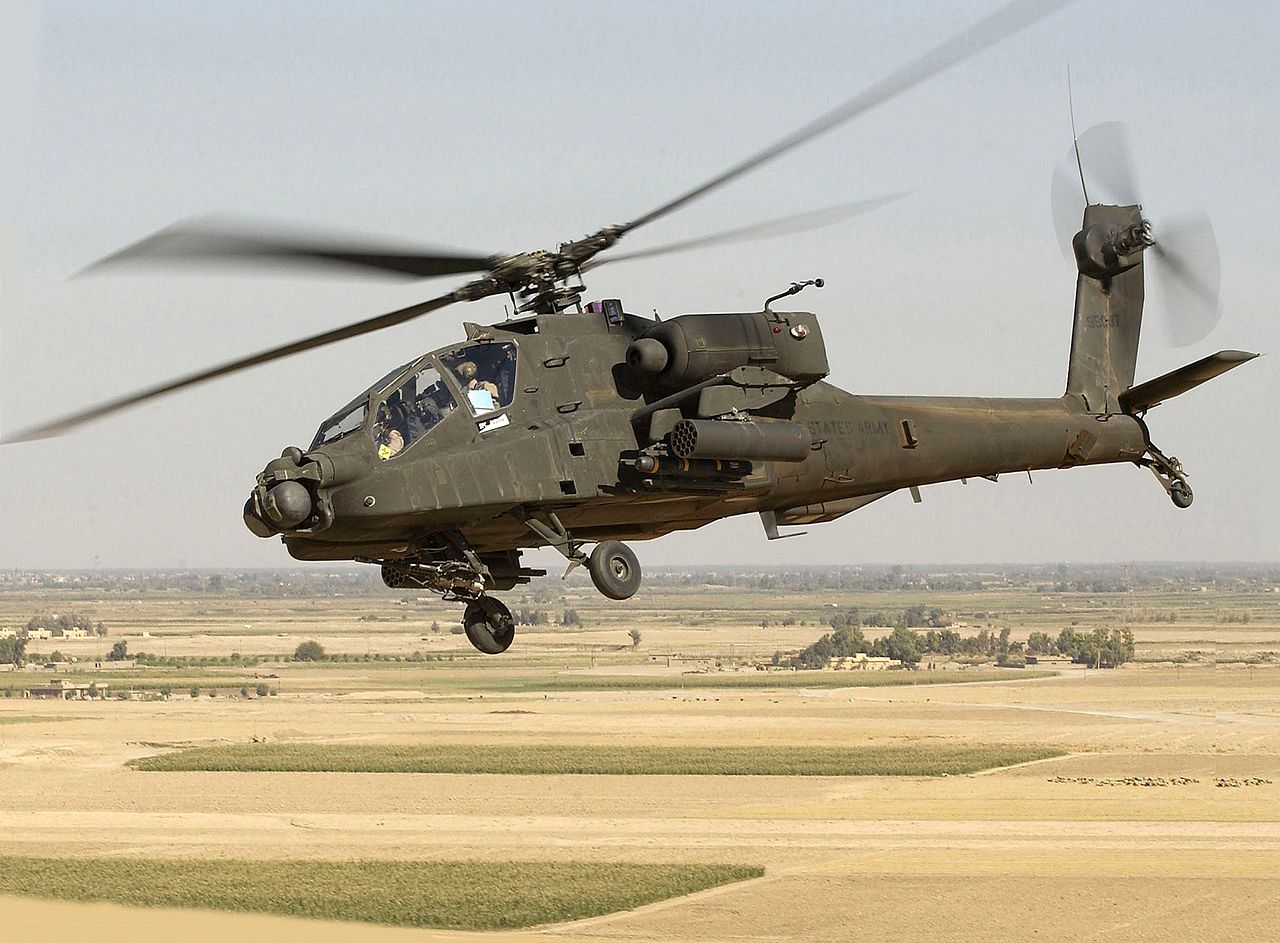
The Hughes/McDonnell Douglas/Boeing AH-64 Apache ( ə-PATCH-ee) is an American twin-turboshaft attack helicopter with a tailwheel-type landing gear and a tandem cockpit for a crew of two. Nose-mounted sensors help acquire targets and provide night vision. It carries a 30 mm (1.18 in) M230 chain gun under its forward fuselage and four hardpoints on stub-wing pylons for armament and stores, typically AGM-114 Hellfire missiles and Hydra 70 rocket pods. Redundant systems help it survive combat damage.
The Apache began as the Model 77 developed by Hughes Helicopters for the United States Army's Advanced Attack Helicopter program to replace the AH-1 Cobra. The prototype YAH-64 first flew on 30 September 1975. The U.S. Army selected the YAH-64 over the Bell YAH-63 in 1976, and later approved full production in 1982. After acquiring Hughes Helicopters in 1984, McDonnell Douglas continued AH-64 production and development. The helicopter was introduced to U.S. Army service in April 1986. The advanced AH-64D Apache Longbow was delivered to the Army in March 1997. Production has been continued by Boeing Defense, Space & Security. As of March 2024, over 2,700 Apaches have been delivered to the U.S. Army and 18 international partners and allies.
Primarily operated by the U.S. Army, the AH-64 has also become the primary attack helicopter of multiple nations, including Greece, Japan, Israel, the Netherlands, Singapore, and the United Arab Emirates. It has been built under license in the United Kingdom as the AgustaWestland Apache. American AH-64s have served in conflicts in Panama, the Persian Gulf, Kosovo, Afghanistan, Iraq, and Iran. Israel has used the Apache to fight in Lebanon and the Gaza Strip. British and Dutch Apaches were deployed to wars in Afghanistan and Iraq beginning in 2001 and 2003.

Development
Advanced Attack Helicopter
After the AH-56 Cheyenne was cancelled in 1972 in favor of projects like the U.S. Air Force A-10 Thunderbolt II and the Marine Corps AV-8A Harrier, the United States Army sought an aircraft to fill an anti-armor attack role that would still be under Army command. The 1948 Key West Agreement forbade the Army from owning combat fixed-wing aircraft. The Army wanted an aircraft better than the AH-1 Cobra in firepower, performance, and range. It would have the maneuverability for terrain following nap-of-the-earth (NoE) flying. To this end, the U.S. Army issued a Request For Proposals (RFP) for the Advanced Attack Helicopter (AAH) program on 15 November 1972. As a sign of the importance of this project, in September 1973 the Army designated its five most important projects as the "Big Five", with the AAH included.
Proposals were submitted by Bell, Boeing Vertol/Grumman team, Hughes, Lockheed, and Sikorsky. In July 1973, the U.S. Department of Defense selected finalists Bell and Hughes Aircraft's Toolco Aircraft Division (later Hughes Helicopters). This began the phase 1 of the competition. Each company built prototype helicopters and went through a flight test program. Hughes' Model 77/YAH-64A prototype first flew on 30 September 1975, while Bell's Model 409/YAH-63A prototype first flew on 1 October 1975. After evaluating the test results, the Army selected Hughes' YAH-64A over Bell's YAH-63A in 1976. Reasons for selecting the YAH-64A included its more damage tolerant four-blade main rotor and the instability of the YAH-63's tricycle landing gear arrangement.
The AH-64A then entered phase 2 of the AAH program under which three pre-production AH-64s would be built, additionally, the two YAH-64A flight prototypes and the ground test unit were upgraded to the same standard. Weapons and sensor systems were integrated and tested during this time, including the laser-guided AGM-114 Hellfire missile. Development of the Hellfire missile had begun in 1974, originally known by the name of Helicopter Launched, Fire and Forget Missile ('Hellfire' being a shortened acronym), for the purpose of arming helicopter platforms with an effective anti-tank missile.

Into production
In 1981, three pre-production AH-64As were handed over to the U.S. Army for Operational Test II. The Army testing was successful, but afterward it was decided to upgrade to the more powerful T700-GE-701 variant of engine, rated at 1,690 shp (1,260 kW). The AH-64 was named the Apache in late 1981, after the Apache tribe, following the tradition of naming Army helicopters after Native American tribes. It was approved for full-scale production in 1982. In 1983, the first production helicopter was rolled out at Hughes Helicopter's facility at Mesa, Arizona. Hughes Helicopters was purchased by McDonnell Douglas for $470 million in 1984 (equivalent to $1,457,000,000 in 2025). The helicopter unit later became part of The Boeing Company with the merger of Boeing and McDonnell Douglas in August 1997. In 1986, the incremental or flyaway cost for the AH-64A was $7M and the average unit cost was approximately $13.9M based on total costs.
A 1985 Department of Defense engineering analysis by the inspector general's office reported that significant design deficiencies still needed to be addressed by the contractor. The Army project manager Col. William H. Forster published a list of 101 action items. In 1986, the four 22-foot-long main rotor blades, each made from steel and composite material glued together to maximize strength and minimize weight by the Composite Structures Division of Alcoa Composites, were added to the list. The steel-composite rotors could not meet the Army specification for a life of 1500 flight hours, and needed replacement after just 146 hours. After six changes to the design, the rotor blade life was extended to 1400 hours by early 1991.
As of 2024, the AH-64E is being produced at an economical rate of 82 aircraft a year. Boeing states that the minimum sustainment rate for the aircraft is 48 per year while current tooling and space allows for up to 98 aircraft to be manufactured per year. The U.S. Army states that with additional investment and labor, production could be raised to 144 aircraft per year.
Further development
During the 1980s, McDonnell Douglas studied an AH-64B, featuring an updated cockpit, new fire control system and other upgrades. In 1988, funding was approved for a multi-stage upgrade program to improve sensor and weapon systems. Technological advance led to the program's cancellation in favor of more ambitious changes. In August 1990, development of the AH-64D Apache Longbow was approved by the Defense Acquisition Board. The first AH-64D prototype flew on 15 April 1992. Prototype testing ended in April 1995. During testing, six AH-64D helicopters were pitted against a bigger group of AH-64As. The results demonstrated the AH-64D to have a sevenfold increase in survivability and fourfold increase in lethality compared to the AH-64A. On 13 October 1995, full-scale production was approved; a $1.9-billion five-year contract was signed in August 1996 to upgrade 232 AH-64As into AH-64Ds. On 17 March 1997, the first production AH-64D flew. It was delivered on 31 March.
Portions of the Apache are produced by other aerospace firms. AgustaWestland has produced a number of components for the Apache both for the international market and for the British Army's AgustaWestland Apache. Since 2004, Korea Aerospace Industries has been the sole manufacturer of the Apache's fuselage. Fuselage production had previously been performed by Teledyne Ryan Aeronautical. The transfer of fuselage production led to a prolonged legal dispute between Teledyne Ryan and Boeing.
The AH-64D program cost a total of $11 billion (~$16 billion in 2024) through 2007. In April 2006, Boeing was awarded a $67.6 million (~$101 million in 2024) fixed-price contract for the remanufacture of several existing U.S. AH-64As to the AH-64D configuration. Between May 2009 and July 2011, a further five contracts were issued to remanufacture batches of AH-64As into AH-64Ds. Since 2008, nations operating the older Apaches have been urged to undertake modernization programs as support for the AH-64A is withdrawn.

By May 2019, Boeing tested in a wind tunnel a compound Apache scale model with a pusher propeller, a small wing to increase range and speed, and a counter-torque tail rotor like the cancelled Lockheed AH-56 Cheyenne of the 1960s. It competed for the U.S. Army's Future Long Range Assault Aircraft (FLRAA) unveiled in April, developed from the Future Vertical Lift Capability Set 3 (medium rotorcraft) without the attack requirement, while the U.S. Army's FARA should replace the retired Bell OH-58 Kiowa scout and up to half of the AH-64 fleet.
Indian fuselage manufacturing facility
On 9 November 2015, Boeing and Tata Advanced Systems (TASL) announced a joint venture to co-produce the fuselage of AH-64 in India for the global market. This was after the Indian Air Force ordered the helicopters. On 18 June 2016, the companies laid the foundation of the facility in the outskirts of Hyderabad. The joint venture was named Tata–Boeing Aerospace (TBAL). In March 2018, the facility was inaugurated by Nirmala Sitharaman, the then Indian Defence Minister. On 1 June 2018, TBAL delivered the first Made-in-India fuselage to Boeing ahead of schedule. The fuselage would be then transported Boeing's AH-64 Apache manufacturing facility in Mesa, Arizona for final assembly. The facility will also deliver secondary structure and vertical spar boxes for the combat helicopter. On 23 July 2021, TBAL delivered the 100th Indian-made fuselage. By then, the facility also started delivering secondary structure and vertical spar boxes to Boeing. On 19 January 2023, TBAL delivered the first fuselage for the Indian Army's 6-aircraft contract. Overall, over 190 fuselages were supplied by TBAL. The facility also became the sole manufacturer of Apache fuselage globally, in addition to supplying parts for Boeing 737, 777 and 787 aircraft. On 10 February 2025, TBAL delivered the 300th fuselage.
As of 2018, the facility spans over an area of 14,000 m2 (3.5 acres) and is staffed by 350 workers at full production. The workforce, by 2023, grew to 900. As for the fuselages delivered, 90% of the components are being manufactured in India through more than 100 MSME suppliers.
Design
Overview
The AH-64 Apache has a four-blade main rotor and a four-blade tail rotor. The crew sits in tandem, with the pilot sitting behind and above the co-pilot/gunner. Both crew members are capable of flying the aircraft and performing methods of weapon engagements independently. The AH-64 is powered by two General Electric T700 turboshaft engines with high-mounted exhausts on either side of the fuselage. Various models of engines have been used on the Apache; those in British service originally used engines from Rolls-Royce. In 2004, General Electric Aviation began producing more powerful T700-GE-701D engines, rated at 2,000 shp (1,500 kW) for AH-64Ds.
The crew compartment and rotor blades are designed to sustain a hit from 23 mm (0.91 in) rounds. The airframe includes some 2,500 lb (1,100 kg) of protection and has a self-sealing fuel system to protect against ballistic projectiles. The crew compartment also incorporates a transparent blast shield between the pilot and gunner seats so that at least one crew member can survive in the event of a direct hit, but the canopy and windows are otherwise unrated against ballistic threats.
The aircraft was designed to meet the crashworthiness requirements of MIL-STD-1290, which specifies minimum requirement for crash impact energy attenuation to minimize crew injuries and fatalities. This was achieved through incorporation of increased structural strength, crashworthy landing gear, seats and fuel system.

On a standard day, when temperatures are 59 °F (15 °C), the AH-64 has a vertical rate of climb of 1,775 feet per minute (541 m/min), and a service ceiling of 21,000 feet (6,400 m).
Avionics and targeting
One of the revolutionary features of the Apache was its helmet mounted display, the Integrated Helmet and Display Sighting System (IHADSS); among its capabilities, either the pilot or gunner can slave the helicopter's 30 mm automatic M230 Chain Gun to their helmet, making the gun track head movements to point where they look. The M230E1 can be alternatively fixed to a locked forward firing position, or controlled via the Target Acquisition and Designation System (TADS). On more modern AH-64s, the TADS/PNVS has been replaced by Lockheed Martin's Arrowhead (MTADS) targeting system.
U.S. Army engagement training is performed under the Aerial Weapons Scoring System Integration with Longbow Apache Tactical Engagement Simulation System (AWSS-LBA TESS), using live 30 mm and rocket ammunition as well as simulated Hellfire missiles. The Smart Onboard Data Interface Module (SMODIM) transmits Apache data to an AWSS ground station for gunnery evaluation. The AH-64's standard of performance for aerial gunnery is to achieve at least 1 hit for every 30 shots fired at a wheeled vehicle at a range of 800–1,200 m (870–1,310 yd).
The AH-64 was designed to perform in front-line environments, and to operate at night or day and during adverse weather conditions, thanks to systems including the Target Acquisition and Designation System, Pilot Night Vision System (TADS/PNVS), passive infrared countermeasures, GPS, and the IHADSS. Longbow-equipped Apaches can locate up to 256 targets simultaneously within 50 km (31 mi). In August 2012, 24 U.S. Army AH-64Ds were equipped with the Ground Fire Acquisition System (GFAS), which detects and targets ground-based weapons fire sources in all-light conditions and with a 120° visual field. The GFAS consists of two sensor pods working with the AH-64's other sensors, and a thermographic camera that precisely locates muzzle flashes.
In 2014, it was announced that new targeting and surveillance sensors were under development to provide high-resolution color imagery to crews, replacing older low definition black-and-white imaging systems. Lockheed received the first contract in January 2016, upgrading the Arrowhead turret to provide higher-resolution color imaging with longer ranges and a wider field of view. In 2014, the U.S. Army was adapting its Apaches for increased maritime performance as part of the Pentagon's rebalance to the Pacific. Additional avionics and sensor improvements includes an extended-range radar capable of detecting small ships in littoral environments, software adaptions to handle maritime targets, and adding Link 16 data-links for better communications with friendly assets.
Armament and configurations
The AH-64 is adaptable to numerous different roles within its context as Close Combat Attack (CCA). In addition to the 30 mm M230E1 Chain Gun, the Apache carries a range of external stores and weapons on its stub-wing pylons, typically a mixture of AGM-114 Hellfire anti-tank missiles, and Hydra 70 general-purpose unguided 70 mm (2.756 in) rockets. The Hellfire is designed to defeat stationary or moving tanks as far away as 6,500 meters.
Since 2005, the Hellfire missile outfitted with a thermobaric warhead is designated AGM-114N; this missile variant is intended for use against ground forces and urban warfare operations. In October 2015, the U.S. Army ordered its first batch of Advanced Precision Kill Weapon System (APKWS) guided 70 mm rockets for the Apache.
Starting in the 1980s, the Stinger and AIM-9 Sidewinder air-to-air missiles and the AGM-122 Sidearm anti-radiation missile were evaluated for use upon the AH-64. The Stinger was initially selected; the U.S. Army was also considering the Starstreak air-to-air missile. External fuel tanks can also be carried on the stub wings to increase range and mission time. The stub-wing pylons have mounting points for maintenance access; these mountings can also be used to secure personnel externally for emergency transport. Stinger missiles are often used on non-U.S. Apaches, as foreign forces do not have as many air superiority aircraft to control the skies. The AH-64E initially lacked the ability to use the Stinger to make room for self-defense equipment, but the capability was added back following a South Korean demand.
The AH-64E is able to control unmanned aerial vehicles (UAVs), used by the U.S. Army to perform aerial scouting missions previously performed by the OH-58 Kiowa. Apaches can request to take control of an RQ-7 Shadow or MQ-1C Grey Eagle from ground control stations to safely scout via datalink communications. There are four levels of UAV interoperability (LOI): LOI 1 indirectly receives payload data; LOI 2 receives payload data through direct communication; LOI 3 deploys the UAV's armaments; and LOI 4 takes over flight control. UAVs can search for enemies and, if equipped with a laser designator, target them for the Apache or other friendly aircraft.
Boeing has suggested that the AH-64 could be fitted with a directed energy weapon. The company has developed a small laser weapon, initially designed to engage small UAVs, that uses a high-resolution telescope to direct a 2–10 kW beam with the diameter of a penny out to a range of 5.4 nmi (10.0 km; 6.2 mi). On the Apache, the laser could be used to destroy enemy communications or radio equipment.
On 14 July 2016, it was reported that the AH-64 had successfully completed testing of the MBDA Brimstone anti-armor missile. In January 2020, the U.S. Army announced it was fielding the Spike NLOS missile on AH-64E Apaches as an interim solution to acquire new munitions that provide greater stand-off capabilities.
Operational history
United States
Twentieth century
In January 1984, the U.S. Army formally accepted its first production AH-64A and training of the first pilots began later that year. The first operational Apache unit, 7th Battalion, 17th Cavalry Brigade, began training on the AH-64A in April 1986 at Fort Hood, Texas. Two operational units with 68 AH-64s first deployed to Europe in September 1987 and took part in large military exercises there.
Upon fielding the Apache, capabilities such as the FLIR's use in extensive night operations made it clear that it was capable of operating beyond the forward line of own troops (FLOT) to which previous attack helicopters were normally restricted. It was discovered that the Apache was coincidentally fitted with the Have Quick UHF radio system used by the U.S. Air Force, allowing inter-service coordination and joint operations such as the joint air attack teams (JAAT). The Apache has operated extensively with close air support (CAS) aircraft, such as the USAF's Fairchild Republic A-10 Thunderbolt II and the USMC's McDonnell Douglas AV-8B Harrier II, often acting as a target designator to conserve the Apache's own munitions. The Apache was first used in combat in 1989, during Operation Just Cause, the invasion of Panama. It participated in over 240 combat hours, attacking various targets, mostly at night. General Carl Stiner, the commander of the operation, stated: "You could fire that Hellfire missile through a window from four miles away at night."
Nearly half of all U.S. Apaches were deployed to Saudi Arabia following Iraq's invasion of Kuwait in 1990. During Operation Desert Storm on 17 January 1991, eight AH-64As guided by four MH-53 Pave Low IIIs destroyed part of Iraq's radar network in the operation's first attack, allowing the attack aircraft to evade detection. Each Apache carried an asymmetric load of Hydra 70 rockets, Hellfires, and one auxiliary fuel tank. During the 100-hour ground war, a total of 277 AH-64s took part, destroying 278 tanks, numerous armored personnel carriers and other Iraqi vehicles, for a total of over 500 kills. One AH-64 was lost in the war, crashing after a close range rocket-propelled grenade (RPG) hit; the crew survived. While effective in combat, the AH-64 presented serious logistical difficulties. Findings reported in 1990 stated "maintenance units could not keep up with the Apache's unexpectedly high work load..." To provide spare parts for combat operations, the U.S. Army unofficially grounded all other AH-64s worldwide; Apaches in the theater flew only one-fifth of planned flight-hours. Such problems were evident before the Gulf War.
The AH-64 played roles in the Balkans during separate conflicts in Bosnia and Kosovo in the 1990s. During Task Force Hawk, 24 Apaches were deployed to a land base in Albania in 1999 for combat in Kosovo. These required 26,000 tons of equipment to be transported over 550 C-17 flights, at a cost of US$480 million. During these deployments, the AH-64 encountered problems, such as deficiencies in training, night vision equipment, fuel tanks, and survivability.
In 2000, Major General Dick Cody, 101st Airborne's commanding officer, wrote a strongly worded memo to the Chief of Staff about training and equipment failures. Almost no pilots were qualified to fly with night vision goggles, preventing nighttime operations. The Washington Post printed a front-page article on the failures, commenting: "The vaunted helicopters came to symbolise everything wrong with the Army as it enters the 21st century: Its inability to move quickly, its resistance to change, its obsession with casualties, its post-Cold War identity crisis". Although no Apache combat missions took place, two were lost in training exercises. An effective network of Yugoslav air defenses stopped Apaches from being deployed on combat missions in Kosovo.
21st century
U.S. Apaches served in Operation Enduring Freedom in Afghanistan during the War in Afghanistan (2001–2021) from 2001. It was the only Army platform capable of providing accurate CAS duties for Operation Anaconda, often taking fire and quickly repaired during the intense early fighting. Apaches often flew in small teams with little autonomy to react to threats and opportunities, requiring lengthy dialogue with centrally micromanaged command structures. U.S. AH-64Ds typically flew in Afghanistan and Iraq without the Longbow Radar in the absence of armored threats. On 21 December 2009, a pair of U.S. Apaches attacked a British-held base in a friendly fire incident, killing one British soldier.
In 2003, the AH-64 participated in the invasion of Iraq during Operation Iraqi Freedom. On 24 March 2003, 31 Apaches were damaged; one was shot down in an unsuccessful attack on an Iraqi Republican Guard armored brigade near Karbala. Iraqi tank crews had set up a "flak trap" among terrain and effectively employed their guns. Iraqi officials claimed a farmer with a Brno rifle shot down the Apache, but the farmer denied involvement. The AH-64 came down intact and the crew were captured; it was destroyed via air strike the following day. This incident had significant consequences for the AH-64 helicopter because it revealed an important vulnerability. Despite being considered by army aviators as flying tanks at the time, it became clear that the AH-64 was actually highly susceptible to rifle fire. As a result, the army quietly disclosed in early 2006 that AH-64s would no longer have a major role in carrying out attacks deep inside enemy lines.
By the end of U.S. military operations in Iraq in December 2011, several Apaches had been shot down by enemy fire and lost in accidents. In 2006, an Apache was downed by a Soviet-made Strela 2 (SA-7) in Iraq, despite it being typically able to avoid such missiles. In 2007, four Apaches were destroyed on the ground by insurgent mortar fire using web-published geotagged photographs taken by soldiers. Several AH-64s were lost to accidents in Afghanistan. Most Apaches that took heavy damage were able to continue their missions and return safely. By 2011, the U.S. Army Apache fleet had accumulated more than 3 million flight hours since the first prototype flew in 1975. A DOD audit released in May 2011 found that Boeing had frequently overcharged the U.S. Army for routine spare parts in helicopters like the Apache, ranging from 33.3 percent to 177,475 percent.
On 21 February 2013, the 1st Battalion (Attack), 229th Aviation Regiment at Joint Base Lewis–McChord became the first U.S. Army unit to field the AH-64E Apache Guardian; a total of 24 AH-64E were received by mid-2013. On 27 November 2013, the AH-64E achieved initial operating capability (IOC). In March 2014, the 1st–229th Attack Reconnaissance Battalion deployed 24 AH-64Es to Afghanistan in the type's first combat deployment. From April through September 2014, AH-64Es in combat maintained an 88 percent readiness rate. The unit's deployment ended in November 2014, with the AH-64E accumulating 11,000 flight hours, each helicopter averaging 66 hours per month. The AH-64E flies 20 mph (32 km/h) faster than the AH-64D, cutting response time and has improved fuel efficiency, increasing time on station from 2.5–3 hours to 3–3.5 hours; Taliban forces were reportedly surprised by the AH-64E attacking sooner and for longer periods. AH-64Es also worked with medium and large UAVs to find targets and maintain positive ID, conducting 60 percent of the unit's direct-fire engagements in conjunction with UAVs; Guardian pilots often controlled UAVs and accessed their video feeds to use their greater altitudes and endurance to see the battlespace from standoff ranges.
In 2014, the Army began implementing a plan to move all Apaches from the Army Reserve and National Guard to the active Army to serve as scout helicopters to replace the OH-58 Kiowa. Using the AH-64 to scout would be less expensive than Kiowa upgrades or purchasing a new scout helicopter. AH-64Es can control UAVs like the MQ-1C Grey Eagle to perform aerial scouting missions; a 2010 study found the teaming of Apaches and UAVs was the most cost-effective alternative to a new helicopter and would meet 80 percent of reconnaissance requirements, compared to 20 percent with existing OH-58s and 50 percent with upgraded OH-58s. National Guard units, who would lose their attack helicopters, criticized the proposal. In March 2015, the first heavy attack reconnaissance unit was formed with 24 Apaches and 12 Shadow UAVs.
In July 2014, the Pentagon announced that Apaches had been dispatched to Baghdad to protect embassy personnel from Islamic State militant attacks. On 4 October 2014, Apaches began performing missions in Operation Inherent Resolve against Islamic State ground forces. In October 2014, U.S. Army AH-64s and Air Force fighters participated in four air strikes on Islamic State units northeast of Fallujah. In June 2016, Apaches were used in support of the Iraqi Army's Mosul offensive and provided support during the Battle of Mosul, sometimes flying night missions supporting Iraqi operations. In December 2019, two Apaches provided overwatch for U.S. Marines to secure the U.S. embassy in Baghdad, Iraq after armed militants, supported by Iran, attempted to storm the facility.
In March 2024, two Apache crashes within two days increased scrutiny.
On 30 April 2025, US Secretary of Defense Pete Hegseth ordered the Secretary of the Army to "end procurement of obsolete systems, and cancel or scale back ineffective or redundant programs, including manned aircraft, excess ground vehicles (e.g., HMMWV), and outdated UAVs." The Army said it would stop procuring AH-64s.
AH-64s were used in combat in the 2026 Iran war. On 9 June 2026, a US AH-64 Apache was shot down in the Strait of Hormuz at 0330 local time (7:30 p.m ET) while on patrol. A US Naval Forces Central Command Task Force 59 Sea Drone was used to rescue the two-person crew. On the same day, the downing of the US AH-64 was confirmed by President Trump to be caused by Iranian drone fire. Iran said that it did not deliberately target the US helicopter.
Israel
The Israeli Air Force (IAF) first received AH-64As in 1990, for a fleet of 42 by 2000. The IAF's choice to buy Apaches over upgrading its AH-1 Cobra attack helicopters was controversial. In 2000, Israel was interested in acquiring up to 48 AH-64Ds, but U.S. reluctance to share the source code complicated the prospect. In April 2005, Boeing delivered the IAF's first AH-64D. In 2001, the U.S. government was allegedly investigating misuse of the Apache and other U.S.-supplied military equipment against Palestinians. In 2009, the sale of six AH-64Ds was reportedly blocked by the Obama Administration, pending interagency review, over concerns they may pose a threat to civilian Palestinians in Gaza. In IAF service, the AH-64A was named Peten (Hebrew: פתן, for Cobra), while the AH-64D was named Saraph (Hebrew: שרף, for venomous/fiery winged serpent).
Israeli Apaches were used in the assassination of Abbas al-Musawi, the secretary-general of Hezbollah on 16 February 1992 in southern Lebanon, which was the first targeted killing by Israeli attack helicopters. During the 1990s, Israeli AH-64As frequently attacked Hezbollah outposts in Lebanon. On 13 April 1996, during Operation Grapes of Wrath, an Apache fired two Hellfire missiles at an ambulance in Lebanon, killing six civilians. During the al-Aqsa Intifada in the 2000s, AH-64s were used to kill senior Hamas figures, such as Ahmed Yassin, Abdel Aziz al-Rantisi, and Adnan al-Ghoul. Human Rights Watch documented instances of IAF Apaches attacking civilian homes during the 2002 Jenin operation, killing one civilian. Consequently, HRW urged the US government to seek written assurances from Israel that Apaches would not be used to violate humanitarian law in the future.
In 2004, Israeli AH-64s carried out the assassination of Ahmed Yassin and also killed 7 bystanders. Ahmed Yassin was the spiritual leader of Hamas; given that he was also blind, paraplegic and in a wheelchair, Palestinians saw the killing as "a cowardly execution of a frail old man in a wheelchair who did not attempt to hide". The attack also killed 7 bystanders, and was internationally condemned.