Bavaria, officially the Free State of Bavaria, is a landlocked state of Germany. It borders the states of Baden-Württemberg to the west, Hesse to the north-west, and Thuringia and Saxony to the north, as well as the countries of Switzerland and Austria to the south and the Czech Republic to the east. The state's capital and largest city is Munich; other major cities include Nuremberg, Augsburg, Regensburg, and Ingolstadt. With an area of 70,550 square kilometres (27,249 sq mi), it is the largest German state, and with 13.08 million inhabitants, the second-most populous.

The history of Bavaria begins with the settlement of Celtic tribes during the Iron Age. The territory was then ruled by the Roman Empire and incorporated into the provinces of Raetia and Noricum in the first century AD. Following the collapse of the Roman Empire, the Duchy of Bavaria was created in Francia in 555 AD. It later became part of East Francia and controlled territory in modern-day Austria, Slovenia and Italy. Within the Holy Roman Empire it gained elector status in 1623 during the Thirty Years' War, eventually becoming the Kingdom of Bavaria in 1806. Following the Unification of Germany, Bavaria remained a kingdom within the German Empire until the end of World War I. The modern state of Bavaria was established in 1945 and became part of West Germany in 1949.

The culture of Bavaria is heavily influenced by its Catholic heritage. The Bavarian language is a group of German dialects in both Bavaria and Austria with around 12 million speakers, making it the largest German dialect. Other major cultural influences of Bavaria include its cuisine, consisting of foods such as Weißwurst and Leberkäse, its architecture, largely focused on Alpine symbolism in southern Alpine regions, and its major festivals such as the Oktoberfest in Munich.

Bavaria
Gerd Seidel (Rob Irgendwer) · CC BY-SA 3.0 via Wikimedia Commons

Modern Bavaria's borders consist of Altbayern as well as parts of the historical regions of Franconia and Swabia. There are 7 administrative regions of Bavaria, 3 of which are in Franconia and Altbayern and 1 of which is in Swabia. Bavaria has a tradition of convervatism; the CSU is the largest party in Bavaria and is known as the 'sister party' of the national CDU, being collectively known as the Union.

History

Antiquity

Though Bavaria has been occupied by humans since the Paleolithic era, Celtic tribes of the Bronze Age, such as the Boii were the first documented inhabitants of the Bavarian Alps. In June 2023, archeologists discovered a bronze sword, dated to the 14th century BC, in a former Celtic village; its workmanship so well-preserved "it almost shines." During the early modern era, these peoples were retrospectively romanticized as the most ancient culture of Bavaria, even though the Indo-European languages were relative newcomers to the region. Evidence of the ancient Straubing culture, Únětice culture and La Tène culture may be found in what is Bavaria today.

Archeologists know of a large Celtic Iron Age settlement which was founded in Feldmoching-Hasenbergl north of suburban Munich. Evidence suggests up to 500 people lived in the village from 450 BC. Local life appears to have centred around what could be a town hall or temple, and continued in different forms up to 1000 AD. In Manching, Upper Bavaria, an unfortified and semi-urban society appears to have prospered between the 3rd century BC until the early 1st century AD. The settlement featured food ovens, pottery kilns and metallurgical furnaces. By 200 BC the community there was active in trade—finds of coins, along with an icon-like golden tree suggest it was trading with distant Italo-Greek communities.

Bavaria
Nico Hofmann · CC BY-SA 3.0 via Wikimedia Commons

In the 1st century BC, Bavaria was conquered by the Roman Empire. An imperial military camp was built 60 km north-west of where Munich sits today, under orders of Augustus Caesar, between 8 and 5 BC. The camp later became the town of Augusta Vindelicorum, which would become the capital of the Roman province of Raetia. Another fort was founded in 60 AD, west of modern-day Manching, as evidenced by a legionnaire's sandal found near remains of an ancient fort. By the late 2nd century AD, Germanic tribes, including Marcomanni people, were pushing back on Roman forces of Marcus Aurelius and later, Commodus in the Marcomannic Wars. By 180 AD, Commodus had decided to abandon the annexed positions in Bavaria, leaving its control to Celtic and Germanic tribes.

Middle Ages

Around the year 500 AD, some elements of that victorious Marcomanni people helped form the Bavarii confederation, which incorporated Bohemia and Bavaria. In the 530s, the Merovingian dynasty incorporated the kingdom of Thuringia after their defeat by the Franks. The Baiuvarii were Frankicised a century later. The Lex Thuringorum documents an upper class nobility of adalingi. From about 554 to 788, the house of Agilolfing ruled the Duchy of Bavaria, ending with Tassilo III who was deposed by Charlemagne.

Tassilo I of Bavaria tried unsuccessfully to hold the eastern frontier against the expansion of Slavic peoples and the Pannonian Avars around 600. Garibald II seems to have achieved a balance of power between 610 and 616.

Bavaria
Ad17minstral · CC BY-SA 4.0 via Wikimedia Commons

At Hugbert's death in 735, the duchy passed to Odilo of Bavaria from the neighboring Alemannia. Odilo issued a Lex Baiuvariorum for Bavaria, completed the process of church organization in partnership with Saint Boniface in 739, and tried to intervene in Frankish succession disputes by fighting for the claims of the Carolingian dynasty. He was defeated near Augsburg in 743 but continued to rule until his death in 748.

Saint Boniface completed the people's conversion to Christianity in the early 8th century. Tassilo III of Bavaria succeeded to rule Bavaria. He initially ruled under Frankish oversight but began to function independently from 763 onward. He was particularly noted for founding new monasteries and for expanding eastwards, oppressing Slavs in the eastern Alps and along the Danube and colonizing these lands. After 781, however, Charlemagne began to exert pressure and Tassilo III was deposed in 788. Dissenters attempted a coup against Charlemagne at Regensburg in 792, led by Pepin the Hunchback.

With the revolt of Henry II, Duke of Bavaria in 976, Bavaria lost large territories in the south and southeast.

Bavaria
Diego Delso · CC BY-SA 4.0 via Wikimedia Commons

One of the most important dukes of Bavaria was Henry the Lion of the house of Welf, founder of Munich, and de facto the second most powerful man in the empire as the ruler of two duchies. When in 1180, Henry the Lion was deposed as Duke of Saxony and Bavaria by his cousin, Frederick I, Holy Roman Emperor (a.k.a. "Barbarossa" for his red beard), Bavaria was awarded as fief to the Wittelsbach family, counts palatinate of Schyren ("Scheyern" in modern German). They ruled for 738 years, from 1180 to 1918. In 1180, however, Styria was also separated from Bavaria. The Electorate of the Palatinate by Rhine (Kurpfalz in German) was also acquired by the House of Wittelsbach in 1214, which they would subsequently hold for six centuries.

The first of several divisions of the duchy of Bavaria occurred in 1255. With the extinction of the Hohenstaufen in 1268, Swabian territories were acquired by the Wittelsbach dukes. Emperor Louis the Bavarian acquired Brandenburg, Tyrol, Holland and Hainaut for his House but released the Upper Palatinate for the Palatinate branch of the Wittelsbach in 1329. That time also Salzburg finally became independent from the Duchy of Bavaria.

In the 14th and 15th centuries, upper and lower Bavaria were repeatedly subdivided. Four Duchies existed after the division of 1392: Bavaria-Straubing, Bavaria-Landshut, Bavaria-Ingolstadt and Bavaria-Munich. In 1506 with the Landshut War of Succession, the other parts of Bavaria were reunited, and Munich became the sole capital. The country became a center of the Jesuit-inspired Counter-Reformation.

Bavaria
Mikhail Deynekin · CC BY-SA 3.0 via Wikimedia Commons

Electorate of Bavaria

In 1623, early in the Thirty Years' War, the Bavarian duke replaced his relative the Elector Palatine among the Holy Roman Empire's powerful prince-elector, gaining both a vote in determining the Emperor thenceforth and special legal status under the Empire's laws. During the early and mid-18th century, the ambitions of the Bavarian prince-electors led to several wars with Austria as well as to occupations by Austria during the War of the Spanish Succession and the War of the Austrian Succession; on one occasion, the Bavarian House of Wittelsbach secured the election of one of its own members rather than a Habsburg as emperor.

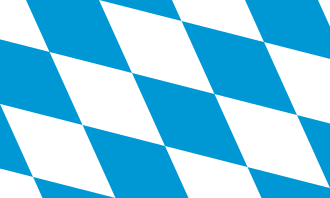
To mark the unification of Bavaria and the Electoral Palatinate, both being principal Wittelsbach territories, Elector Maximilian IV Joseph was crowned king of Bavaria. King Maximilian Joseph was quick to change the coat of arms. The various heraldic symbols were replaced and a classical Wittelsbach pattern introduced. The white and blue lozenges symbolized the unity of the territories within the Bavarian kingdom.

The new state also comprised the Duchy of Jülich and Berg as these on their part were in personal union with the Palatinate.

Bavaria
Tk at German Wikipedia · CC BY-SA 3.0 via Wikimedia Commons

Kingdom of Bavaria

When the Holy Roman Empire dissolved under Napoleon's onslaught, Bavaria became a kingdom in 1806 and joined the Confederation of the Rhine.

The Duchy of Jülich was ceded to France and the Electoral Palatinate was divided between France and the Grand Duchy of Baden. The Duchy of Berg was given to Joachim Murat. The County of Tyrol and the federal state of Salzburg were temporarily annexed with Bavaria but eventually ceded to Austria at the Congress of Vienna. In return, Bavaria was allowed to annex the modern-day region of Palatinate to the west of the Rhine and Franconia in 1815.

Between 1799 and 1817, the leading minister, Count Montgelas, followed a strict policy of modernization copying Napoleonic France; he laid the foundations of centralized administrative structures that survived the monarchy and, in part, have retained core validity through to the 21st century. In May 1808, a first constitution was passed by Maximilian I, being modernized in 1818. This second version established a bicameral Parliament with a House of Lords (Kammer der Reichsräte) and a House of Commons (Kammer der Abgeordneten). That constitution was followed until the collapse of the monarchy at the end of World War I.

After the rise of Prussia in the early 18th century, Bavaria preserved its independence by playing off the rivalry of Prussia and Austria. Allied to Austria, it was defeated along with Austria in the 1866 Austro-Prussian War and was not incorporated into the North German Confederation of 1867, but the question of German unity was still alive. When France declared war on Prussia in 1870, all the south German states (Baden, Württemberg, Hessen-Darmstadt and Bavaria) aside from Austria joined the Prussian forces and ultimately joined the Federation, which was renamed Deutsches Reich (German Empire) in 1871.

Bavaria continued as a monarchy, and retained some special rights within the federation (such as railways and postal services and control of its army in peace times).

Part of the German Empire

When Bavaria became part of the newly formed German Empire, this action was considered controversial by Bavarian nationalists who had wanted to retain independence from the rest of Germany, as had Austria.

As Bavaria had a heavily Catholic majority population, many people resented being ruled by the mostly Protestant northerners in Prussia. As a direct result of the Bavarian-Prussian feud, political parties formed to encourage Bavaria to break away and regain its independence.

In the early 20th century, Wassily Kandinsky, Paul Klee, Henrik Ibsen, and other artists were drawn to Bavaria, especially to the Schwabing district in Munich, a center of international artistic activity at the time.

Free State of Bavaria

World War I led to the abolition of the monarchy all over Germany in 1918. The Bavarian monarchy was the first to fall when on 8 November 1918 Socialist politician Kurt Eisner proclaimed the People's State of Bavaria. Eisner headed a new, republican government as minister-president. On 12 November, King Ludwig III signed the Anif declaration, releasing both civil and military officers from their oaths, which the Eisner government interpreted as an abdication.

After losing the January 1919 elections, Eisner was assassinated in February 1919, ultimately leading to a Communist revolt and the short-lived Bavarian Soviet Republic being proclaimed 6 April 1919. After violent suppression by elements of the German Army and notably the Freikorps, the Bavarian Soviet Republic fell in May 1919. The Bamberg Constitution (Bamberger Verfassung) was enacted on 12 or 14 August 1919 and came into force on 15 September 1919, placing the Free State of Bavaria inside the Weimar Republic.

Extremist activity further increased, notably the 1923 Beer Hall Putsch led by the Nazis, and Munich and Nuremberg became seen as strongholds of Nazism during the Weimar Republic and Nazi dictatorship. In the crucial German federal election, March 1933, the Nazis received around 43% of the votes cast in Bavaria.

As a manufacturing centre, Munich was heavily bombed during World War II and was occupied by United States Armed Forces, becoming a major part of the American Zone of Allied-occupied Germany, which lasted from 1945 to 1947, and then of Bizone.

The Rhenish Palatinate was detached from Bavaria in 1946 and made part of the new state Rhineland-Palatinate. In 1949, Bavaria became part of the Federal Republic of Germany, despite the Bavarian Parliament voting against adopting the Basic Law of Germany, mainly because it was seen as not granting sufficient powers to the individual states (Länder), but at the same time declared that it would accept it if two-thirds of the other Länder ratified it. All of the other states ratified it, so it became law. Thus, during the Cold War, Bavaria was part of West Germany.

Bavarian identity

Bavarians have often emphasized a separate national identity and considered themselves as "Bavarians" first, "Germans" second. In the 19th-century sense, an independent Kingdom of Bavaria existed from only 1806 to 1871. A separate Bavarian identity was emphasized more strongly when Bavaria joined the Prussia-dominated German Empire in 1871, while the Bavarian nationalists wanted to keep Bavaria as Catholic and an independent state. Aside from the minority Bavaria Party, most Bavarians now accept Bavaria as part of Germany.

Another consideration is that Bavaria is not culturally uniform. While inhabitants of Altbayern ("Old Bavaria"), the regions forming the historic Bavaria before further acquisitions in 1806–1815, speak a Bavarian dialect of German, Franconia in the north and Bavarian Swabia in the southwest have a distinct culture including different dialects of German, East Franconian and Swabian, respectively.

Flags and coat of arms

Flags

Uniquely among German states, Bavaria has two official flags of equal status, one with a white and blue stripe, the other with white and blue diamond-shaped lozenges. Either may be used by civilians and government offices, who are free to choose between them. Unofficial versions of the flag, especially a lozenge style with coat of arms, are sometimes used by civilians.

Coat of arms

Bavaria has two official designs for its coat of arms; they are referred to as the "greater" (German: das große) coat of arms and the "lesser" (German: das kleine) coat of arms. Both were formally adopted by the Bavarian State Parliament on 5 June 1950.

Munich artist Eduard Ege designed the greater Bavarian coat of arms in 1946. He primarily based his design on the royal coat of arms of Ludwig I. His design includes several heraldic elements of historical significance for Bavaria.

The Golden Lion: At the dexter chief, sable, a lion rampant Or, armed and langued gules. This represents the administrative region of Upper Palatinate.

The "Franconian Rake": At the sinister chief, per fess dancetty, gules, and argent. This represents the administrative regions of Upper, Middle and Lower Franconia.

The Blue "Pantier" (mythical creature from French heraldry, sporting a flame instead of a tongue): At the dexter base, argent, a Pantier rampant azure, armed Or and langued gules. This represents the regions of Lower and Upper Bavaria.

The Three Lions: At the sinister base, Or, three lions passant guardant sable, armed and langued gules. This represents Swabia.

The White-And-Blue inescutcheon: The inescutcheon of white and blue fusils askance was originally the coat of arms of the Counts of Bogen, adopted in 1247 by the House of Wittelsbach. The white-and-blue fusils are indisputably the emblem of Bavaria and these arms today symbolize Bavaria as a whole. Along with the People's Crown, it is officially used as the Minor Coat of Arms.

The People's Crown (Volkskrone): The coat of arms is surmounted by a crown with a golden band inset with precious stones and decorated with five ornamental leaves. This crown first appeared in the coat of arms to symbolize sovereignty of the people after the royal crown was eschewed in 1923.

Geography

Bavaria shares international borders with Austria (Salzburg, Tyrol, Upper Austria and Vorarlberg) and the Czech Republic (Karlovy Vary, Plzeň and South Bohemian Regions), as well as with Switzerland (across Lake Constance to the Canton of St. Gallen).

Neighboring states within Germany are Baden-Württemberg, Hesse, Thuringia, and Saxony. Two major rivers flow through the state: the Danube (Donau) and the Main. The Bavarian Forest and the Bohemian Forest form the vast majority of the frontier with the Czech Republic and Bohemia.

The geographic center of the European Union is located in the northwestern corner of Bavaria.

Climate

At lower elevations the climate is classified according to Köppen's guide as "Cfb" or "Dfb". At higher altitudes the climate becomes "Dfc" and "ET".

The summer months have been getting hotter in recent years. For example, June 2019 was the warmest June in Bavaria since weather observations have been recorded and the winter 2019/2020 was 3 degrees Celsius warmer than the average temperature for many years all over Bavaria. On 20 December 2019 a record temperature of 20.2 °C (68.4 °F) was recorded in Piding. In general winter months are seeing more precipitation which is taking the form of rain more often than that of snow compared to the past. Extreme weather like the 2013 European floods or the 2019 European heavy snowfalls is occurring more and more often. One effect of the continuing warming is the melting of almost all Bavarian Alpine glaciers: Of the five glaciers of Bavaria only the Höllentalferner is predicted to exist over a longer time perspective. The Südliche Schneeferner has almost vanished since the 1980s.