
The Battle of Sarikamish was an engagement between the Russian and Ottoman Empires during World War I. It took place from 22 December 1914, to 17 January 1915, as part of the Caucasus campaign.
The battle resulted in a decisive Russian victory. The Ottoman plan relied on highly mobile troops capable of reaching specific objectives at precise times, drawing on German and Napoleonic tactical principles. However, the Ottoman forces were inadequately equipped for the harsh winter conditions and suffered severe losses in the Allahuekber Mountains. It is estimated that approximately 25,000 Ottoman soldiers froze to death before the main engagement began.
Following the defeat, Ottoman Minister of War Enver Pasha, who had devised the strategy at Sarikamish, blamed the Armenians for the outcome. The battle subsequently became a prelude to the Armenian genocide.

Some sources regard the battle as one of the most significant of the campaign, noting that the Ottoman Third Army was so severely weakened that it was forced to suspend operations temporarily.
Background
Russia regarded the Caucasus Front as secondary to the Eastern Front, which received the majority of Russian resources. Russia had captured the fortress of Kars from the Ottoman Empire during the Russo-Turkish War in 1877, subsequently incorporating it into the militarily administered Kars Oblast. After the Ottoman Empire entered World War I in October 1914 on the side of the Central Powers, Russia feared a Caucasus campaign aimed at retaking Kars and the port of Batum.
From the perspective of the Central Powers, a campaign in the Caucasus would serve to divert Russian forces. The immediate strategic objective of the Ottoman Caucasus campaign was to recapture Artvin, Ardahan, Kars, and Batum. In the longer term, the Ottoman Minister of War, İsmail Enver, hoped that a successful offensive would open a route to Tbilisi and beyond, potentially provoking a revolt among Muslims in the Caucasus. Another strategic goal was to cut Russian access to hydrocarbon resources around the Caspian Sea.

Prelude
The headquarters of the Ottoman Third Army was located in Erzurum, under the command of Hasan Izzet Pasha. On 30 October 1914, the Third Army headquarters was informed by the High Command in Constantinople about the Ottoman Navy's bombardment of the Russian ports of Novorossiysk, Odessa, and Sevastopol in the Black Sea. The High Command expected the Russian Army to cross the Ottoman border at any time. The Bergmann Offensive (2 November 1914 – 16 November 1914) ended with the defeat of Russian forces under General Bergmann.
After a partial victory in the Bergmann Offensive, the Ottomans reinforced their Caucasian Third Army (50,000 soldiers) with the Tenth Corps (40,000 fresh troops). They correctly assessed that the Russian Caucasian Army did not receive significant reinforcements, apart from the Plastun brigades (11 battalions) and the 2nd Turkestan Corps (21 infantry battalions of 700 soldiers each, and 12 cavalry squadrons of 130 cavalry each). Before planning the Sarikamish Offensive, the chief of staff of the Ninth Corps, Şerif İlden, estimated the Russian strength at 60,000 soldiers, in line with the figure of 64,000 provided by Paul Muratoff.
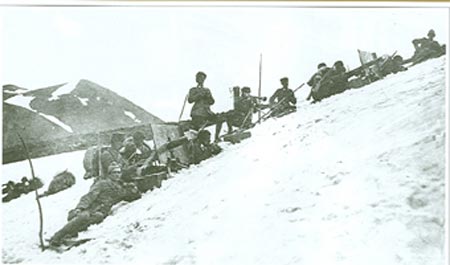
The Ninth and Tenth Corps of the Ottoman Third Army consisted of well-trained soldiers; however, the army was poorly equipped for winter conditions. Ottoman sources record extremely high casualties from frostbite, though specific figures are not given. A significant portion of the 50,000–60,000 non-combat losses suffered by the Ottomans was due to frostbite and a typhus epidemic. In comparison, the Russians lost approximately 6,000 soldiers to frostbite and a further 12,000 to typhus, combat wounds, and other illnesses. Another factor contributing to the high Ottoman non-combat losses was inadequate logistics, rear services, and sanitary measures.
The Ottoman Minister of War, Ismail Enver Pasha, devised an operational plan while at the Department of War in Istanbul. His strategy was based on German principles derived from Napoleonic tactics. The plan involved a single envelopment maneuver using three corps. On the flank, the XI Corps was to fix Russian forces in place and conduct diversionary attacks. On the left, the X Corps (40,000 soldiers) under Colonel Hafız Hakkı and the IX Corps (28,000 soldiers) under Brigadier Ali İhsan Pasha would advance toward Kötek (30 km southwest of Sarikamish), 15 km northeast of the main Russian Army (estimated at 50,000 soldiers), and drive the Russians into the Aras Valley, where they would be destroyed by a coordinated attack from all three corps.
Initially, Hasan İzzet Pasha supported the outflanking maneuver and offensive, influenced by his trust in Enver Pasha. He finalized the details of the plan. On 17 December, Enver Pasha returned to Erzurum after inspecting the army and finding that Hasan İzzet Pasha had accepted the plan. In the presence of other officers, Enver Pasha told Hasan İzzet Pasha: "I am going to Erzurum. Either I will return to Istanbul from there, or I will watch your actions as a spectator."
However, on 18 December, Hasan İzzet Pasha telegraphed Enver Pasha:

IX Corps, X Corps' pioneers would arrive on the Kötek-Kars road in eight to nine days, meanwhile it is doubtful that the XI Corps, left alone, would not be crushed. When the pioneers come out of the great mountains, they will be in a difficult position against the enemy, who are not less than themselves. I see the outcome of this offensive field battle as doubtful according to our preparation. In case of failure, the long expedition will turn against us. Let's not give a pitched battle and be content with expelling the enemy in Id (Narman). For the future, hope is left for attack and invasion...
There is no record of Enver Pasha's immediate response to this message. Later on 18 December, Hasan İzzet Pasha telegraphed again:
I ask for forgiveness from my duty as I do not see the strength and confidence in myself to carry out these movements, and I am actually disturbed by an extraordinary nervousness.

Enver Pasha returned to Köprüköy in an attempt to persuade Hasan İzzet Pasha. When he failed to do so, Enver Pasha temporarily assumed direct command of the Third Army. His chief of staff, Bronsart von Schellendorf, and the head of the operations department, Major Otto von Feldmann (Turkish: Harekat Şubesi Müdürü), continued to serve under his leadership.
Battle
Battlefield
The war zone stretched approximately 1,250–1,500 kilometers (780–930 miles) from the Black Sea to Lake Van, making concentration of forces challenging. Operations were conducted on a plateau averaging 1,500–2,000 meters (4,900–6,600 ft) above sea level. The primary difficulty for the Ottomans was the poor state of the roads and inadequate transportation infrastructure. In contrast, Russia's main advantage was the Kars Gyumri Akhalkalaki railway line with a terminal at Sarikamish, located just 24 kilometres (15 mi) from the border.
The only viable routes through the Caucasian heights were high mountain passes near the cities of Kars and Sarikamish. Beyond these lay the upper valleys of the Aras and Euphrates rivers, extending westward. Elsewhere, roads were merely tracks, impassable to artillery. Forces were concentrated about 80 kilometres (50 mi) on either side of the border, with Kars serving as the main Russian fortress and Erzurum as the Ottoman counterpart.

The Ottoman Third Army, under Enver Pasha, comprised the IX, X, and XI Corps. A detachment (one infantry regiment and Special Organization (Teşkilat-ı Mahsusa) volunteers) known as Ştanke Bey Müfrezesi, commanded by German Lieutenant Colonel Stange, was sent to Artvin to reinforce the offensive and pin down Russian forces. The total fighting power included 90,000 regular troops, with the Russian Sarikamish detachment consisting of 60,000 infantry, 4,000 cavalry (Cossacks), and 14,000 reserves, totalling approximately 78,000 soldiers. Including reserves and personnel from the Erzurum Fortress, total Ottoman manpower reached 118,000, while overall numbers, including transportation units, depot regiments, and military police, reached about 200,000. The Ottomans had 73 machine guns and 218 artillery pieces, a figure comparable to the Russian artillery strength.)
Ottoman forces were inadequately prepared for winter conditions. The IX and X Corps began their long march without winter clothing and carried only dry bread and olives as rations. The XI Corps, positioned at the front, was in a similar situation.
On the Russian side, the 2nd and 3rd Caucasian Corps and the 1st Turkestan Corps had been sent to the Western Front, leaving the following composition in the Caucasus:
1st Caucasian Corps: 32 battalions
2nd Turkestan Corps: 21 battalions
Three Plastun brigades: 18 battalions
66th Division: 16 battalions
Various independent detachments
At the start of the war, the Russian forces included 100 infantry battalions (about 100,000 infantry), 117 cavalry companies (approximately 15,000 cavalry), and 256 artillery pieces:
(a) Erzurum–Kars sector:
39th Infantry Division (16 battalions, 48 guns)
One brigade of the 20th Infantry Division (24 battalions, each with 1,250–1,300 soldiers)
1st Caucasian Cossack Division
One brigade of the 1st Plastun Brigade (6 battalions, each with 600–800 soldiers)
Total: 29 battalions, 30 sotni (Cossack cavalry companies), and 96 guns
The 2nd Turkestan Corps (21 battalions, 42 guns) joined the battlefield on 16 November.
(b) Erzurum–Oltu sector:
One brigade of the 20th Infantry Division
One Cossack regiment (6 sotni)
Total: 8 battalions, 6 sotni, and 24 guns
(c) Erevan–Bayazit sector:
One brigade of the 66th Division (8 battalions)
2nd Kuban Plastun Brigade (6 battalions)
2nd Caucasian Cossack Division
Transcaspian Cossack Brigade
Total: 14 battalions, 36 sotni, and 52 guns
(d) Batum region:
264th Infantry Regiment (of the 66th Division)
One battalion from the 1st Kuban Plastun Brigade (6 battalions)
Total: 5 battalions with 8 guns, plus additional battalions from Frontier Guards.
(e) Persian Azerbaijan detachment:
2nd Caucasian Rifle Brigade
4th Caucasian Cossack Division
Total: 8 battalions, 24 sotni, and 24 guns, under General Chernozubov.
The garrison at Kars included the 263rd Infantry Regiment (of the 66th Division), with 4 battalions.
During the Battle of Sarikamish, the Russian Caucasian Army was reinforced by Armenian and Georgian volunteers, as well as the newly formed 3rd Caucasian Rifle Brigade (8 battalions), bringing its total strength to around 130,000 soldiers. During the earlier Bergmann Offensive, the Russian Army had suffered approximately 7,000 casualties.
In the Sarikamish campaign, the Russian Army fighting the Ottoman Third Army consisted of 30 battalions of the 1st Caucasian Corps, 21 battalions of the 2nd Turkestan Corps, and 11 Plastun battalions, totaling 58,000 infantry and 4,000 cavalry. Additionally, there were 4 battalions of the 66th Division in Kars, the 3rd Caucasian Rifle Brigade (8 battalions), and the Siberian Cossack Brigade (12 sotni) in Tbilisi, totaling an additional 14,000 soldiers brought as reinforcements.
Apart from these, there were 12 Russian battalions in Batumi and surrounding areas, 8 battalions and 30 cavalry companies in Ağrı, and 8 battalions and 24 cavalry companies in Iranian Azerbaijan; these units did not participate in the Battle of Sarikamish.