
The Battle of Borodino or the Battle of Moscow took place on the outskirts of Moscow near the village of Borodino on 7 September 1812, during Napoleon's invasion of Russia. The Grande Armée fought against the Imperial Russian Army.
After the Russian retreat at the Battle of Smolensk, the road to Moscow lay open. Napoleon fought against General Mikhail Kutuzov, whom the Emperor Alexander I had appointed to replace Barclay de Tolly on 29 August after Smolensk was razed and captured by the French and Polish forces. Approximately a quarter of a million soldiers were involved in the battle, and it was the bloodiest single day of the Napoleonic Wars. In the battle, up to 50 French generals and marshals were killed or wounded, as well as 29 Russian generals; hence Sir Robert Wilson referred to it as the Battle of the Generals.
After the Battle of Borodino, Napoleon remained on the battlefield with his army; the Imperial Russian forces retreated southwards. What followed was the French occupation of Moscow, while the retreating Russians resorted to scorched earth tactics to trap Napoleon and his men within their own largest city. The main results of the battle were that Napoleon managed to take the Russian strong but unfinished defensive positions: the redoubt and the flèches, though he was unable to end the war as he hoped. In particular, Napoleon's reluctance to deploy his Imperial Guard, as he wished to negotiate with Alexander to make him re-join against the British, has been widely criticized by historians as a large blunder, as it allowed the Russian army to retreat into territory increasingly hostile to the French.

Background
Napoleon's invasion of Russia
Napoleon with the French Grande Armée began his invasion of Russia on 24 June 1812 by crossing the Niemen river.
As his Russian army was outnumbered by far, Mikhail Bogdanovich Barclay de Tolly successfully used a "delaying operation", defined as an operation where a force under pressure trades space for time by slowing down the enemy's momentum and inflicting maximum damage on the enemy without, in principle, becoming decisively engaged, using a Fabian strategy as a defence in depth by retreating further eastwards into Russia without giving battle.
After the Battle of Smolensk, the Tsar replaced the unpopular Barclay de Tolly with Mikhail Kutuzov, who on 18 August took over the army at Tsaryovo-Zaymishche and ordered his soldiers to prepare for battle. Kutuzov understood Barclay's decision to retreat was correct, but the Tsar, the Russian troops and Russia could not accept further retreat. A battle had to occur in order to preserve the morale of the soldiers and the nation. He then ordered not another retreat, but a search for a battleground eastwards at Gzhatsk on 30 August, thus using Barclay's delaying operation again, by which time the ratio of French to Russian forces had shrunk from 3:1 to 5:4. The main part of Napoleon's army had entered Russia with 286,000 soldiers, but by the time of the battle was reduced mostly through starvation and disease.
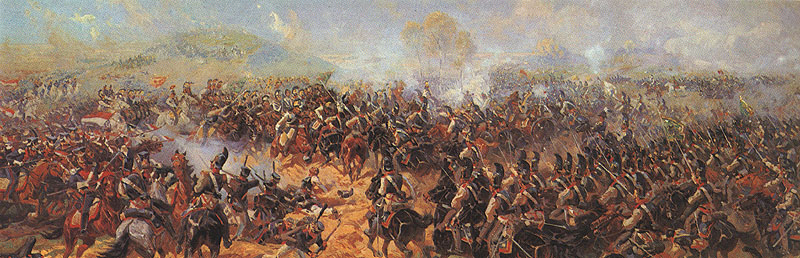
Kutuzov's army established a defensive line near the village of Borodino. Although the Borodino field was too open and had too few natural obstacles to protect the Russian center and the left flank, it was chosen because it blocked both Smolensk–Moscow roads and because there were simply no better locations. Starting on 3 September, Kutuzov strengthened the line with earthworks, including the Raevsky redoubt (named after Nikolay Raevsky who was in charge of its defence) in the center-right of the line, and three open, arrow-shaped "Bagration flèches" (named after Pyotr Bagration) on the left.
Battle of Shevardino
The initial Russian position, which stretched south of the new Smolensk Highway (Napoleon's expected route of advance), was anchored on its left by a pentagonal earthwork redoubt erected on a mound near the village of Shevardino. The Russian generals soon realized their left wing was overly exposed and vulnerable, so the Russian line was moved back from this position, but the redoubt remained manned, with Kutuzov stating the fortification was manned simply to delay the advance of the French forces. Historian Dmitry Buturlin reports it was used as an observation point to determine the course of the French advance. Historians Witner and Ratch, and many others, reported it was used as a fortification to threaten the French right flank, despite being beyond the effective reach of guns of the period.
The Chief of Staff of the Russian 1st Army, Aleksey Yermolov, said the Russian left was shifting positions when the French Army arrived sooner than expected; thus, the Battle of Shevardino became a delaying effort to shield the redeployment of the Russian left. The construction of the redoubt and its purpose is disputed by historians to this day.
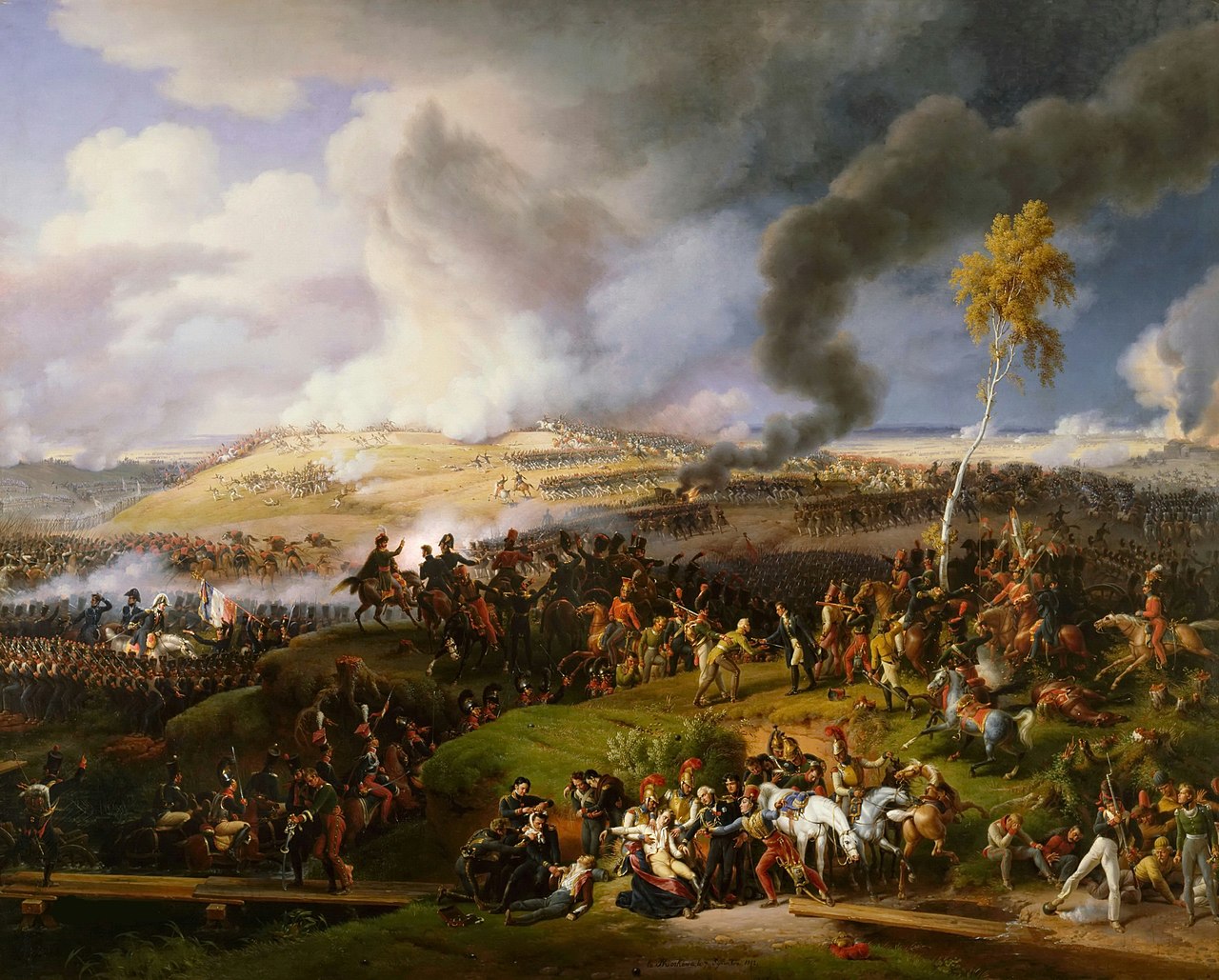
The conflict began on September 5 when Marshal Joachim Murat's French forces met Pyotr Konovnitsyn's Russians in a massive cavalry clash, the Russians eventually retreating to the Kolorzkoi Cloister when their flank was threatened. Combat resumed the next day but Konovnitsyn again retreated when Viceroy Eugène de Beauharnais' Fourth Corps arrived, threatening his flank. The Russians withdrew to the Shevardino Redoubt, where a pitched battle ensued. Murat led Nansouty's First Cavalry Corps and Montbrun's Second Cavalry Corps, supported by Compans's Division of Davout's First Infantry Corps against the redoubt. Simultaneously, Prince Józef Poniatowski's Polish infantry attacked the position from the south. The fighting was heavy and very fierce, as the Russians refused to retreat until Kutuzov personally ordered them to do so. The French captured the redoubt at the cost of 4,000–5,000 French and 6,000 Russian casualties. The small redoubt was destroyed and covered by the dead and dying of both sides.
The unexpected French advance from the west and the fall of the Shevardino redoubt threw the Russian formation into disarray. Since the left flank of their defensive position had collapsed, Russian forces withdrew to the east, constructing a makeshift position centered around the village of Utitsa. The left flank of the Russian position was thus ripe for a flanking attack.
Opposing forces
Russian forces
A series of reforms to the Russian army had begun in 1802, creating regiments of three battalions, each battalion having four companies. The defeats of Austerlitz, Eylau and Friedland led to important additional reforms, though continuous fighting in the course of three wars with France, two with Sweden and two with the Ottoman Empire had not allowed time for these to be fully implemented and absorbed. A divisional system was introduced in 1806, and corps were established in 1812. Prussian influence may be seen in the organizational setup. By the time of Borodino the Russian army had changed greatly from the force which met the French in 1805–1807.
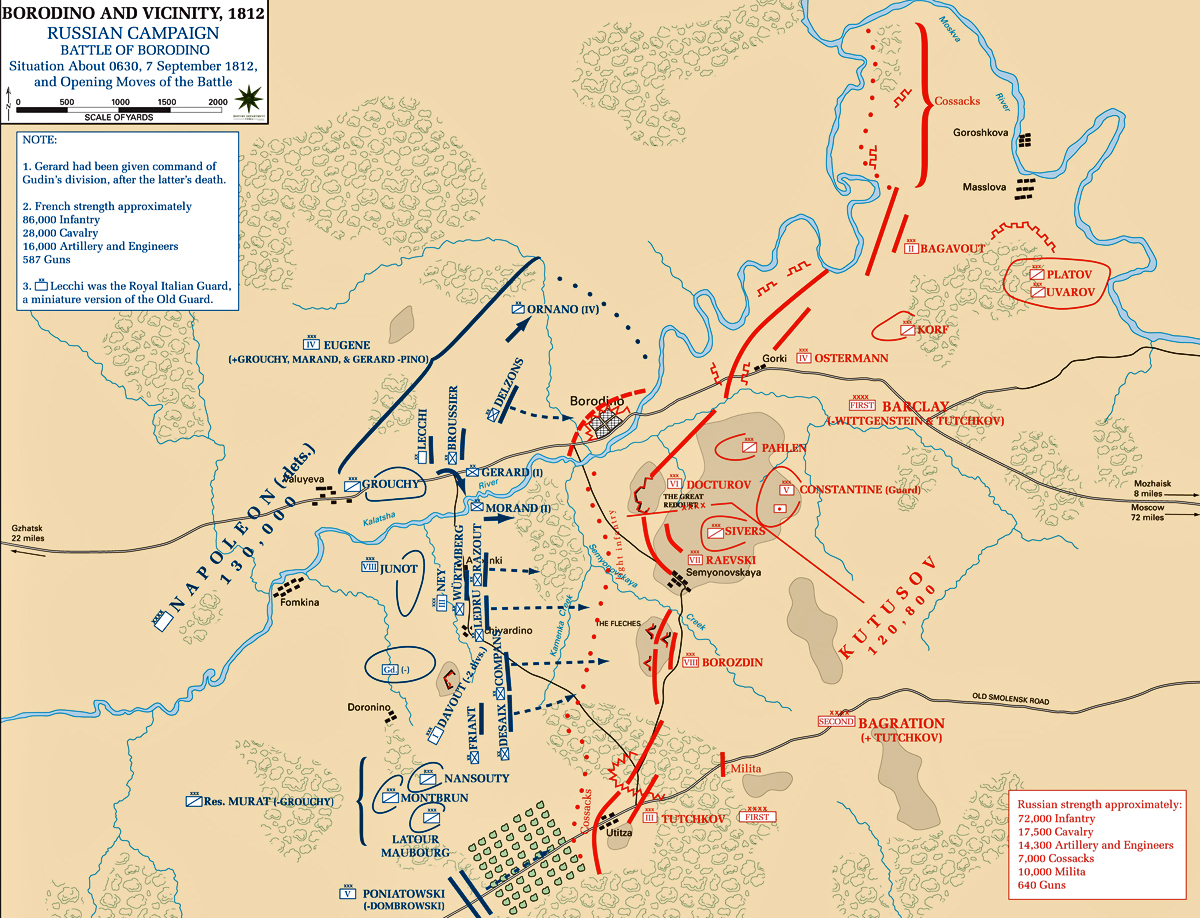
Russian forces present at the battle included 180 infantry battalions, 164 cavalry squadrons, 20 Cossack regiments and 55 artillery batteries (637 artillery pieces). In total, the Russians fielded 155,200 troops. There were 10,000 Cossacks and 33,000 Russian militiamen in the area who did not participate in the battle; for a total of 43,000 irregulars. After the battle the militia units were broken up to provide reinforcements for depleted regular infantry battalions. Of the 637 Russian artillery pieces, 300 were held in reserve and many of these were never committed to the battle.
French forces
According to historian Alexander Mikaberidze, the French army remained the finest army of its day by a good margin. The vast French military resources in manpower, horsepower, and firepower along with fusion of the Ancien Régime's legacy with the formations of the French revolution and Napoleon's reforms transformed it into a military machine that had dominated Europe by 1799. Each corps of the French army was in fact its own mini-army capable of independent action. Despite being the finest army of its day in 1812, the French military was in decline since the Battle of Austerlitz due to spending military resources in the Peninsular War, and losing many French veterans in battles like Eylau, Aspern, and Wagram.
French forces included 214 battalions of infantry, 317 squadrons of cavalry and 587 artillery pieces totaling 128,000 troops. However, the French Imperial Guard, which consisted of 30 infantry battalions, 27 cavalry squadrons and 109 artillery pieces – a total of 18,500 troops – never committed to action.

Battle
Position
According to Carl von Clausewitz, although the Russian left was on marginally higher ground, this was but a superficial matter and did not provide much of a defensive advantage. The positioning of the Russian right was such that for the French the left seemed an obvious choice. The Russian position at Borodino consisted of a series of disconnected earthworks running in an arc from the Moskva River on the right, along its tributary, the Kolocha (whose steep banks added to the defense), and towards the village of Utitsa on the left. Thick woods interspersed along the Russian left and center (on the French side of the Kolocha) made the deployment and control of French forces difficult, aiding the defenders. The Russian center was defended by the Raevsky Redoubt, a massive open-backed earthwork mounting nineteen 12-pounder cannons with a clear field of fire all the way to the Kolocha's banks.
Kutuzov was very concerned the French might take the New Smolensk Road around his positions and on to Moscow, so he placed the more powerful 1st Army under Barclay on the right, in positions which were already strong and virtually unassailable by the French. The 2nd Army under Bagration was expected to hold the left. The fall of Shevardino unanchored the Russian left flank but Kutuzov did nothing to change these initial dispositions despite the repeated pleas of his generals to redeploy their forces.
Thus, when the action began and became a defensive rather than an offensive battle for the Russians, their heavy preponderance in artillery was wasted on a right wing that would never be attacked, while the French artillery did much to help win the battle. Colonel Karl Wilhelm von Toll and others would make attempts to cover up their mistakes in this deployment and later attempts by historians would compound the issue. Indeed, Clausewitz also complained about Toll's dispositions being so narrow and deep that needless losses were incurred from artillery fire. The Russian position therefore was just about 8 kilometres (5 mi) long with about 80,000 of the 1st Army on the right and 34,000 of the 2nd Army on the left.
Bagration's flèches
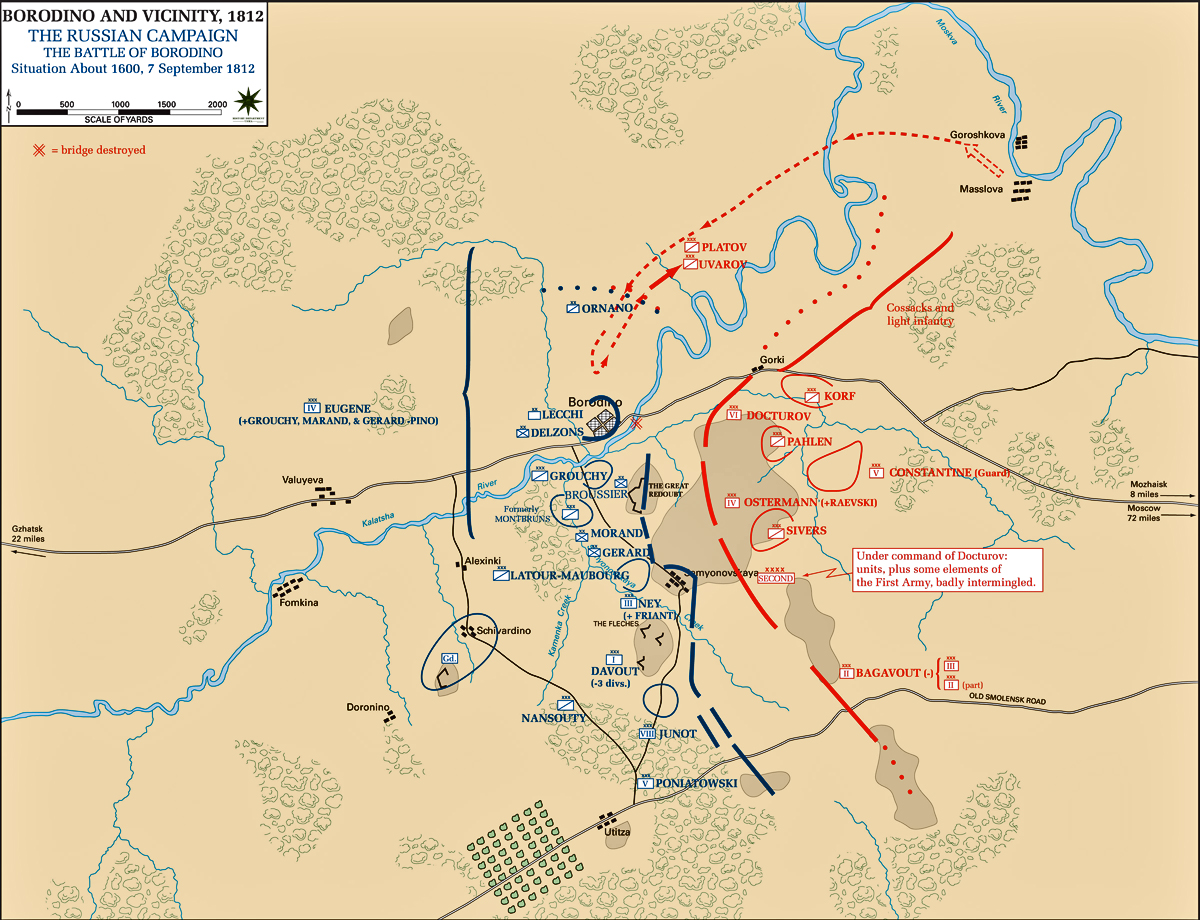
The first area of operations was on the Bagration flèches, as was predicted by both Barclay de Tolly and Bagration. Napoleon, commanding the French forces, made errors similar to his Russian adversary, deploying his forces inefficiently and failing to exploit the weaknesses in the Russian line. Despite Marshal Davout's suggestion of a maneuver to outflank the weak Russian left, the Emperor instead ordered Davout's First Corps to move directly into the teeth of the defense, while the flanking maneuver was left to the weak Fifth Corps of Prince Poniatowski.
The initial French attack was aimed at seizing three Russian positions collectively known as the Bagration flèches, three arrowhead-shaped, open-backed earthworks which arced out to the left en échelon in front of the Kolocha stream. These positions helped support the Russian left, which had no terrain advantages. There was much to be desired in the construction of the flèches, one officer noting the ditches were much too shallow, the embrasures open to the ground, making them easy to enter, and they were much too wide, exposing infantry inside them. The flèches were supported by artillery from the village of Semyanovskaya, whose elevation dominated the other side of the Kolocha.
The battle began at 06:00 with the opening of the 102-gun French grand battery against the Russian center. Davout sent Compans's Division against the southernmost of the flèches, with Dessaix's Division echeloned out to the left. They were opposed by Vorontsov's and Neverovsky's divisions. When Compans exited the woods on the far bank of the Kolocha, he was hit by massed Russian cannon fire; both Compans and Dessaix were wounded, but the French continued their assault. Davout, seeing the confusion, personally led the 57th Line Regiment (Le Terrible) forward until he had his horse shot from under him; he fell so hard General Jean-Barthélemot Sorbier reported him dead. General Jean Rapp arrived to replace him, only to find Davout alive and leading the 57th forward again. Rapp then led the 61st Line Regiment forward when he was wounded (for the 22nd time in his career).
By 07:30, Davout had gained control of the three flèches. Prince Bagration quickly led a counterattack that threw the French out of the positions, only to have Marshal Michel Ney lead a charge by the 24th Regiment that retook them. Although not enamoured of Barclay, Bagration turned to him for aid, ignoring Kutuzov altogether; Barclay, to his credit, responded quickly, sending three guard regiments, eight grenadier battalions and twenty-four 12-pounder cannons at their best pace to bolster Semyаnovskaya. Colonel Toll and Kutuzov moved the Guard Reserve units forward as early as 09:00.
During the confused fighting, French and Russian units moved forward into impenetrable smoke and were smashed by artillery and musketry fire horrendous even by Napoleonic standards. Infantry and cavalry had difficulty maneuvering over the heaps of corpses and masses of wounded. Murat advanced with his cavalry around the flèches to attack Bagration's infantry, but was confronted by General Duka's 2nd Cuirassier Division supported by Neverovsky's infantry. The French carried out seven assaults against the flèches and each time were beaten back in fierce close combat. Bagration in some instances was personally leading counterattacks, and in a final attempt to push the French completely back he got hit in the leg by cannonball splinters somewhere around 11:00. He insisted on staying on the field to observe Duka's decisive cavalry attack.
This counter-punch drove Murat to seek the cover of allied Württemberger infantry. Barclay's reinforcements, however, were sent into the fray only to be torn to pieces by French artillery, leaving Friant's Division in control of the Russian forward position at 11:30. Dust, smoke, and exhaustion all combined kept the French commanders (Davout, Ney and Murat) from comprehending that the Russians had fallen back and vulnerable for a French attack. The 2nd Army's command structure fell apart as Bagration was removed from the battlefield, and the report of his being hit quickly spread and led to a collapse in morale. General Dmitry Dokhturov took over command in the center instead of Bagration. Napoleon, who was sick with a cold and too far from the action to really observe what was going on, refused to reinforce his subordinates. He was hesitant to release his last reserve, the Imperial Guard, in a location so far away from France.
First attacks on the Raevsky redoubt
Beauharnais advanced his corps against Borodino, rushing the village and capturing it from the Russian Guard Jägers. However, the advancing columns rapidly lost their cohesion; shortly after clearing Borodino, they faced fresh Russian assault columns and retreated to the village. General Delzons was posted to Borodino to prevent the Russians retaking it. Morand's division then crossed to the north side of the Semyenovka stream, while the remainder of Beauharnais' forces traversed three bridges across the Kolocha to the south, placing them on the same side of the stream as the Russians. He then deployed most of his artillery and began to push the Russians back toward the Raevsky redoubt. Broussier and Morand's divisions then advanced together with furious artillery support. The redoubt changed hands as Barclay was forced to personally rally Paskevich's routed regiment.
Kutuzov ordered Yermolov to take action; the general brought forward three horse artillery batteries that began to blast the open-ended redoubt, while the 3rd Battalion of the Ufa Regiment and two Jäger regiments brought up by Barclay rushed in with the bayonet to eliminate Bonnamy's brigade, which broke into the redoubt. The Russian reinforcements' assault returned the redoubt to Russian control.
Beauharnais' artillery continued to pound Russian support columns, while Marshals Ney and Davout set up a crossfire with artillery positioned on the Semyonovskaya heights. Barclay countered by moving the Prussian General Eugen over to the right to support Miloradovich, who led both IV Infantry and II Cavalry corps, in his defense of the redoubt. The French responded to this move by sending forward General Sorbier, the commander of the Imperial Guard artillery. Sorbier brought forth 36 artillery pieces from the Imperial Guard Artillery Park and also took command of 49 horse artillery pieces from Nansouty's Ist Cavalry Corps and La Tour Maubourg's IV Cavalry Corps, as well as Beauharnais' own artillery, opening up a massive artillery barrage.
When Barclay brought up troops against an attacking French brigade, he described it as "a walk into Hell". During the height of the battle, Kutuzov's subordinates were making almost all of the tactical decisions for him; according to Clausewitz, the Russian commander "seemed to be in a trance". Kutuzov ordered Yermolov and Toll to survey the situation of the 2nd Army after the fall of the flèches. Afterwards, he reorganized the entire Russian army with a front facing west, thus abandoning the original idea that the French would outflank his right. With the death of General Kutaisov, the Chief of Artillery, most of the Russian cannons sat useless on the heights to the rear and were never ordered into battle, while the French artillery wreaked havoc on the Russians.
Cossack raid on the northern flank
On the morning of the battle at around 07:30, Don Cossack patrols from Matvei Platov's regiment discovered a ford across the Kolocha river on the extreme Russian right (northern) flank. Seeing the ground in front of them was clear of enemy forces, Platov saw an opportunity to go around the French left flank and into the enemy's rear. He at once sent one of his aides to ask for permission from Kutuzov for such an operation. Platov's aide was lucky enough to encounter Colonel von Toll, an enterprising member of Kutuzov's staff, who suggested General Uvarov's 1st Cavalry Corps be added to the operation and at once volunteered to present the plan to the commander-in-chief.
Together, they went to see Kutuzov, who nonchalantly gave his permission. There was no clear plan and no objectives were drawn up, the whole manoeuvre being interpreted by both Kutuzov and Uvarov as a feint. Uvarov and Platov thus set off with just around 8,000 cavalry and 12 guns in total, and no infantry support. As Uvarov moved southwest and south and Platov moved west, they eventually arrived at the undefended rear of Beauharnais' IV Corps. This was near midday, just as he was getting his orders to conduct another assault on the Raevsky redoubt.
The sudden appearance of masses of enemy cavalry so close to the supply train and the Emperor's headquarters caused panic and consternation, prompting Beauharnais to immediately cancel his attack and pull back his entire Corps westwards to deal with the alarming situation. Meanwhile, the two Russian cavalry commanders tried to break what French infantry they could find in the vicinity. Having no infantry of their own, the poorly coordinated Russian attacks came to nothing.
Unable to achieve much else, Platov and Uvarov moved back to their own lines and the action was perceived as a failure by both Kutuzov and the Russian General Staff (chief – Bennigsen). As it turned out, the action had the utmost importance in the outcome of the battle, as it delayed the attack of the IV Corps on the Raevsky redoubt for a critical two hours. During these two hours, the Russians were able to reassess the situation, realize the terrible state of Bagration's 2nd Army and send reinforcements to the front line. General Alexander Ostermann-Tolstoy and his corps filled the fallen ranks, but suffered heavy cannonfire. Meanwhile, the retreat of Beauharnais' Corps left Montbrun's II French Cavalry Corps to fill the gap under the most murderous fire, which used up and demoralized these cavalry, greatly reducing their combat effectiveness. The delay contradicted a military principle the Emperor had stated many times: "Ground I may recover, time never". The Cossack raid contributed to Napoleon's later decision not to commit his Imperial Guard to battle.
Final attack on Raevsky redoubt
At 14:00, Napoleon renewed the assault against the redoubt, as Broussier's, Morand's and Gérard's divisions launched a massive frontal attack, with Chastel's light cavalry division on their left and the II Reserve Cavalry Corps on their right.
The Russians sent Likhachyov's 24th Division into the battle, who fought bravely under Likhachyov's motto: "Brothers, behind us is Moscow!" But the French troops approached too close for the cannons to fire, and the cannoneers fought a pitched close-order defence against the attackers. General Caulaincourt ordered Watier's cuirassier division to lead the assault. Barclay saw Beauharnais' preparations for the assault and attempted to counter it, moving his forces against them. The French artillery, however, began bombarding the assembling force even as it gathered. Caulaincourt led Watier's cuirassiers in an assault on the opening at the back of the redoubt; he was killed as the charge was beaten off by fierce Russian musketry.
General Thielmann then led eight Saxon and two Polish cavalry squadrons against the rear of the redoubt, while officers and sergeants of his command actually forced their horses through the redoubt's embrasures, sowing confusion amongst the defenders and allowing the French cavalry and infantry to take the position. The battle had all but ended, with both sides so exhausted that only the artillery was still at work. At 15:30, the Raevsky redoubt fell with most of the 24th Division's troops. General Likhachyov was captured by the French. However, the French attempts to break through further were thwarted by the Russian Guard Cavalry, which charged and repelled the French assault. In this assault, cavalry general Grouchy was wounded when his units tried to break through the Russians, whilst Barclay and his retinue took part in the fight and was forced to draw his sword in self-defense.
Utitsa
The third area of operations was around the village of Utitsa. The village was at the southern end of the Russian positions and lay along the old Smolensk road. It was rightly perceived as a potential weak point in the defense as a march along the road could turn the entire position at Borodino. Despite such concerns, the area was a tangle of rough country thickly covered in heavy brush well suited for deploying light infantry. The forest was dense, the ground marshy, and Russian Jaegers were deployed there in some numbers. Russian General Nikolay Tuchkov had some 23,000 troops but half were untrained Opolchenye (militia) armed only with pikes and axes and not ready for deployment.
Poniatowski had about 10,000 soldiers, all trained and eager to fight, but his first attempt did not go well. It was at once realized the massed troops and artillery could not move through the forest against Jaeger opposition, so they had to reverse to Yelnya and then move eastward. Tuchkov had deployed his 1st Grenadier Division in line, backing it with the 3rd division in battalion columns. Some four regiments were called away to help defend the redoubts under attack and another two Jäger regiments were deployed in the Utitsa woods, weakening the position.
The Polish contingent contested control of Utitsa village and mound, capturing them with their first attempt. Tuchkov later ejected the French forces from both by 08:00, and was mortally wounded while leading this counter-attack. General Jean-Andoche Junot led the Westphalians to join the attack and again captured the village, which was set on fire by the Russians. After the village's capture, Russians and Poles continued to skirmish and cannonade for the rest of the day without much progress. The heavy undergrowth greatly hindered Poniatowski's efforts but eventually he came near cutting off the Russian left from the rest of the Russian forces.
General Barclay sent help in the form of Karl Gustav von Baggovut with Pyotr Konovnitsyn in support. The latter asked Kutuzov for reinforcements, but he refused, fearing for the redoubt sector. Baggovut took command of the Russian left flank in place of the wounded Tuchkov. Any hope of real progress by the Poles was lost.
Napoleon's refusal to commit the Guard
Towards 15:00, after hours of resistance, the Russian army was in dire straits, but the French forces were exhausted and had neither the necessary stamina nor will to carry out another assault. Both armies were exhausted after the battle and the Russians withdrew from the field the following day. Borodino represented the last Russian effort at stopping the French advance on Moscow, which fell a week later. At this crucial juncture, Murat's chief of staff, General Augustin Daniel Belliard, rode straight to the Emperor's Headquarters and, according to General Ségur who wrote an account of the campaign, told him the Russian line was breached, the road to Mozhaysk behind the Russian line was visible through the gaping hole the French attack had pierced, an enormous crowd of runaways and vehicles were hastily retreating, and a final push would be enough to decide the fate of the Russian army and the war. Generals Daru, Dumas and Marshal Louis Alexandre Berthier also joined in and told the Emperor everyone thought the time had come for the Guard to be committed to battle.
Given the ferocity of the Russian defense, everyone was aware such a move would cost the lives of thousands of Guards, but it was thought the presence of this prestigious unit would bolster the morale of the entire army for a final decisive push. A notable exception was Marshal Bessières, commander of the Guard cavalry, who was one of the very few senior generals to strongly advise against the intervention of the Guard. As the general staff were discussing the matter, General Rapp, a senior aide-de-camp to the Emperor, was being brought from the field of battle, having been wounded in action.
Rapp immediately recommended to the Emperor the Guard be deployed for action and the Emperor is said to have retorted: "I will most definitely not; I do not want to have it blown up. I am certain of winning the battle without its intervention." Determined not to commit this valuable final reserve so far away from France, Napoleon rejected another such request, this time from Marshal Ney. Instead, he called the commander of the "Young Guard", Marshal Mortier, and instructed him to guard the field of battle without moving forward or backward, while at the same time unleashing a massive cannonade with his 400 guns.
End of the battle
Napoleon went forward to see the situation from the former Russian front lines shortly after the redoubts were taken. The Russians had moved to the next ridge-line in much disarray; however, this disarray was not clear to the French, with dust and haze obscuring the Russian dispositions. Kutuzov ordered the Russian Guard to hold the line and it did. The compact squares of the Russian formation made for easy artillery targets, though the Russian Guard stood in place from 4 pm to 6 pm, resulting in a large amount of casualties. All he could see were masses of troops in the distance and thus nothing more was attempted. Neither the attack which relied on brute force, nor the refusal to use the Guard to finish the day's work, showed any brilliance on Napoleon's part.
Clausewitz and Alexander I of Russia both noted the poor positioning of the Russian troops particularly hobbled the defense. Barclay communicated with Kutuzov to receive further instructions. According to Ludwig von Wolzogen (in an account dripping with sarcasm), the commander was found a half-hour away on the road to Moscow, encamped with an entourage of young nobles and grandly pronouncing he would drive Napoleon off the next day.
Despite his bluster, Kutuzov knew from dispatches his army was too badly mauled to fight a continuing action the following day. He knew exactly what he was doing: by fighting the pitched battle, he could now retreat with the Russian army still intact, lead its recovery, and force the weakened French forces to move even further from their bases of supply. The dénouement became a textbook example of what a hold logistics had upon an army far from its center of supply. On September 8, the Russian army moved away from the battlefield in twin columns, allowing Napoleon to occupy Moscow and await for five weeks a Russian surrender that would never come.