
An observatory is a location used for observing terrestrial, marine, or celestial events. Astronomy, climatology/meteorology, geophysics, oceanography and volcanology are examples of disciplines for which observatories have been constructed.
The term observatoire has been used in French since at least 1976 to denote any institution that compiles and presents data on a particular subject (such as public health observatory) or for a particular geographic area (European Audiovisual Observatory).
Astronomical observatories
Astronomical observatories are mainly divided into four categories according to location: space-based, airborne, ground-based, and underground-based. Historically, ground-based observatories were as simple as containing a mural instrument (for measuring the angle between stars) or Stonehenge (which has some alignments on astronomical phenomena). Astronomical observatories may be private or they may be public.
Ground-based observatories
Ground-based observatories, located on the surface of Earth, are used to make observations in the radio and visible light portions of the electromagnetic spectrum. Most optical telescopes are housed within a dome or similar structure, to protect the delicate instruments from the elements. Telescope domes have a slit or other opening in the roof that can be opened during observing, and closed when the telescope is not in use. In most cases, the entire upper portion of the telescope dome can be rotated to allow the instrument to observe different sections of the night sky. Radio telescopes usually do not have domes.
For optical telescopes, most ground-based observatories are located far from major centers of population, to avoid the effects of light pollution. The ideal locations for modern observatories are sites that have dark skies, a large percentage of clear nights per year, dry air, and are at high elevations. At high elevations, the Earth's atmosphere is thinner, thereby minimizing the effects of atmospheric turbulence and resulting in better astronomical "seeing". Sites that meet the above criteria for modern observatories include the southwestern United States, Hawaii, Canary Islands, the Andes, and high mountains in Mexico such as Sierra Negra. Major optical observatories include Mauna Kea Observatory and Kitt Peak National Observatory in the US, Roque de los Muchachos Observatory in Spain, and Paranal Observatory and Cerro Tololo Inter-American Observatory in Chile.
Specific research study performed in 2009 shows that the best possible location for ground-based observatory on Earth is Ridge A—a place in the central part of Eastern Antarctica. This location provides the least atmospheric disturbances and best visibility.

Solar observatories
Radio observatories
Beginning in 1933, radio telescopes have been built for use in the field of radio astronomy to observe the Universe in the radio portion of the electromagnetic spectrum. Such an instrument, or collection of instruments, with supporting facilities such as control centres, visitor housing, data reduction centers, and/or maintenance facilities are called radio observatories. Radio observatories are similarly located far from major population centers to avoid electromagnetic interference (EMI) from radio, TV, radar, and other EMI emitting devices, but unlike optical observatories, radio observatories can be placed in valleys for further EMI shielding. Some of the world's major radio observatories include the Very Large Array in New Mexico, United States, Jodrell Bank in the UK, Arecibo in Puerto Rico, Parkes in New South Wales, Australia, and Chajnantor in Chile. A related discipline is Very-long-baseline interferometry (VLBI).
Highest astronomical observatories
Since the mid-20th century, a number of astronomical observatories have been constructed at very high altitudes, above 4,000–5,000 m (13,000–16,000 ft). The largest and most notable of these is the Mauna Kea Observatory, located near the summit of a 4,205 m (13,796 ft) volcano in Hawaiʻi. The Chacaltaya Astrophysical Observatory in Bolivia, at 5,230 m (17,160 ft), was the world's highest permanent astronomical observatory from the time of its construction during the 1940s until 2009. It has now been surpassed by the new University of Tokyo Atacama Observatory, an optical-infrared telescope on a remote 5,640 m (18,500 ft) mountaintop in the Atacama Desert of Chile.
Oldest astronomical observatories
The oldest proto-observatories, in the sense of an observation post for astronomy,

Wurdi Youang, Australia
Zorats Karer, Karahunj, Armenia
Loughcrew, Ireland

Newgrange, Ireland
Stonehenge, Great Britain
Chankillo, Peru

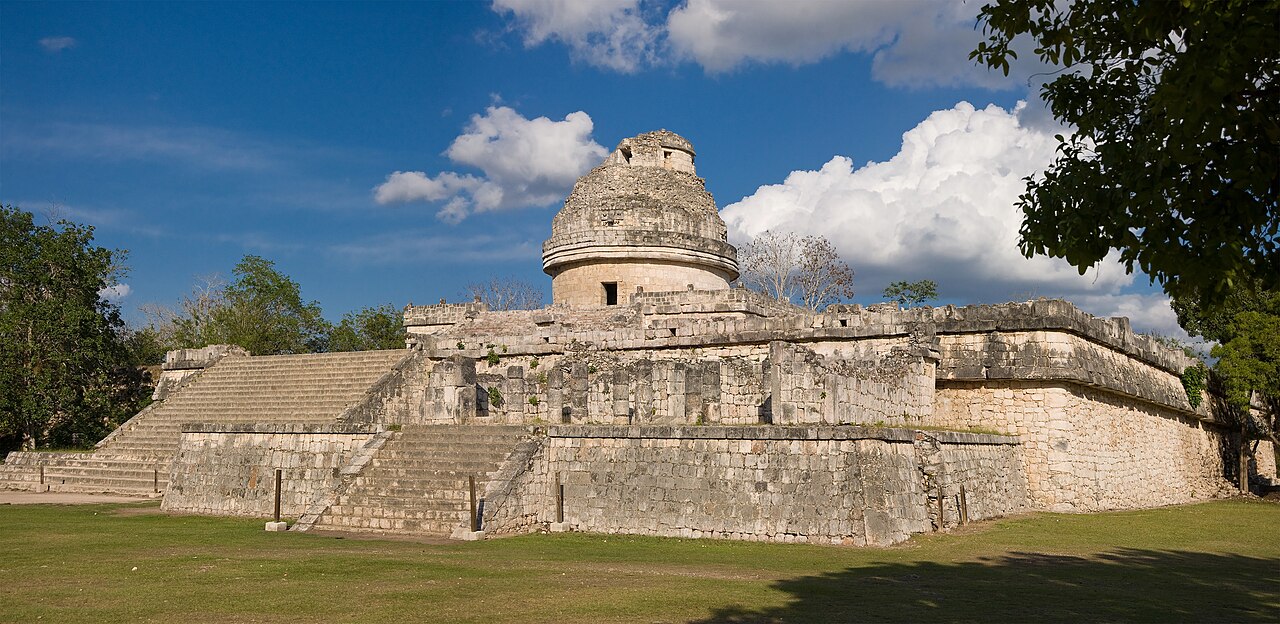
El Caracol, Mexico
Buto, Egypt
Abu Simbel, Egypt

Kokino, Kumanovo, North Macedonia
Observatory at Rhodes, Greece
Goseck circle, Germany
Ujjain, India
Arkaim, Russia
Newark Earthworks, Hopewell Culture (United States of America)
Cheomseongdae, South Korea
Angkor Wat, Cambodia
The oldest true observatories, in the sense of a specialized research institute, include:
825: Al-Shammisiyyah Observatory, Baghdad, Iraq
869: Mahodayapuram Observatory, Kerala, India
1259: Maragheh Observatory, Azerbaijan, Iran
1276: Gaocheng Astronomical Observatory, China
1420: Ulugh Beg Observatory, Samarqand, Uzbekistan
1442: Beijing Ancient Observatory, China
1577: Constantinople Observatory of Taqi ad-Din, Turkey
1580: Uraniborg, Denmark (present-day Sweden)
1581: Stjärneborg, Denmark (present-day Sweden)
1633: Leiden Observatory, Netherlands
1642: Panzano Observatory, Italy
1642: Round Tower, Denmark
1667: Paris Observatory, France
1675: Royal Greenwich Observatory, England
1695: Sukharev Tower, Russia
1711: Berlin Observatory, Germany
1724: Jantar Mantar, India
1753: Stockholm Observatory, Sweden
1753: Vilnius University Observatory, Lithuania
1753: Real Instituto y Observatorio de la Armada, Spain
1759: Trieste Observatory, Italy.
1757: Macfarlane Observatory, Scotland.
1759: Turin Observatory, Italy.
1764: Brera Astronomical Observatory, Italy.
1765: Mohr Observatory, Indonesia.
1771: Lviv Observatory, Ukraine.
1774: Observatory of the Vatican, Italy.