
The Arabic alphabet, or the Arabic abjad, is the Arabic script as specifically codified for writing the Arabic language. It is a unicameral script written from right-to-left in a cursive style, and includes 28 letters, of which most have contextual forms. The Arabic alphabet is an abjad, with only consonants required to be written (though the long vowels – ā ī ū – are also written, with letters used for consonants); due to its optional use of diacritics to notate vowels, it is considered an impure abjad.
Letters
The basic Arabic alphabet contains 28 letters, each of which behaves either as a full-fledged letter or as a diacritic. Forms using the Arabic script to write other languages added and removed letters: for example ⟨پ⟩ is often used to represent /p/ in adaptations of the Arabic script.
Many letters look similar but are distinguished from one another by dots (ʾiʿjām) above or below their central part (rasm). These dots are an integral part of a letter, since they distinguish between letters that represent different sounds. For example, the Arabic letters ب b, ت t, and ث th have the same basic shape, but with one dot added below, two dots added above, and three dots added above respectively. The letter ن n also has the same form in initial and medial forms, with one dot added above, though it is somewhat different in its isolated and final forms. Historically, they were often omitted, in a writing style called rasm.

Both printed and written Arabic are cursive, with most letters within a word directly joined to adjacent letters.
Letter forms
The Arabic alphabet is always cursive and letters vary in shape depending on their position within a word. Letters can exhibit up to four distinct forms corresponding to an initial, medial (middle), final, or isolated position (IMFI). While some letters show considerable variations, others remain almost identical across all four positions. Generally, letters in the same word are linked together on both sides by short horizontal lines, but six letters (و ,ز ,ر ,ذ ,د ,ا) can only be linked to their preceding letter. In addition, some letter combinations are written as ligatures (special shapes), notably lām-alif لا, which is the only mandatory ligature (the unligated combination لا is considered difficult to read).
Table of basic letters
Hamza forms
The hamza /ʔ/ (glottal stop) can be written either alone, as if it were a letter, or with a carrier, when it becomes a diacritic. Hamzat al-madd (آ) indicates a long /ʔ/ + /aː/ sound as in آسف ʾāsif /ʔaː.sif/ "sorry", while the other Hamzas indicate the glottal stop /ʔ/ in different positions of the word as in مسؤول masʾūl /mas.ʔuːl/ and سائل sāʾil /saː.ʔil/, the writing of the Hamza is based on a set of rules, For the writing rule of each form, see Hamza § Arabic "seat" rules.

Modified letters
The following are not individual letters, but rather different contextual variants of some of the Arabic letters.
Long vowels
In the fully vocalized Arabic text found in texts such as the Quran, a long ā following a consonant other than a hamzah is written with a short a sign (fatḥah) on the consonant plus an ʾalif after it; long ī is written as a sign for short i (kasrah) plus a yāʾ; and long ū as a sign for short u (ḍammah) plus a wāw. Briefly, ᵃa = ā; ⁱy = ī; and ᵘw = ū. Long ā following a hamzah may be represented by an ʾalif maddah or by a free hamzah followed by an ʾalif. Arabic never allows two consecutive ʾalifs.
The table below shows vowels placed above or below a dotted circle replacing a primary consonant letter or a shaddah sign. For clarity in the table, the primary letters on the left used to mark these long vowels are shown only in their isolated form. Most consonants do connect to the left with ʾalif, wāw and yāʾ written then with their medial or final form. Additionally, the letter yāʾ in the last row may connect to the letter on its left, and then will use a medial or initial form. Use the table of primary letters to look at their actual representative glyph and joining types.

In unvocalized text (one in which the short vowels are not marked), the long vowels are represented by the vowel in question: ʾalif mamdūdah/maqṣūrah, wāw, or yāʾ. Long vowels written in the middle of a word of unvocalized text are treated like consonants with a sukūn (see below) in a text that has full diacritics. Here also, the table shows long vowel letters only in isolated form for clarity.
Combinations وا and يا are always pronounced wā and yā respectively. The exception is the suffix ـوا۟ in verb endings where ʾalif is silent, resulting in ū or aw. In addition, when transliterating names and loanwords, Arabic language speakers write out most or all the vowels as long (ā with ا ʾalif, ē and ī with ي yaʾ, and ō and ū with و wāw), meaning it approaches a true alphabet.
Diphthongs
The diphthongs حروف اللين ḥurūfu l-līn /aj/ and /aw/ are represented in vocalized text as follows:
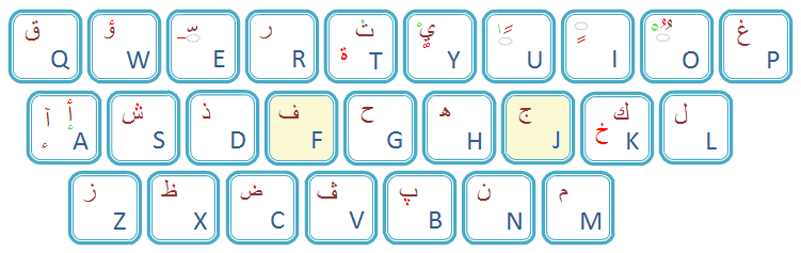
A final yaʾ is usually written at the end of words for nisba (اَلنِّسْبَة nisbah) which is a common suffix to form adjectives of relation or pertinence. The suffix is ـِيّ -iyy for masculine (ـِيَّة -iyya(t)- for feminine); for example اِشْتِرَاكِيّ ištirākiyy "socialist", it is also used for a singulative ending that applies to human or other sentient beings as in جندي jundiyy "a soldier". However nowadays this final yaʾ is mostly pronounced with a long yaʾ (yāʾ mamdūdah) -ī as in اِشْتِرَاكِي ištirākī /iʃtiraːkiː/ instead of اِشْتِرَاكِيّ ištirākiyy /iʃtiraːkijj/. A similar mistake happens at the end of some third person plural verbs as in جَرَوْا jaraw "they ran" which is pronounced nowadays as جَرُوا jarū /d͡ʒaruː/.
Ligatures
The use of ligature in Arabic is common. There is one compulsory ligature, that for lām ل + alif ا, which exists in two forms. All other ligatures, of which there are many, are optional.
A more complex ligature that combines as many as seven distinct components is commonly used to represent the word Allāh الله. The only ligature within the primary range of Arabic script in Unicode (U+06xx) is lām + alif. This is the only one compulsory for fonts and word-processing. Other ranges are for compatibility to older standards and contain other ligatures, which are optional.
Note: Unicode also has in its Presentation Form B FExx range a code for this ligature. If your browser and font are configured correctly for Arabic, the ligature displayed above should be identical to this one, U+FEFB
Alphabetical order
There are two main collating sequences ('alphabetical orderings') for the Arabic alphabet: Hija'i, and Abjadi.
The Hija'i order (هِجَائِيّ Hijāʾiyy /hid͡ʒaːʔijj/) is the more common order and it is used when sorting lists of words and names, such as in phonebooks, classroom lists, and dictionaries.

The original Abjadi order (أَبْجَدِيّ ʾabjadiyy /ʔabd͡ʒadijj/) derives from that used by the Phoenician alphabet and therefore resembles the sequence of letters in Hebrew and Greek. Letters are also assigned numerical values (abjad numerals) for purposes of numerology, as is done in Hebrew gematria and Greek isopsephy. Letters in the Hija'i order are not considered to have numerical values.
Hijaʼi
Modern dictionaries and reference books use the hijāʾī alphabetical order instead of the Abjadi alphabetical order, in which letters are arranged mainly by similarity of shape. The hijaʼi order is never used for numerals.
A different hijaʼi order was used in the Maghreb but is now considered obsolete. The sequence is:
The al-iklīl order, now obsolete, also arranged letters mainly by shape. It was first used in the 10th-century work Kitāb al-Iklīl. The sequence is:
Abjadi
The abjadi order is the usual Arabic order in dictionaries and reference books of the late 1st millennium to the early 2nd millennium. However, this Arabic abjadi order is not a simple correspondence with the earlier north Semitic alphabetic order, as the latter has a position corresponding to the Aramaic letter samek 𐡎, which has no cognate letter in the Arabic alphabet historically because Proto-Semitic fricatives *š (represented by šin 𐡔 in Aramaic) and *s (represented by samek 𐡎 in Aramaic) had merged into Arabic s س, while Proto-Semitic *ś became Arabic š ش.
The loss of sameḵ was compensated for:
In the Mashriqi abjad sequence, by splitting the letter šīn 𐡔 into two independent Arabic letters: ش shīn and س sīn, with the latter taking the place of sameḵ 𐡎;
And in the Maghrebi abjad sequence, by splitting the letter ṣāḏē 𐡑 into two independent Arabic letters: ض ḍad and ص ṣad, with the latter taking the place of sameḵ 𐡎.
The six other letters that do not correspond to any north Semitic letter are placed at the end.
This is commonly vocalized as follows:
ʾabjad hawwaz ḥuṭṭī kalaman saʿfaṣ qarashat thakhadh ḍaẓagh.
Another vocalization is:
ʾabujadin hawazin ḥuṭiya kalman saʿfaṣ qurishat thakhudh ḍaẓugh
This can be vocalized as:
ʾabujadin hawazin ḥuṭiya kalman ṣaʿfaḍ qurisat thakhudh ẓaghush
Notes:
Diacritics
Users of Arabic usually write long vowels but omit short ones, so readers must utilize their knowledge of the language in order to supply the missing vowels. However, in the education system and particularly in classes on Arabic grammar these vowels are used since they are crucial to the grammar. An Arabic sentence can have a completely different meaning by a subtle change of the vowels. This is why in an important text such as the Qur’ān the three basic vowel signs are mandated, like the Arabic diacritics and other types of marks, like the cantillation signs.
Short vowels
In the Arabic handwriting of everyday use, in general publications, and on street signs, short vowels are typically not written. On the other hand, copies of the Qur’ān cannot be endorsed by the religious institutes that review them unless the diacritics are included. Children's books, elementary school texts, and Arabic-language grammars in general will include diacritics to some degree. These are known as "vocalized" texts.
Short vowels may be written with diacritics placed above or below the consonant that precedes them in the syllable, called ḥarakāt. All Arabic vowels, long and short, follow a consonant; in Arabic, words like "Ali" or "alif", for example, start with a consonant: ‘Aliyy, alif.
Nunation
Nunation (Arabic: تنوين tanwīn) is the addition of a final -n to a noun or adjective. The vowel before it indicates grammatical case. In written Arabic, nunation is indicated by doubling the vowel diacritic at the end of the word, e.g. شُكْرًا šukran [ʃukran] 'thank you'.
Gemination
Gemination is the doubling of a consonant. Instead of writing the letter twice, Arabic places a W-shaped sign called shaddah above it.
Vowel omission
An Arabic syllable can be open (ending with a vowel) or closed (ending with a consonant):
open: CV [consonant-vowel] (long or short vowel)
closed: CVC (short vowel only)
A normal text is composed only of a series of consonants plus vowel-lengthening letters; thus, the word qalb, "heart", is written qlb, and the word qalaba "he turned around", is also written qlb. To write qalaba without this ambiguity, we could indicate that the l is followed by a short a by writing a fatḥah above it.
To write qalb, we would instead indicate that the l is followed by no vowel by marking it with a diacritic called sukūn ( ْ), like this: قلْب. This is one step down from full vocalization, where the vowel after the q would also be indicated by a fatḥah: قَلْب.