
Alberto Kenya Fujimori Inomoto (26 July 1938—11 September 2024) was a Peruvian politician, professor, and engineer who served as the president of Peru from 1990 to 2000. During Fujimori's tenure, the Peruvian Armed Forces repressed the far-left guerrilla group Shining Path, halting the group's actions while also killing thousands of civilians. Fujimori became known for his neoliberal political and economic ideology of Fujimorism, which pushed a free market economy and social conservatism. He also collaborated with the head of the National Intelligence Service (SIN), Vladimiro Montesinos, to consolidate power and eliminate political opponents. Fujimori's presidency was marked by authoritarian measures, excessive use of propaganda, entrenched political corruption, multiple cases of extrajudicial killings, and human rights violations.
Born in Lima, Fujimori was the country's first president of Japanese descent, and was an agronomist and university rector prior to entering politics. Fujimori emerged as a politician during the midst of the internal conflict in Peru, the Peruvian Lost Decade, and the ensuing violence caused by the Shining Path. In 1992, during his first presidential term, Fujimori, with the support of SIN and the Peruvian Armed Forces, adopted the military's Plan Verde, targeting members of Peru's indigenous community and subjecting them to forced sterilizations. As part of the plan, he also carried out a self-coup against the Peruvian legislature and judiciary. Fujimori dissolved the Peruvian Congress and Supreme Court, effectively making him a dictator of Peru. The coup was criticized by Peruvian politicians, international governments, intellectuals and journalists, but was well received by the country's private business sector and a substantial part of the public. Following the coup d'état, Fujimori drafted a new constitution in 1993, which was approved in a referendum, and was elected as president for a second term in 1995 and controversially for a third term in 2000.
In 2000, following his third term election, Fujimori faced mounting allegations of widespread corruption and crimes against humanity within his government. Subsequently, Fujimori fled to Japan, where he submitted his presidential resignation via fax. Peru's congress refused to accept his resignation, instead voting to remove him from office on the grounds that he was "permanently morally disabled". While he was in Japan, Peru issued multiple criminal charges against him, stemming from the corruption and human rights abuses that occurred during his government. Peru requested Fujimori's extradition from Japan, which was refused by the Japanese government as they recognised him as a Japanese citizen, and Japanese laws stipulating against extraditing its citizens. In 2005, while Fujimori was visiting Santiago, Chile, he was arrested by the Carabineros de Chile at the request of Peru, and extradited to Lima to face charges in 2007. Fujimori was sentenced to 25 years in prison, but was pardoned by president Pedro Pablo Kuczynski in 2017, and was officially released in December 2023 following several years of legal proceedings regarding the legality of his pardon. He died in September 2024, nine months after his release. In 2026, his daughter Keiko was elected the country's president.

Early life, education, and career
Alberto Kenya Fujimori Inomoto was born on 26 July 1938 in the Miraflores district of Lima, Peru, to Japanese parents Naoichi Fujimori (né Minami) and Mutsue Inomoto. His parents were originally from Kumamoto Prefecture and immigrated to Peru in 1934. Fujimori's parents were Buddhists, but he was baptized and raised Catholic. Aside from Spanish and English, he also spoke Japanese which was the primary language in his childhood home.
Fujimori obtained his early education at the Colegio Nuestra Señora de la Merced and La Rectora School. In 1956, he graduated from La Gran Unidad Escolar Alfonso Ugarte in Lima. Fujimori pursued his undergraduate studies at the Universidad Nacional Agraria La Molina in 1957, graduating first in his class in 1961 with a degree in agricultural engineering. He briefly lectured in mathematics at the university before moving to France to study physics at the University of Strasbourg. In 1969, he earned a master's degree in mathematics from the University of Wisconsin–Milwaukee through a Ford Foundation scholarship.
In recognition of his academic achievements, the sciences faculty of the National Agrarian University offered Fujimori the deanship and in 1984 appointed him to the rectorship of the university, which he held until 1989. In 1987, Fujimori also became president of the National Assembly of University Rectors, a position that he held twice. He also hosted a TV show called Concertando from 1988 to 1989 on Peru's state-owned network, Canal 7.
Birthplace dispute
In July 1997, the news magazine Caretas alleged that Fujimori was born in Japan, in his father's hometown of Kawachi, Kumamoto Prefecture. Because the Constitution of Peru requires the president to have been born in Peru, this would have made Fujimori ineligible to be president. The magazine, which had been sued for libel by Vladimiro Montesinos seven years earlier, reported that Fujimori's birth and baptismal certificates might have been altered. Caretas also alleged that Fujimori's mother declared having two children when she entered Peru; Fujimori was the second of four children. Caretas's contentions were hotly contested in the Peruvian media; the magazine Sí described the allegations as "pathetic" and "a dark page for [Peruvian] journalism". Latin American scholars Cynthia McClintock and Fabián Vallas note that the issue appeared to have died down among Peruvians after the Japanese government announced in 2000 that "Fujimori's parents had registered his birth in the Japanese Embassy in Lima". The Japanese government determined that he was also a Japanese citizen because of his parents' registration in the koseki.
Presidency (1990–2000)
First term
1990 general election
During the first presidency of Alan García, the economy had entered a period of hyperinflation and the political system was in crisis due to the country's internal conflict, leaving Peru in "economic and political chaos". The armed forces grew frustrated with the inability of the García administration to handle the nation's crises and began to draft Plan Verde as a plan to overthrow his government. According to Rospigliosi, lawyer and friend of Fujimori, Vladimiro Montesinos was not initially involved with the Plan Verde, but his ability to resolve issues for the military resulted with the armed forces tasking Montesinos with implementing the plan with Fujimori, Both General Nicolás de Bari Hermoza and Montesinos were responsible for the relationship between the armed forces and Fujimori. Mario Vargas Llosa, Fujimori's final opponent in the election, later reported that United States Ambassador to Peru, Anthony C. E. Quainton, personally told him that allegedly leaked documents of the Central Intelligence Agency (CIA) purportedly being supportive of Fujimori's candidacy were authentic. Rendón writes that the United States supported Fujimori because of his relationship with Montesinos, who had previously been charged with spying on the Peruvian military for the CIA.
During the second round of elections, Fujimori originally received support from left-wing groups and those close to the García government, exploiting the popular distrust of the existing Peruvian political establishment and the uncertainty about the proposed neoliberal economic reforms of his opponent, novelist Mario Vargas Llosa. Fujimori won the 1990 presidential election as a dark horse candidate under the banner of Cambio 90, defeating Vargas Llosa in a surprise result. He capitalized on profound disenchantment with outgoing president Alan García and the American Popular Revolutionary Alliance party (APRA).

During the campaign, Fujimori was nicknamed "el chino," which translates to "the Chinese guy" or "the Chinaman"; it is common for people of any East Asian descent to be called chino in Peru, as elsewhere in Spanish-speaking Latin America, both derogatorily and affectionately. Although he was of Japanese heritage, Fujimori suggested that he was always pleased by the nickname, which he perceived as a term of affection. With his election victory, he became the third person of East Asian descent to serve as presidency of a South American state, after President Arthur Chung of Guyana and Henk Chin A Sen of Suriname.
Economic shock
According to news magazine Oiga, the armed forces finalized plans on 18 June 1990 involving multiple scenarios for a coup d'état to be executed on 27 July 1990, the day prior to Fujimori's inauguration. The magazine noted that in one of the scenarios, titled "Negotiation and agreement with Fujimori. Bases of negotiation: concept of directed Democracy and Market Economy", Fujimori was to be directed on accepting the military's plan at least 24 hours before his inauguration. Fernando Rospigliosi states "an understanding was established between Fujimori, Montesinos and some of the military officers" involved in the Plan Verde prior to Fujimori's inauguration. Montesinos and SIN officials ultimately assumed the armed forces' position in the plan, placing SIN operatives into military leadership roles. Fujimori went on to adopt many of the policies outlined in the Plan Verde. Fujimori was sworn in as president on 28 July 1990, allegedly his 52nd birthday.
During his first term in office, Fujimori enacted wide-ranging neoliberal reforms, known as the Fujishock. Hernando de Soto, the founder of the Institute for Liberty and Democracy, became an advisor. Between 1988 and 1995, de Soto and the ILD were mainly responsible for some four hundred initiatives, laws, and regulations that led to significant changes in Peru's economic system. Under Fujimori, de Soto served as "the President's personal representative", with The New York Times describing de Soto as an "overseas salesman" for Fujimori in 1990, writing that he had represented the government when meeting with creditors and United States representatives. Others dubbed de Soto as the "informal president" for Fujimori. De Soto proved to be influential to Fujimori, who began to repeat de Soto's advocacy for deregulating the Peruvian economy. The International Monetary Fund (IMF) was content with Peru's measures, and guaranteed loan funding for Peru. Inflation rapidly began to fall and foreign investment capital flooded in.

Nonetheless, the Fujishock restored Peru to the global economy, though not without immediate social cost; international business participated in crony capitalism with the government. The privatization campaign involved selling off of hundreds of state-owned enterprises, and replacing the country's troubled currency, the inti, with the nuevo sol. Fujimori's initiative relaxed private sector price controls, drastically reduced government subsidies and government employment, eliminated all exchange controls, and also reduced restrictions on investment, imports, and capital. Tariffs were radically simplified, the minimum wage was immediately quadrupled, and the government established a US$400 million poverty relief fund. The latter seemed to anticipate the economic agony to come: the price of electricity quintupled, water prices rose eightfold, and gasoline prices 3,000%.
Military regime
During Fujimori's first term in office, APRA and the Democratic Front (Vargas Llosa's party) remained in control of both chambers of Congress—then composed of a Chamber of Deputies and a Senate—hampering the enactment of economic reform. Fujimori also had difficulty combating the Shining Path due largely to what he perceived as intransigence and obstructionism in Congress. By March 1992, the Congress met with the approval of only 17% of the electorate, according to one poll; in the same poll, the president's approval stood at 42%.
Fujimori and his military handlers had planned for a coup during his preceding two years in office. In response to the political deadlock, Fujimori, with the support of the military, carried out a self-coup on 5 April 1992, Congress was shut down by the military, the constitution was suspended and the judiciary was dissolved. Without political obstacles, the military was able to implement the objectives outlined in Plan Verde while Fujimori served as president to project an image that Peru was supporting a liberal democracy. Montesinos would go on to adopt the actual function of Peru's government.

The coup was well received by the public, with Fujimori's approval rating jumping significantly in the wake of the coup. Fujimori often cited this public support in defending the coup, which he characterized as "not a negation of real democracy, but on the contrary... a search for an authentic transformation to assure a legitimate and effective democracy". Fujimori believed that Peruvian democracy had been nothing more than "a deceptive formality—a façade". He claimed the coup was necessary to break with the deeply entrenched special interests that were hindering him from rescuing Peru from the chaotic state in which García had left it.
Fujimori's coup was immediately met with near-unanimous condemnation from the international community. The Organization of American States (OAS) denounced the coup and demanded a return to "representative democracy", despite Fujimori's claim that the coup represented a "popular uprising". Foreign ministers of OAS member states reiterated this condemnation of the autogolpe. They proposed an urgent effort to promote the reestablishment of "the democratic institutional order" in Peru. Negotiations between the OAS, the government, and opposition groups initially led Fujimori to propose a referendum to ratify the auto-coup, but the OAS rejected this. Fujimori then proposed scheduling elections for a Democratic Constituent Congress (CCD), which would draft a new constitution to be ratified by a national referendum. Despite a lack of consensus among political forces in Peru regarding this proposal, an ad hoc OAS meeting of ministers nevertheless endorsed this scenario in mid-May. Elections for the Democratic Constituent Congress were held on 22 November 1992.
Various states individually condemned the coup. Venezuela broke off diplomatic relations, and Argentina withdrew its ambassador. Chile joined Argentina in requesting Peru's suspension from the Organization of American States. International lenders delayed planned or projected loans, and the United States, Germany, and Spain suspended all non-humanitarian aid to Peru. Fujimori, in turn, later received most of the participants of the November 1992 Venezuelan coup attempt as political asylees, who had fled to Peru after its failure.

Peru–United States relations earlier in Fujimori's presidency had been dominated by questions of coca eradication and Fujimori's initial reluctance to sign an accord to increase his military's eradication efforts in the lowlands. Fujimori's autogolpe became a major obstacle to relations, as the United States immediately suspended all military and economic aid, with exceptions for counter-narcotic and humanitarian funds. Two weeks after the self-coup, the George H. W. Bush administration changed its position and officially recognized Fujimori as the legitimate leader of Peru, partly because he was willing to implement economic austerity measures, but also because of his adamant opposition to the Shining Path.
On 13 November 1992, General Jaime Salinas Sedó attempted to overthrow Fujimori in a failed military coup. Salinas asserted that his intentions were to turn Fujimori over to be tried for violating the constitution.
Second term
The 1993 Constitution allowed Fujimori to run for a second term, and in April 1995, at the height of his popularity, he easily won reelection with almost two-thirds of the vote. His main opponent, former Secretary-General of the United Nations Javier Pérez de Cuéllar, won only 21 percent of the vote. Fujimori's supporters won comfortable majority in the new unicameral Congress. One of the first acts of the new congress was to declare an amnesty for all members of the military and police accused or convicted of human rights abuses between 1980 and 1995.
During his second term, Fujimori and Ecuadorian President Sixto Durán Ballén signed a peace agreement over a border dispute that had simmered for more than a century. The treaty allowed the two countries to obtain international funds for developing the border region. Fujimori also settled some issues with Chile, Peru's southern neighbor, which had been unresolved since the 1929 Treaty of Lima.
The 1995 election was the turning point in Fujimori's career. Peruvians began to be more concerned about freedom of speech and the press. Before he was sworn in for a second term, he stripped two universities of their autonomy and reshuffled the national electoral board. This led his opponents to call him "Chinochet", a reference to his previous nickname and to Chilean dictator Augusto Pinochet. Modeling his rule after Pinochet, Fujimori reportedly enjoyed this nickname.
According to a poll by the Peruvian Research and Marketing Company conducted in 1997, 40.6% of Lima residents considered President Fujimori an authoritarian.
In addition to the fate of democracy under Fujimori, Peruvians were becoming increasingly interested in the myriad allegations of criminality that involved Fujimori and Montesinos. Using SIN, Fujimori gained control of the majority of the armed forces, with the Financial Times stating that "[i]n no other country in Latin America did a president have so much control over the armed forces".
A 2002 report by Health Minister Fernando Carbone later suggested that Fujimori was involved in the forced sterilizations of up to 300,000 indigenous women between 1996 and 2000, as part of a population control program. A 2004 World Bank publication said that in this period Montesinos's abuse of the power Fujimori granted him "led to a steady and systematic undermining of the rule of law".
Third term, flight to Japan and resignation
By the arrival of the new millennium, Fujimori became increasingly authoritarian, strengthening collaboration with Montesinos and the NIS. Shortly after he began his second term, his supporters in Congress passed a law of "authentic interpretation" which effectively allowed him to run for another term in 2000. A 1998 effort to repeal this law by referendum failed. In late 1999, Fujimori announced that he would run for a third term. The electoral authorities, which were politically sympathetic to him, accepted his argument that the two-term restriction did not apply to him, as it was enacted while he was already in office.
Exit polls showed that Fujimori fell short of the 50% required to avoid an electoral runoff, but the first official results showed him with 49.6% of the vote, just short of outright victory. Eventually, he was credited with 49.9%—20,000 votes short of avoiding a runoff. Despite reports of numerous irregularities, the international observers recognized an adjusted victory of Fujimori. As voting is mandatory in Peru, Fujimori's primary opponent, Alejandro Toledo, called for his supporters to spoil their ballots in the runoff by writing "No to fraud!" on them. The Organization of American States electoral observation mission pulled out of the country, saying that the process would be neither free nor fair.
In the runoff, Fujimori won with 51.1% of the total votes. While votes for Toledo declined from 37.0% of the total votes cast in the first round to 17.7% of the votes in the second round, invalid votes jumped from 8.1% of the total votes cast in the first round to 31.1% of total votes in the second round. The large percentage of invalid votes in the election suggests widespread dissatisfaction with the electoral process among voters.
Although Fujimori won the runoff with only a bare majority (but 3/4 valid votes), rumors of irregularities led most of the international community to shun his third swearing-in on 28 July. For the next seven weeks, there were daily demonstrations in front of the presidential palace. As a conciliatory gesture, Fujimori appointed former opposition candidate Federico Salas as prime minister. Opposition parties in Congress refused to support this move, and Toledo campaigned vigorously to have the election annulled. At this point, a corruption scandal involving Montesinos broke out, and exploded into full force on the evening of 14 September 2000, when the cable television station Canal N (the only independent television network at the time) broadcast footage of Montesinos apparently bribing opposition congressman Alberto Kouri to defect to Fujimori's Peru 2000 party. The video was originally presented at a press conference by Fernando Olivera and Luis Iberico of the Independent Moralizing Front (FIM); many other similar videos were released in the following weeks.
Fujimori's support virtually collapsed, and a few days later he announced in a nationwide address that he would shut down the SIN and call new elections, in which he would not be a candidate. On 10 November, he won approval from Congress to hold elections on 8 April 2001.
On 13 November, Fujimori left Peru for a visit to Brunei to attend the Asia-Pacific Economic Cooperation forum. On 16 November, Valentín Paniagua took over as president of Congress after the pro-Fujimori leadership lost a vote of confidence. On 17 November, Fujimori traveled from Brunei to Tokyo, where he submitted his presidential resignation via fax. Congress refused to accept his resignation, instead voting on 22 November 62–9 to remove him from office on the grounds that he was "permanently morally disabled" and banned him from Peruvian politics for a decade.
On 19 November, government ministers presented their resignations en bloc. Fujimori's first vice president, Francisco Tudela, had broken with him and resigned a few days earlier. This left second vice president Ricardo Márquez Flores as next in line for the presidency. Congress refused to recognize him, as he was an ardent Fujimori loyalist; Márquez resigned two days later. Paniagua was next in line, and became interim president to oversee the April 2001 elections.
Post-presidency (2000–2024)
Arrest and trial
Alejandro Toledo, who assumed the presidency in 2001, spearheaded the criminal case against Fujimori. He arranged meetings with the Supreme Court, tax authorities, and other powers in Peru to "coordinate the joint efforts to bring the criminal Fujimori from Japan". His vehemence in this matter at times compromised Peruvian law: forcing the judiciary and legislative system to keep guilty sentences without hearing Fujimori's defense; not providing Fujimori with representation when Fujimori was tried in absentia; and expelling pro-Fujimori congressmen from the parliament without proof of the accusations against them. Those expulsions were later reversed by the judiciary.
Congress authorized charges against Fujimori in August 2001. Fujimori was alleged to be a coauthor, along with Vladimiro Montesinos, of the death-squad killings at Barrios Altos in 1991 and La Cantuta in 1992, respectively. At the behest of Peruvian authorities, in March 2003 Interpol issued an arrest order for Fujimori on charges that included murder, kidnapping, and crimes against humanity.
In September 2003, Fujimori and several of his ministers were denounced for crimes against humanity, for allegedly having overseen forced sterilizations during his regime. In November, Congress approved an investigation of Fujimori's involvement in the airdrop of Kalashnikov rifles into the Colombian jungle in 1999 and 2000 for guerrillas of the Revolutionary Armed Forces of Colombia (FARC). Fujimori maintained he had no knowledge of the arms-trading, and blamed Montesinos. By approving the charges, Congress lifted the immunity granted to Fujimori as a former president, so that he could be criminally charged and prosecuted.
Congress also voted to support charges against Fujimori for the detention and disappearance of 67 students from the central Andean city of Huancayo and the disappearance of several residents from the northern coastal town of Chimbote during the 1990s. It also approved charges that Fujimori mismanaged millions of dollars from Japanese charities, suggesting that the millions of dollars in his bank account were far too much to have been accumulated legally.
In 2004, the Special Prosecutor established to investigate Fujimori released a report alleging that the Fujimori administration had obtained US$2 billion through graft. Most of this money came from Vladimiro Montesinos's web of corruption. The Special Prosecutor's figure of two billion dollars is considerably higher than the one arrived at by Transparency International, an NGO that studies corruption. Transparency International listed Fujimori as having embezzled an estimated US$600 million or about $861 million in 2021, which would rank seventh in the list of money embezzled by heads of government active within 1984–2004.
Fujimori dismissed the judicial proceedings underway against him as "politically motivated", citing Toledo's involvement. Fujimori established a new political party in Peru, Sí Cumple, working from Japan. He hoped to participate in the 2006 presidential elections, but in February 2004, the Constitutional Court dismissed this possibility, because the ex-president was specifically barred by Congress from holding any office for ten years. Fujimori saw the decision as unconstitutional, as did his supporters such as former congress members Luz Salgado, Martha Chávez and Fernán Altuve, who argued it was a "political" maneuver and that the only body with the authority to determine the matter was the National Elections Jury (JNE). Valentín Paniagua disagreed, suggesting that the Constitutional Court finding was binding and that "no further debate is possible".
Fujimori's Sí Cumple (roughly translated, "He Keeps His Word") received more than 10% in many country-level polls, contending with APRA for the second-place slot, but did not participate in the 2006 elections after its participation in the Alliance for the Future (initially thought as Alliance Sí Cumple) had not been allowed.
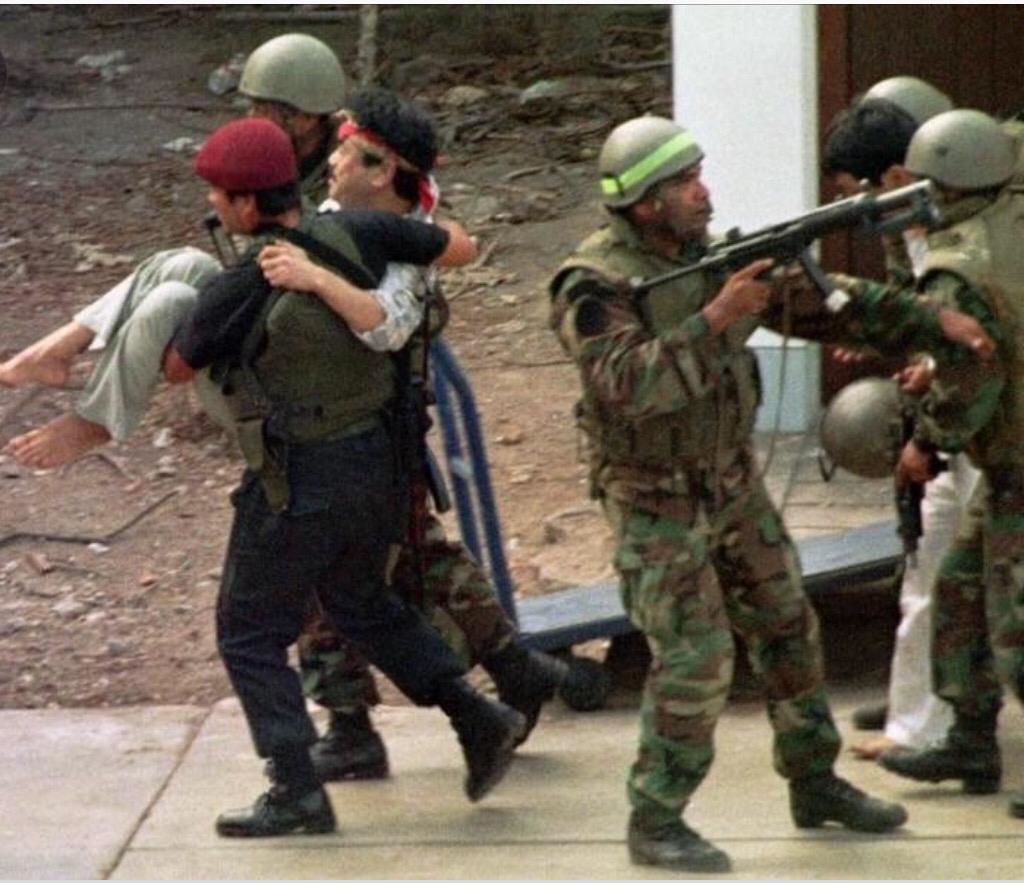
Fujimori remained in self-imposed exile in Japan, where he resided with his friend, the Catholic novelist Ayako Sono. Several senior Japanese politicians supported Fujimori, partly because of his decisive action in ending the 1996–97 Japanese embassy crisis. Peru had requested Fujimori's extradition from Japan, which was refused by the Japanese government due to Fujimori being a Japanese citizen, and Japanese laws stipulating against extraditing its citizens.
By March 2005, it appeared that Peru had all but abandoned its efforts to extradite Fujimori from Japan. In September of that year, Fujimori obtained a new Peruvian passport in Tokyo and announced his intention to run in the upcoming 2006 national election.
Fujimori arrived in Chile in November 2005, but hours after his arrival there he was arrested following an arrest warrant issued by a Chilean judge, Peru then requested his extradition. While under house arrest in Chile, Fujimori announced plans to run in Japan's Upper House elections in July 2007 for the far-right People's New Party. Fujimori was extradited from Chile to Peru in September 2007.
On 7 April 2009, a three-judge panel convicted Fujimori on charges of human rights abuses, declaring that the "charges against him have been proven beyond all reasonable doubt". The panel found him guilty of ordering the Grupo Colina death squad to commit the November 1991 Barrios Altos massacre and the July 1992 La Cantuta massacre, which resulted in the deaths of 25 people, as well as for taking part in the kidnappings of opposition journalist Gustavo Gorriti and businessman Samuel Dyer Ampudia. As of 2009 Fujimori's conviction is the only instance of a democratically elected head of state being tried and convicted of human rights abuses in his own country. Later on 7 April, the court sentenced Fujimori to 25 years in prison. Likewise, the Court found him guilty of aggravated kidnapping, under the aggravating circumstance of cruel treatment, with respect to journalist Gustavo Gorriti and businessman Samuel Dyer Ampudia. The Special Criminal Chamber determined that the sentence was to expire on 10 February 2032. On 2 January 2010, the sentence to 25 years in prison for human rights violations was confirmed.
He faced a third trial in July 2009 over allegations that he illegally gave US$15 million in state funds to Montesinos during the two months prior to his fall from power. Fujimori admitted paying the money to Montesinos but claimed that he had later paid back the money to the state. On 20 July, the court found him guilty of embezzlement and sentenced him to a further 7+1⁄2 years in prison.
A fourth trial took place in September 2009 in Lima. Fujimori was accused of using Montesinos to bribe and tap the phones of journalists, businessmen and opposition politicians—evidence of which led to the collapse of his government in 2000. Fujimori admitted the charges but claimed that the charges were made to damage his daughter's presidential election campaign. The prosecution asked the court to sentence Fujimori to eight years imprisonment with a fine of US$1.6 million plus US$1 million in compensation to ten people whose phones were bugged. Fujimori pleaded guilty and was sentenced to six years' imprisonment on 30 September 2009.
Pardon requests and release
Press reports in late 2012 indicated that Fujimori was suffering from tongue cancer and other medical problems. His family asked President Ollanta Humala for a pardon. President Humala rejected a pardon in 2013, saying that Fujimori's condition was not serious enough to warrant it. In July 2016, with three days left in his term, President Humala said that there was insufficient time to evaluate a second request to pardon Fujimori, leaving the decision to his successor Pedro Pablo Kuczynski. On 24 December 2017, President Kuczynski pardoned him on health grounds. Kuczynski's office stated that the hospitalized 79-year-old Fujimori had a "progressive, degenerative and incurable disease". The pardon kicked off at least two days of protests and led at least three congressmen to resign from Kuczynski's party. A spokesman for Popular Force alleged there was a pact that, in exchange for the pardon, Popular Force members helped Kuczynski fight ongoing impeachment proceedings.
On 20 February 2018, the National Criminal Chamber ruled that it did not apply the resolution that granted Fujimori the right of grace for humanitarian reasons. Therefore, the former president had to face the process for the Pativilca Case with a simple appearance. On 3 October 2018, the Peruvian Supreme Court reversed Fujimori's pardon and ordered his return to prison. He was rushed to a hospital and returned to prison on 23 January 2019. His pardon was formally annulled on 13 February 2019.