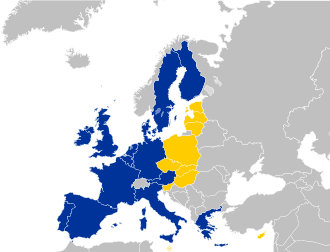
The largest enlargement of the European Union (EU), in terms of number of states and population, took place on 1 May 2004.
The simultaneous accessions concerned the following countries (sometimes referred to as the "A10" countries): Cyprus, the Czech Republic, Estonia, Hungary, Latvia, Lithuania, Malta, Poland, Slovakia, and Slovenia. Seven of these were part of the former Eastern Bloc (of which three were from the former Soviet Union and four were and still are member states of the Central European alliance Visegrád Group). Slovenia was a non-aligned country prior to independence, and it was one of the former republics of Yugoslavia (together sometimes referred to as the "A8" countries), and the remaining two were Mediterranean island countries, both member states of the Commonwealth of Nations and were part of the Non-Aligned Movement.
Part of the same wave of enlargement was the accession of Bulgaria and Romania in 2007, who were unable to join in 2004, but, according to the European Commission, constitute part of the fifth enlargement.

History
Background
With the end of World War II in May 1945, Europe found itself divided between a capitalist Western Bloc and a communist Eastern Bloc, as well as Third World neutral countries. The European Economic Community (EEC) was created in 1957 between six countries within the Western Bloc and later expanded to twelve countries across Europe. European communist countries had a looser economic grouping with the USSR known as Comecon. To the south there was a non-aligned communist federated country – Yugoslavia.
Between 1989 and 1991, the Cold War between the two superpowers was coming to an end, with the USSR's influence over communist Europe collapsing. As the communist states began their transition to free market democracies, aligning to Euro-Atlantic integration, the question of enlargement into the continent was thrust onto the EEC's agenda.
Negotiations
The Phare strategy was launched soon after to adapt more the structure of the Central and Eastern European countries (Pays d'Europe Centrale et Orientale (PECO)) to the European Economic Community. One of the major tools of this strategy was the Regional Quality Assurance Program (Programme Régional d'Assurance Qualité (PRAQ)) which started in 1993 to help the PECO States implement the New Approach in their economy.
The Acquis Communautaire contained 3,000 directives and some 100,000 pages in the Official Journal of the European Union to be transposed. It demanded a lot of administrative work and immense economic change, and raised major cultural problems – e.g. new legal concepts and language consistency problems.
Accession
Malta held a non-binding referendum on 8 March 2003; the narrow Yes vote prompted a snap election on 12 April 2003 fought on the same question and after which the pro-EU Nationalist Party retained its majority and declared a mandate for accession.
Poland held a referendum on 7 and 8 June 2003: [1] voting Yes by a wide margin of about 77.5% with a turnout of around 59%.
The Treaty of Accession 2003 was signed on 16 April 2003, at the Stoa of Attalus in Athens, Greece, between the then-EU members and the ten acceding countries. The text also amended the main EU treaties, including the Qualified Majority Voting of the Council of the European Union. The treaty was ratified on time and entered into force on 1 May 2004 amid ceremonies around Europe.
European leaders met in Dublin for fireworks and a flag-raising ceremony at Áras an Uachtaráin, the Irish presidential residence. At the same time, citizens across Ireland enjoyed a nationwide celebration styled as the Day of Welcomes. President Romano Prodi took part in celebrations on the Italian-Slovenian border at the divided town of Gorizia/Nova Gorica; at the German-Polish border, the EU flag was raised and Ode to Joy was sung; and there was a laser show in Malta, among the various other celebrations.
Limerick, Ireland's third largest city, hosted Slovenia as one of ten cities and towns to individually welcome the ten accession countries. The then Slovenian Prime Minister Anton Rop was Guest Speaker at a business luncheon hosted by Limerick Chamber.
Progress
1 EU Association Agreement type: Europe Agreement for the states of the Fifth Enlargement.
Free movement issues
As of May 2011, there are no longer any special restrictions on the free movement of citizens of these new member states.
With their original accession to the EU, free movement of people between all 25 states would naturally have applied. However, due to concerns of mass migration from the new members to the old EU-15, some transitional restrictions were put in place. Mobility within the EU-15 (plus Cyprus) and within the new states (minus Cyprus) functioned as normal (although the new states had the right to impose restrictions on travel between them). Between the old and new states, transitional restrictions up to 1 May 2011 could be put in place, and EU workers still had a preferential right over non-EU workers in looking for jobs even if restrictions were placed upon their country. No restrictions were placed on Cyprus or Malta. The following restrictions were put in place by each country;
Austria and Germany: Restriction on free movement and to provide certain services. Work permits still needed for all countries. In Austria, to be employed the worker needs to have been employed for more than a year in his home country prior to accession. Germany had bilateral quotas which remained in force.
Cyprus: No restrictions.
Malta: No restrictions on its workers, but does have the right to migration into the country.
Netherlands: Initially against restrictions, but tightened up its policies in early 2004 and said it would tighten its policies if more than 22,000 workers arrived per year.
Finland: 2 years of transitional arrangements where a work permit would be granted only where a Finnish national cannot be found for the job. Does not apply to students, part-time workers, entrepreneurs, people living in Finland for non-work purposes, people who were already living in Finland for a year or people who would be entitled to work anyway if they were from a third country.
Denmark: Two years where only full-time workers can get a work permit, if they had a residence permit. Workers did not get welfare but restrictions only apply to wage earners (all the EU-10 citizens can set up a business).
France: Five years of restrictions depending on sector and region. Students, researchers, self-employed and service providers were exempt from the restrictions.
Spain: Two years.
Portugal: Two years, annual limit of 6,500.
Sweden: No restrictions.
Czech Republic and Slovakia: No restrictions.
Poland: Reciprocal limits, only British and Irish citizens had free access. Countries with looser or tighter limits face similar limits in Poland.
Belgium, Greece and Luxembourg: Two years.
United Kingdom: Welfare restrictions only, registration needed.
Ireland: No restrictions.
Hungary: Reciprocal limits for seven years.
Despite the fears, migration within the EU concerns less than 2% of the population. However, the migration did cause controversy in those countries which saw a noticeable influx, creating the image of a "Polish Plumber" in the EU, caricaturing the cheap manual labour from A8 countries making an imprint on the rest of the EU. The extent to which E8 immigration generated a lasting public backlash has been debated. Ten years after the enlargement, a study showed that increases in E8 migrants in Western Europe over the last ten years had been accompanied by a more widespread acknowledgement of the economic benefits of immigration. Following the 2007 enlargement, most countries placed restrictions on the new states, including the most open in 2004 (Ireland and the United Kingdom) with only Sweden, Finland and the 2004 members (minus Malta and Hungary). But by April 2008, these restrictions on the eight members had been dropped by all members except Germany and Austria.
Remaining areas of inclusion
Cyprus, Czech Republic, Estonia, Hungary, Latvia, Lithuania, Malta, Poland, Slovakia, and Slovenia became members on 1 May 2004, but some areas of cooperation in the European Union will apply to some of the EU member states at a later date. These are:
Schengen Area (see Enlargement of the Schengen Area; Cyprus is still not a member of the Schengen Area)
Eurozone (see Enlargement of the eurozone; Czech Republic, Hungary, Poland are still not members of the Eurozone)
New member states
Cyprus
Since 1974 Cyprus has been divided between the Greek south (the Republic of Cyprus) and the northern areas under Turkish military occupation (the self-proclaimed Turkish Republic of Northern Cyprus). The Republic of Cyprus is recognised as the sole legitimate government by every UN (and EU) member state except Turkey, while the northern occupied area is recognised only by Turkey.
Cyprus began talks to join the EU, which provided impetus to solve the dispute. With the agreement of the Annan Plan for Cyprus, it was hoped that the two communities would join the EU together as a single United Cyprus Republic. Turkish Cypriots supported the plan. However, in a referendum on 24 April 2004 the Greek Cypriots rejected the plan. Thus, a week later, the Republic of Cyprus joined the EU with political issues unresolved. Legally, as the northern republic is not recognised by the EU, the entire island excluding the British overseas territory of Akrotiri and Dhekelia is a member of the EU as part of the Republic of Cyprus, though the de facto situation is that the Government is unable to extend its controls into the occupied areas.
Efforts to reunite the island continue as of 2026. European Union membership forced the country to suspend its membership in the Non-Aligned Movement with Government of Cyprus insisting on maintaining close ties with the NAM.
Poland
Accession of Poland to the European Union took place in May 2004. Poland had been negotiating with the EU since 1989.
With the fall of communism in 1989/1990 in Poland, Poland embarked on a series of reforms and changes in foreign policy, intending to join the EU and NATO. On 19 September 1989 Poland signed the agreement for trade and trade co-operation with the (then) European Community (EC). Polish intention to join the EU was expressed by Polish Prime Minister Tadeusz Mazowiecki in his speech in the European Parliament in February 1990 and in June 1991 by Polish Minister of Foreign Affairs Krzysztof Skubiszewski in Sejm (Polish Parliament).
On 19 May 1990 Poland started a procedure to begin negotiations for an association agreement and the negotiations officially began in December 1990. About a year later, on 16 December 1991 the European Union Association Agreement was signed by Poland. The Agreement came into force on 1 February 1994 (its III part on the mutual trade relations came into force earlier on 1 March 1992).
As a result of diplomatic interventions by the central European states of the Visegrád Group, the European Council decided at its Copenhagen summit in June 1993 that: "the associate member states from Central and Eastern Europe, if they so wish, will become members of the EU. To achieve this, however, they must fulfil the appropriate conditions." Those conditions (known as the Copenhagen criteria, or simply, membership criteria) were:
That candidate countries achieve stable institutions that guarantee democracy, legality, human rights and respect for and protection of minorities.
That candidate countries have a working market economy, capable of competing effectively on EU markets.
That candidate countries are capable of accepting all the membership responsibilities, political, economic and monetary.
At the Luxembourg summit in 1997, the EU accepted the commission's opinion to invite Poland, Czech Republic, Hungary, Slovenia, Estonia and Cyprus to start talks on their accession to the EU. The negotiation process started on 31 March 1998. Poland finished the accession negotiations in December 2002. Then, the Accession Treaty was signed in Athens on 16 April 2003 (Treaty of Accession 2003). After the ratification of that Treaty in the 2003 Polish European Union membership referendum, Poland and other 9 countries became the members of EU on 1 May 2004.
A8 countries
Eight of the 10 countries that joined the European Union during the 2004 enlargement are grouped together as the A8, sometimes also referred to as the EU8. They are grouped separately from the other two states that joined Union in 2004, i.e. Cyprus and Malta, because of their relatively similar ex-Eastern block background, per capita income level, Human Development Index level, and most of all the geographical location in mainland Europe, where the two other states from aforementioned 2004 batch are Mediterranean isles.
These countries are:
Czech Republic