
The Second Morawiecki Cabinet was the government of Poland led by Prime Minister Mateusz Morawiecki of the Law and Justice (PiS) party, formed on 15 November 2019 following PiS's landslide victory in the October 2019 parliamentary elections. It governed Poland until 13 December 2023, when it was replaced by a coalition government led by Donald Tusk after PiS lost its majority in the October 2023 elections. During its four-year tenure, the cabinet oversaw Poland's response to the COVID-19 pandemic, managed the country's eastern border crisis, and clashed repeatedly with European Union institutions over the rule of law.
How Was the Second Morawiecki Cabinet Formed?
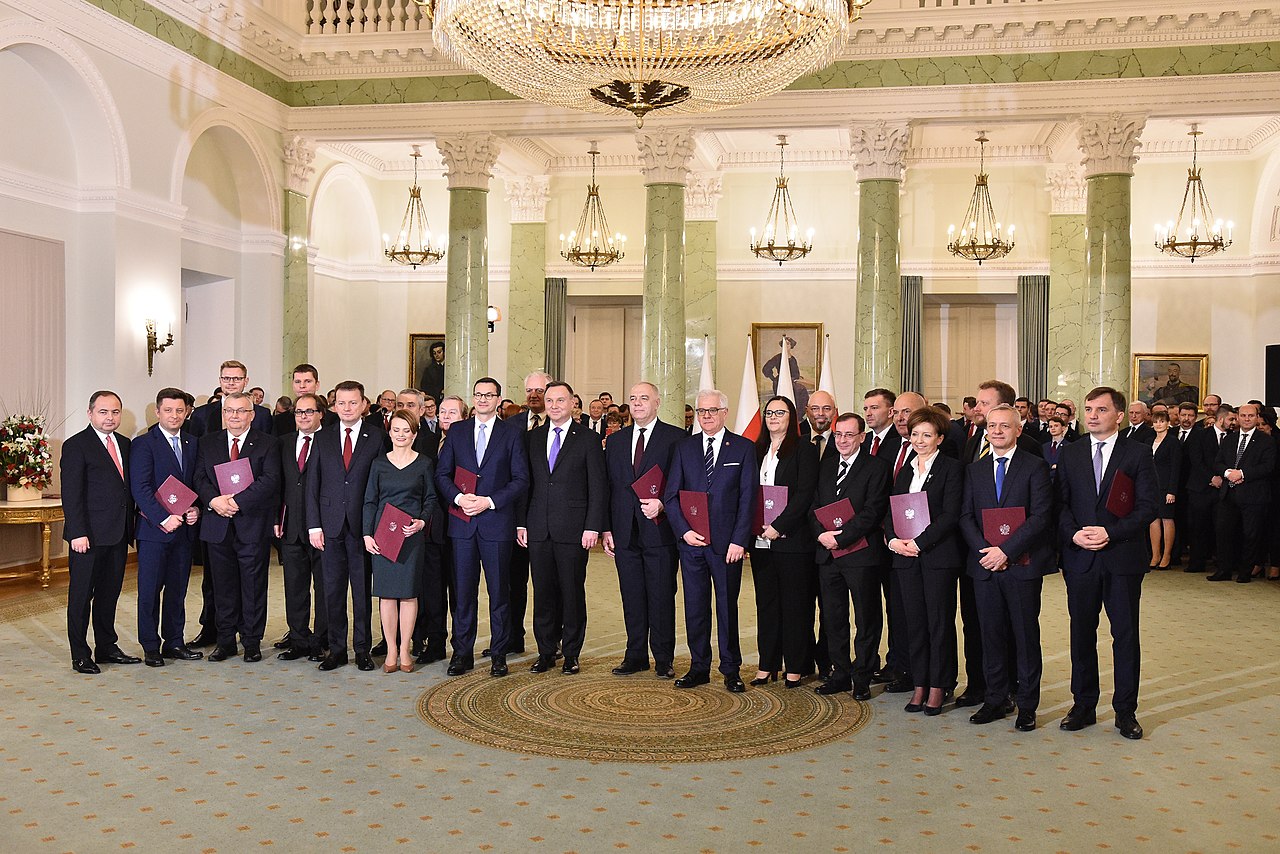
PiS won the October 13, 2019 Sejm elections with 43.59% of the vote — the largest share won by any single party in post-communist Poland — securing 235 out of 460 seats, enough for an outright majority. President Andrzej Duda, a PiS ally, designated Morawiecki to form a government on 9 November 2019. The cabinet was sworn in on 15 November 2019 and won a Sejm confidence vote on 19 November 2019 with 237 votes in favour. The team included key figures such as Zbigniew Ziobro as Minister of Justice and Prosecutor General, Mariusz Błaszczak as Minister of National Defence, and Piotr Gliński as Minister of Culture. The cabinet was notably smaller and more PiS-loyal than its predecessor, reflecting the party's dominant electoral position.
What Were the Cabinet's Major Policies and Controversies?
The cabinet's domestic agenda centred on expanding social welfare programmes, most notably the '500+' child benefit scheme (extended to the first child regardless of income), raising the minimum wage, and introducing a 13th pension payment. On the rule of law, the government continued judicial reforms that the European Commission ruled incompatible with EU treaties, resulting in Poland being fined €1 million per day by the European Court of Justice from October 2021 and the freezing of billions in EU recovery funds. The 2021 Belarus-Poland border crisis, in which Belarusian President Alexander Lukashenko engineered mass migrant crossings into Poland, led the cabinet to declare a state of emergency and construct a border barrier. Russia's full-scale invasion of Ukraine in February 2022 prompted the cabinet to open Poland's borders to over 1.5 million Ukrainian refugees and dramatically increase defence spending toward a target of 4% of GDP — the highest NATO commitment globally.
| Portfolio | Minister | Party |
|---|---|---|
| Prime Minister | Mateusz Morawiecki | PiS |
| Minister of Justice | Zbigniew Ziobro | United Right (Solidarna Polska) |
| Minister of National Defence | Mariusz Błaszczak | PiS |
| Minister of Foreign Affairs | Zbigniew Rau | PiS |
| Minister of Finance | Tadeusz Kościński / Magdalena Rzeczkowska | PiS |
| Minister of Culture | Piotr Gliński | PiS |
Why Did the Second Morawiecki Cabinet End?
In the October 15, 2023 parliamentary elections, PiS won the largest share of votes (35.4%) but fell short of a majority. Three opposition groupings — Civic Coalition, Third Way, and the Left — collectively won 248 seats and formed a coalition. President Duda controversially gave Morawiecki the first opportunity to form a government despite the arithmetic being against him; Morawiecki lost a confidence vote in the Sejm on 11 December 2023 by 190 votes to 266. Donald Tusk was subsequently appointed Prime Minister, and his cabinet was sworn in on 13 December 2023, ending the Second Morawiecki Cabinet's four-year run and eight consecutive years of PiS governance.
