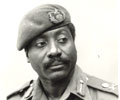
Fred Akuffo was a Ghanaian military officer who served as head of state from July 1978 to June 1979, after leading a palace coup that removed the corrupt General Ignatius Acheampong. A moderate and transitional figure, Akuffo lifted the ban on political parties, organised elections, and planned a return to civilian rule — but was overthrown by Flight Lieutenant Jerry Rawlings in June 1979 and executed just weeks later.
Who Was Fred Akuffo? Background and Military Career
Lieutenant General Frederick William Kwasi Akuffo was born on 21 March 1937 in Akropong, in Ghana's Eastern Region. He trained at the Royal Military Academy Sandhurst in the United Kingdom and rose steadily through the Ghana Armed Forces. By the mid-1970s he was one of the most senior officers in the country, serving as Chief of Defence Staff under Acheampong's Supreme Military Council. Respected for his professionalism, Akuffo was regarded as a pragmatist rather than an ideologue — a sharp contrast to the flamboyant and increasingly erratic Acheampong.
How Did Akuffo Come to Power in 1978?
By 1977–1978, Ghana was in deep crisis. Acheampong's government was mired in corruption, economic mismanagement, and a deeply unpopular proposal for a Union Government blending civilian and military rule. Inflation was rampant, basic goods were scarce, and professional associations — lawyers, doctors, teachers — staged strikes demanding an end to military rule. On 5 July 1978, senior officers of the Supreme Military Council, led by Akuffo, forced Acheampong to resign in a bloodless internal coup. Akuffo assumed the chairmanship of the reconstituted Supreme Military Council and immediately signalled a willingness to return power to civilians.
What Did Akuffo Accomplish as Head of State?
Akuffo moved quickly to liberalise Ghana's political environment. He lifted the ban on political parties in January 1979, allowing organisations suppressed since 1972 to reorganise and campaign openly. A constituent assembly drafted a new constitution, and parliamentary and presidential elections were scheduled for June 1979. He also released political detainees and attempted to stabilise Ghana's battered economy. Critics noted that his anti-corruption measures were half-hearted — Acheampong was placed under house arrest rather than prosecuted, a leniency that fuelled public anger among junior officers and ordinary Ghanaians.
The Rawlings Coup and Akuffo's Execution
On 4 June 1979, with elections just days away, junior military officers led by Flight Lieutenant Jerry John Rawlings launched a successful coup under the Armed Forces Revolutionary Council (AFRC). Rawlings justified the takeover as a house-cleaning exercise to punish corrupt leaders before civilians took over. Akuffo was arrested, tried before a special military tribunal, and convicted of corruption and economic mismanagement. On 26 June 1979, he was executed by firing squad at the Teshie Military Range alongside five other senior officers, including former heads of state Acheampong and General Afrifa. He was 42 years old. Ironically, the civilian elections Akuffo had organised proceeded as planned, and Hilla Limann was inaugurated as president in September 1979.
| Head of State | Period in Power | How Removed | Fate |
|---|---|---|---|
| Kwame Nkrumah | 1957–1966 | Military coup | Died in exile, 1972 |
| Akwasi Afrifa | 1969–1970 | Returned power to civilians | Executed, 1979 |
| Ignatius Acheampong | 1972–1978 | Internal military coup | Executed, 1979 |
| Fred Akuffo | 1978–1979 | Rawlings coup | Executed, 1979 |
| Jerry Rawlings (AFRC) | Jun–Sep 1979 | Handed power to civilians | Returned to power 1981 |