
Thomas Henry Huxley (4 May 1825 – 29 June 1895) was an English biologist and anthropologist who specialised in comparative anatomy. He has become known as "Darwin's Bulldog" for his advocacy of Charles Darwin's theory of evolution.
The stories regarding Huxley's famous 1860 Oxford evolution debate with Samuel Wilberforce were a key moment in the wider acceptance of evolution and in his own career, although some historians think that aspects of the surviving story of the debate are a later fabrication. Huxley had been planning to leave Oxford on the previous day, but, after an encounter with Robert Chambers, the author of Vestiges, he changed his mind and decided to join the debate. Wilberforce was coached by Richard Owen, against whom Huxley also debated about whether humans were closely related to apes.
Huxley was slow to accept some of Darwin's ideas, such as gradualism, and was undecided about natural selection, but despite this, he was wholehearted in his public support of Darwin. Instrumental in developing scientific education in Britain, he fought against the more extreme versions of religious tradition. Huxley coined the term "agnosticism" in 1869 and elaborated on it in 1889 to frame the nature of claims in terms of what is knowable and what is not.
Huxley had little formal schooling and was virtually self-taught. According to Edward Poulton, he became perhaps the finest comparative anatomist of the later 19th century. He worked on invertebrates, clarifying relationships between groups previously little understood. Later, he worked on vertebrates, especially on the relationship between apes and humans. After comparing Archaeopteryx with Compsognathus, he correctly concluded that birds evolved from small carnivorous dinosaurs.
Huxley was best known for his controversial and energetic advocacy of evolution, which had significant effects on society in Britain and elsewhere. Huxley's 1893 Romanes Lecture, "Evolution and Ethics", is influential in China; the Chinese translation of Huxley's lecture transformed the Chinese translation of Darwin's On the Origin of Species.
Early life
Thomas Henry Huxley was born in Ealing, then a village in Middlesex. He was the second youngest of eight children of George Huxley and Rachel Withers. His parents were members of the Church of England, but he sympathized with nonconformists. Like some other British scientists of the nineteenth century such as Alfred Russel Wallace, Huxley was brought up in a literate middle-class family which had fallen on hard times. His father was a mathematics schoolmaster at Great Ealing School until it closed, putting the family into financial difficulties. As a result, Thomas left school at the age of 10, after only two years of formal schooling.

Despite this lack of formal schooling, Huxley was determined to educate himself. He became one of the great autodidacts of the nineteenth century. At first he read Thomas Carlyle, James Hutton's Geology, and Sir William Hamilton's Logic. In his teens, he taught himself German, eventually becoming fluent and used by Charles Darwin as a translator of scientific material in German. He learned Latin, and enough Greek to read Aristotle in the original.
Later on, as a young adult, he made himself an expert, first teaching himself about invertebrates, and later on vertebrates. He did many of the illustrations for his publications on marine invertebrates. In his later debates and writing on science and religion, his grasp of theology was better than many of his clerical opponents.
He was apprenticed for short periods to several medical practitioners: at 13 to his brother-in-law John Cooke in Coventry, who passed him on to Thomas Chandler, notable for his experiments using mesmerism for medical purposes. Chandler's practice was in London's Rotherhithe amidst the squalor endured by the Dickensian poor. Afterward, another brother-in-law took him on: John Salt, his eldest sister's husband. Now aged 16, Huxley entered Sydenham College (behind University College Hospital), a cut-price anatomy school. All this time Huxley continued his programme of reading, which more than made up for his lack of formal schooling.

A year later, buoyed by excellent results and a silver medal prize in the Apothecaries' yearly competition, Huxley was admitted to study at Charing Cross Hospital, where he obtained a small scholarship. At Charing Cross, he was taught by Thomas Wharton Jones, Professor of Ophthalmic Medicine and Surgery at University College London. Jones had been Robert Knox's assistant when Knox bought cadavers from Burke and Hare. The young Wharton Jones, who acted as go-between, was exonerated of crime, but thought it best to leave Scotland. In 1845, under Wharton Jones' guidance, Huxley published his first scientific paper demonstrating the existence of a hitherto unrecognised layer in the inner sheath of hairs, a layer that has been known since as Huxley's layer. Later in life, Huxley organised a pension for his old mentor.
At twenty he passed his First M.B. examination at the University of London, winning the gold medal for anatomy and physiology. However, he did not present himself for the final (Second M.B.) exams and consequently did not qualify for a university degree. His apprenticeships and exam results formed a sufficient basis for his application to the Royal Navy.
Voyage of the Rattlesnake
Aged 20, Huxley was too young to apply to the Royal College of Surgeons for a licence to practise, yet he was "deep in debt". So, at a friend's suggestion, he applied for an appointment in the Royal Navy. He had references on character and certificates showing the time spent on his apprenticeship and on requirements such as dissection and pharmacy. William Burnett, the Physician General of the Navy, interviewed him and arranged for the College of Surgeons to test his competence (by means of a viva voce).

Finally, Huxley was made Assistant Surgeon ('surgeon's mate', but in practice marine naturalist) to HMS Rattlesnake, about to set sail on a voyage of discovery and surveying to New Guinea and Australia. The Rattlesnake left England on 3 December 1846 and, once it arrived in the southern hemisphere, Huxley devoted his time to the study of marine invertebrates. He began to send details of his discoveries back to England, where publication was arranged by Edward Forbes FRS (who had also been a pupil of Knox). Both before and after the voyage Forbes was something of a mentor to Huxley.
Huxley's paper "On the anatomy and the affinities of the family of Medusae" was published in 1849 by the Royal Society in its Philosophical Transactions. Huxley united the Hydroid and Sertularian polyps with the Medusae to form a class to which he subsequently gave the name of Hydrozoa. The connection he made was that all the members of the class consisted of two cell layers, enclosing a central cavity or stomach. This is characteristic of the phylum now called the Cnidaria. He compared this feature to the serous and mucous structures of embryos of higher animals. When at last he got a grant from the Royal Society for the printing of plates, Huxley was able to summarise this work in The Oceanic Hydrozoa, published by the Ray Society in 1859.
The value of Huxley's work was recognised and, on returning to England in 1850, he was elected a Fellow of the Royal Society. In the following year, at the age of twenty-six, he not only received the Royal Society Medal but was also elected to the Council. He met Joseph Dalton Hooker and John Tyndall, who remained his lifelong friends. The Admiralty retained him as a nominal assistant-surgeon, so he might work on the specimens he collected and the observations he made during the voyage of the Rattlesnake.

He solved the problem of Appendicularia, whose place in the animal kingdom Johannes Peter Müller had found himself wholly unable to assign. It and the Ascidians are both, as Huxley showed, tunicates, today regarded as a sister group to the vertebrates in the phylum Chordata. Other papers on the morphology of the cephalopods and on brachiopods and rotifers are also noteworthy. The value of the work done on these voyages was also commemorated in the name of "Rattlesnake Island" off the coast of Queensland.
Later life
Following a lecture at the Royal Institution on 30 April 1852 Huxley indicated that it remained difficult to earn a living as a scientist alone. This was demonstrated in a letter written on 3 May 1852, where he states "Science in England does everything—but PAY. You may earn praise but not pudding". However, Huxley effectively resigned from the navy by refusing to return to active service, and in July 1854 he became professor of natural history at the Royal School of Mines and naturalist to the British Geological Survey in the following year. In addition, he was Fullerian Professor at the Royal Institution 1855–1858 and 1865–1867; Hunterian Professor at the Royal College of Surgeons 1863–1869; president of the British Association for the Advancement of Science 1869–1870; president of the Quekett Microscopical Club 1878; president of the Royal Society 1883–1885; Inspector of Fisheries 1881–1885; and president of the Marine Biological Association 1884–1890. He was elected as a member to the American Philosophical Society in 1869.
The thirty-one years during which Huxley occupied the chair of natural history at the Royal School of Mines included work on vertebrate palaeontology and on many projects to advance the place of science in British life. Huxley retired in 1885, after a bout of depressive illness which started in 1884. He resigned the presidency of the Royal Society in mid-term, the Inspectorship of Fisheries, and his chair (as soon as he decently could) and took six months' leave. His pension was £1200 a year.

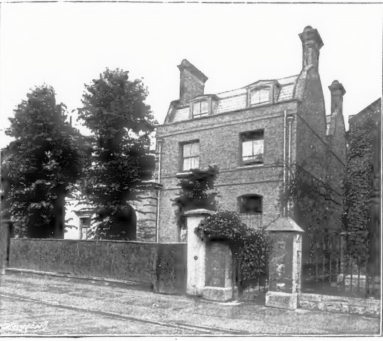
Huxley's London home, in which he wrote many of his works, was at 4 Marlborough Place, St John's Wood. The house was extended in the early 1870s to include a large drawing and dining room at which he held informal Sunday gatherings.
In 1890, he moved from London to Eastbourne, where he had purchased land in the Staveley Road upon which a house was built, 'Hodeslea', under the supervision of his son-in-law F. Waller. Here Huxley edited the nine volumes of his Collected Essays. In 1894 he heard of Eugene Dubois' discovery in Java of the remains of Pithecanthropus erectus (now known as Homo erectus).
He died of a heart attack (after contracting influenza and pneumonia) in 1895 in Eastbourne, and was buried in London at East Finchley Cemetery. No invitations were sent out but two hundred people turned up for the funeral; they included Joseph Dalton Hooker, William Henry Flower, Mulford B. Foster, Edwin Lankester, Joseph Lister, and apparently Henry James. The family plot had been purchased upon the death of his eldest son Noel, who died of scarlet fever in 1860; Huxley's wife Henrietta Anne née Heathorn and son Noel are also buried there.
Family
Huxley and his wife had five daughters and three sons:
Noel Huxley (1856–1860), died aged 3.
Jessie Oriana Huxley (1856–1927), married architect Fred Waller in 1877.
Marian Huxley (1859–1887), married artist John Collier in 1879.
Leonard Huxley (1860–1933), married Julia Arnold.
Rachel Huxley (1862–1934), married twice. Firstly civil engineer Alfred Eckersley in 1884; secondly Harold Shawcross in 1894.
Henrietta (Nettie) Huxley (1863–1940), married Harold Roller, travelled Europe as a singer.
Henry Huxley (1865–1946), became a fashionable general practitioner in London.
Ethel Huxley (1866–1941) married artist John Collier (widower of sister) in 1889.
Public duties and awards
From 1870 onwards, Huxley was to some extent drawn away from scientific research by the claims of public duty. He served on eight Royal Commissions, from 1862 to 1884. From 1871 to 1880 he was a Secretary of the Royal Society and from 1883 to 1885 he was president. He was president of the Geological Society from 1868 to 1870. In 1870, he was president of the British Association at Liverpool and, in the same year was elected a member of the newly constituted London School Board. He was president of the Quekett Microscopical Club from 1877 to 1879. He was the leading person amongst those who reformed the Royal Society, persuaded government about science, and established scientific education in British schools and universities.
He was awarded the highest honours then open to British men of science. The Royal Society, who had elected him as Fellow when he was 25 (1851), awarded him the Royal Medal the next year (1852), a year before Charles Darwin got the same award. He was the youngest biologist to receive such recognition.
He was elected to Honorary membership of the Manchester Literary and Philosophical Society in 1872.
Then later in life he received the Copley Medal in 1888 and the Darwin Medal in 1894; the Geological Society awarded him the Wollaston Medal in 1876; the Linnean Society awarded him the Linnean Medal in 1890. There were many other elections and appointments to eminent scientific bodies; these and his many academic awards are listed in the Life and Letters. He turned down many other appointments, notably the Linacre chair in zoology at Oxford and the Mastership of University College, Oxford.
In 1873 the King of Sweden made Huxley, Hooker and Tyndall Knights of the Order of the Polar Star: they could wear the insignia but not use the title in Britain. Huxley collected many honorary memberships of foreign societies, academic awards and honorary doctorates from Britain and Germany. He also became a foreign member of the Royal Netherlands Academy of Arts and Sciences in 1892. In 1916 a street in the Bronx, New York City, was named in his honour (Huxley Avenue).
As recognition of his many public services, he was appointed Privy Councillor in 1892.
Despite his many achievements, he was given no award by the British state until late in life. In this, he did better than Darwin, who got no award of any kind from the state. (Darwin's proposed knighthood was vetoed by ecclesiastical advisers, including Wilberforce.) Perhaps Huxley had commented too often on his dislike of honours, or perhaps his many assaults on the traditional beliefs of organised religion made enemies in the establishment – he had vigorous debates in print with Benjamin Disraeli, William Ewart Gladstone, and Arthur Balfour, and his relationship with Lord Salisbury was less than tranquil.
Huxley was for about thirty years evolution's most effective advocate, and for some Huxley was "the premier advocate of science in the nineteenth century [for] the whole English-speaking world".
Though he had many admirers and disciples, his retirement and later death left British zoology somewhat bereft of leadership. He had, directly or indirectly, guided the careers and appointments of the next generation. Huxley thought he was "the only man who can carry out my work": The deaths of Balfour and William Kingdon Clifford were "the greatest losses to science in our time".
Vertebrate palaeontology
The first half of Huxley's career as a palaeontologist is marked by a rather strange predilection for 'persistent types', in which he seemed to argue that evolutionary advancement (in the sense of major new groups of animals and plants) was rare or absent in the Phanerozoic. In the same vein, he tended to push the origin of major groups such as birds and mammals back into the Palaeozoic era, and to claim that no order of plants had ever gone extinct.
Much paper has been consumed by historians of science ruminating on this strange and somewhat unclear idea. Huxley was wrong to pitch the loss of orders in the Phanerozoic as low as 7%, and he did not estimate the number of new orders which evolved. Persistent types sat rather uncomfortably next to Darwin's more fluid ideas; despite his intelligence, it took Huxley a surprisingly long time to appreciate some of the implications of evolution. However, gradually Huxley moved away from this conservative style of thinking as his understanding of palaeontology, and the discipline itself, developed.
Huxley's detailed anatomical work was, as always, first-rate and productive. His work on fossil fish shows his distinctive approach: Whereas pre-Darwinian naturalists collected, identified, and classified, Huxley worked mainly to reveal the evolutionary relationships between groups.
The lobe-finned fish (such as coelacanths and lungfish) have paired appendages whose internal skeleton is attached to the shoulder or pelvis by a single bone, the humerus or femur. His interest in these fish brought him close to the origin of tetrapods, one of the most important areas of vertebrate palaeontology.
The study of fossil reptiles led to his demonstrating the fundamental affinity of birds and reptiles, which he united under the title of Sauropsida. His papers on Archaeopteryx and the origin of birds were of great interest then and still are.
Apart from his interest in persuading the world that man was a primate and had descended from the same stock as the apes, Huxley did little work on mammals, with one exception. On his tour of America Huxley was shown the remarkable series of fossil horses, discovered by Othniel Charles Marsh, in Yale University's Peabody Museum. An Easterner, Marsh was America's first professor of palaeontology, but also one who had come west into hostile Indian territory in search of fossils, hunted buffalo, and met Red Cloud (in 1874). Funded by his uncle George Peabody, Marsh had made some remarkable discoveries: the huge Cretaceous aquatic bird Hesperornis, and the dinosaur footprints along the Connecticut River were worth the trip by themselves, but the horse fossils were really special. After a week with Marsh and his fossils, Huxley wrote excitedly, "The collection of fossils is the most wonderful thing I ever saw."
The collection at that time went from the small four-toed forest-dwelling Orohippus from the Eocene through three-toed species such as Miohippus to species more like the modern horse. By looking at their teeth he could see that, as the size grew larger and the toes reduced, the teeth changed from those of a browser to those of a grazer. All such changes could be explained by a general alteration in habitat from forest to grassland. And, it is now known, that is what did happen over large areas of North America from the Eocene to the Pleistocene: The ultimate causative agent was global temperature reduction (see Paleocene–Eocene Thermal Maximum). The modern account of the evolution of the horse has many other members, and the overall appearance of the tree of descent is more like a bush than a straight line.
The horse series also strongly suggested that the process was gradual, and that the origin of the modern horse lay in North America, not in Eurasia. If so, then something must have happened to horses in North America, since none were there when Europeans arrived. The experience with Marsh was enough for Huxley to give credence to Darwin's gradualism, and to introduce the story of the horse into his lecture series.
Marsh's and Huxley's conclusions were initially quite different. However, Marsh carefully showed Huxley his complete sequence of fossils. As Marsh put it, Huxley "then informed me that all this was new to him and that my facts demonstrated the evolution of the horse beyond question, and for the first time indicated the direct line of descent of an existing animal. With the generosity of true greatness, he gave up his own opinions in the face of new truth, and took my conclusions as the basis of his famous New York lecture on the horse."
Support of Darwin
Huxley was originally not persuaded by "development theory", as evolution was once called. This can be seen in his savage review of Robert Chambers' Vestiges of the Natural History of Creation, an 1844 book which contained some quite pertinent arguments in favour of evolution. Huxley had also rejected Jean-Baptiste Lamarck's theory of transmutation, on the basis that there was insufficient evidence to support it. All this scepticism was brought together in a lecture to the Royal Institution, which made Darwin anxious enough to set about an effort to change young Huxley's mind. It was the kind of thing Darwin did with his closest scientific friends, but he must have had some particular intuition about Huxley, who was by all accounts a most impressive person even as a young man.
Huxley was therefore one of the small group who knew about Darwin's ideas before they were published (the group included Joseph Dalton Hooker and Charles Lyell). The first publication by Darwin of his ideas came when Wallace sent Darwin his famous paper on natural selection, which was presented by Lyell and Hooker to the Linnean Society in 1858 alongside excerpts from Darwin's notebook and a Darwin letter to Asa Gray. Huxley's famous response to the idea of natural selection was "How extremely stupid not to have thought of that!" However, he never conclusively made up his mind about whether natural selection was the main method for evolution, though he did admit it was a hypothesis which was a good working basis.
Logically speaking, the prior question was whether evolution had taken place at all. It is to this question that much of Darwin's On the Origin of Species was devoted. Its publication in 1859 completely convinced Huxley of evolution and it was this and no doubt his admiration of Darwin's way of amassing and using evidence that formed the basis of his support for Darwin in the debates that followed the book's publication.
Huxley's support started with his anonymous favourable review of the Origin in the Times for 26 December 1859, and continued with articles in several periodicals, and in a lecture at the Royal Institution in February 1860. At the same time, Richard Owen, whilst writing an extremely hostile anonymous review of the Origin in the Edinburgh Review, also primed Samuel Wilberforce who wrote one in the Quarterly Review, running to 17,000 words. The authorship of this latter review was not known for sure until Wilberforce's son wrote his biography. So it can be said that, just as Darwin groomed Huxley, so Owen groomed Wilberforce; and both the proxies fought public battles on behalf of their principals as much as themselves. Though we do not know the exact words of the Oxford debate, we do know what Huxley thought of the review in the Quarterly:
Since Lord Brougham assailed Dr Young, the world has seen no such specimen of the insolence of a shallow pretender to a Master in Science as this remarkable production, in which one of the most exact of observers, most cautious of reasoners, and most candid of expositors, of this or any other age, is held up to scorn as a "flighty" person, who endeavours "to prop up his utterly rotten fabric of guess and speculation," and whose "mode of dealing with nature" is reprobated as "utterly dishonourable to Natural Science."