
The Ukrainian Soviet Socialist Republic, abbreviated as the Ukrainian SSR, UkrSSR, UkSSR and also known as Soviet Ukraine or just Ukraine, was one of the constituent republics of the Soviet Union from 1922 until 1991. Under the Soviet one-party model, the Ukrainian SSR was governed by the Communist Party of the Soviet Union through its republican branch, the Communist Party of Ukraine.
The first iterations of the Ukrainian SSR were established during the Russian Revolution, particularly after the Bolshevik Revolution. The outbreak of the Ukrainian–Soviet War in the former Russian Empire saw the Bolsheviks defeat the independent Ukrainian People's Republic, during the conflict against which they founded the Ukrainian People's Republic of Soviets, which was governed by the Russian Soviet Federative Socialist Republic (RSFSR), in December 1917; it was later succeeded by the Ukrainian Soviet Republic in 1918. Simultaneously with the Russian Civil War, the Ukrainian War of Independence was being fought among the different Ukrainian republics founded by Ukrainian nationalists, Ukrainian anarchists, and Ukrainian separatists – primarily against Soviet Russia and the Ukrainian SSR, with either help or opposition from neighbouring states. In 1922, it was one of four Soviet republics (with the Russian SFSR, the Byelorussian SSR, and the Transcaucasian SFSR) that signed the Treaty on the Creation of the Soviet Union. As a Soviet quasi-state, the Ukrainian SSR became a founding member of the United Nations in 1945 alongside the Byelorussian SSR, in spite of the fact that they were also legally represented by the Soviet Union in foreign affairs. Upon the dissolution of the Soviet Union in 1991, Ukraine declared independence and became the present-day independent state of Ukraine, although a modified version of the Soviet-era constitution remained in force until the adoption of the Constitution of Ukraine in June 1996.
The republic's borders changed many times, with a general trend toward acquiring lands with ethnic Ukrainian population majority, and losing lands with other ethnic majorities. A significant portion of what is now western Ukraine was gained via the Soviet-German Molotov–Ribbentrop Pact, with the annexation of Eastern Galicia and Volhynia in 1939, significant portions of Romania in 1940, and Carpathian Ruthenia in Czechoslovakia in 1945. From the 1919 establishment of the Ukrainian SSR until 1934, the city of Kharkov served as its capital; however, the republic's seat of government was subsequently relocated in 1934 to the city of Kiev, the historic Ukrainian capital, and remained at Kiev for the remainder of its existence.

Geographically, the Ukrainian SSR was situated in Eastern Europe, to the north of the Black Sea, and was bordered by the Soviet republics of Moldavia (since 1940), Byelorussia, and Russia, and the countries of Romania, Hungary, Czechoslovakia, and Poland. The republic's border with Czechoslovakia formed the Soviet Union's westernmost border point. According to the 1989 Soviet census, the republic of Ukraine had a population of 51,706,746 (second after Russia).
Name
The original names of the republic in 1919 were both Ukraine and Ukrainian Socialist Soviet Republic (Ukrainian: Українська Соціалістична Радянська Республіка, romanized: Ukrainska Sotsialistychna Radianska Respublika, abbreviated УСРР, USRR). After the ratification of the 1936 Soviet Constitution, full official names of all Soviet republics were changed, transposing the second (socialist) and third (sovietskaya in Russian or radianska in Ukrainian) words. In accordance, on 5 December 1936, the 8th Extraordinary Congress Soviets in Soviet Union changed the name of the republic to the Ukrainian Soviet Socialist Republic, which was ratified by the 14th Extraordinary Congress of Soviets in Ukrainian SSR on 31 January 1937. This remained the name of the republic until the 1991 declaration of independence, after which the country became independent and adopted the name Ukraine.
History
Establishment: 1917–1922
Aftermath of the revolution
After the Russian Revolution of 1917, several factions sought to create an independent Ukrainian state, alternately cooperating and struggling against each other. Numerous more or less socialist-oriented factions participated in the formation of the Ukrainian People's Republic among which were Bolsheviks, Mensheviks, Socialists-Revolutionaries and many others. The most popular faction was initially the local Socialist Revolutionary Party that composed the local government together with Federalists and Mensheviks.

Following the abdication of Tsar Nicholas II during the February Revolution of 1917 in Petrograd, many people in Ukraine wished to establish an autonomous Ukrainian Republic. During a period of the Russian Civil War from 1917 to 1923, many factions claiming themselves governments of the newly born republic were formed, each with supporters and opponents. The two most prominent of them were an independent government in Kiev called the Ukrainian People's Republic (UNR) and a Soviet Russia-aligned government in Kharkov called the Ukrainian Soviet Republic (USR). The Kiev-based UNR was internationally recognized and supported by the Central Powers following the Treaty of Brest-Litovsk, whereas the Kharkov-based USR was solely supported by the Soviet Russian forces, while neither the UNR nor the USR were explicitly supported by the White Russian forces that remained, although there were attempts to establish cooperation during the closing stages of the war with the former.
Early Soviet governments
Immediately after the October Revolution in Petrograd, Bolsheviks instigated the Kiev Bolshevik Uprising to support the revolution and secure Kiev. Due to a lack of adequate support from the local population and governing anti-communist Central Rada, however, the Kiev Bolshevik group split. Most moved to Kharkov and received the support of the eastern Ukrainian cities and industrial centers. Later, this move was regarded as a mistake by some of the People's Commissars (Yevgenia Bosch). They issued an ultimatum to the Central Rada on 17 December to recognise the Soviet government of which the Rada was very critical. The Bolsheviks convened a separate congress and declared the first Soviet Republic of Ukraine on 24 December 1917 claiming the Central Rada and its supporters outlaws that need to be eradicated. The conflict between the two competing governments, known as the Ukrainian–Soviet War, was part of the ongoing Russian Civil War, as well as the Ukrainian War of Independence.
The government of the Ukrainian Soviet Republic was founded on 24–25 December 1917. In its publications, it named itself either the Republic of Soviets of Workers', Soldiers' and Peasants' Deputies or the Ukrainian People's Republic of Soviets. The 1917 republic was only recognised by another non-recognised country, the Russian Socialist Federative Soviet Republic. Warfare ensued against the Ukrainian People's Republic for the installation of the Soviet regime in the country, and with the direct support from Soviet Russia the Ukrainian National forces were practically overrun. The government of Ukraine appealed to foreign capitals, finding support in the face of the Central Powers as the others refused to recognise it. With the signing of the Brest-Litovsk Treaty by Russia, the Russian SFSR yielded all the captured Ukrainian territory as the Bolsheviks were forced out of Ukraine, and the Ukrainian People's Republic of Soviets was eventually dissolved.

In July 1918, the former members of the government formed the Communist Party (Bolsheviks) of Ukraine, the constituent assembly of which took place in Moscow. With the defeat of the Central Powers in World War I, the Bolsheviks resumed its hostilities towards the Ukrainian People's Republic fighting for Ukrainian independence and organised another Soviet Ukrainian government. The Provisional Workers' and Peasants' Government of Ukraine was created on November 28, 1918, in Kursk, with its initial seat being located in the city of Sudzha. On 10 March 1919, the Third All-Ukrainian Congress of Soviets ratified the Constitution of the Ukrainian Soviet Socialist Republic in Kharkiv. A group of three thousand workers were dispatched from Russia to take grain from local farms to feed Russian cities and were met with resistance. The Ukrainian language was also censured from administrative and educational use. Eventually fighting both White forces in the east and Ukrainian forces in the west, Lenin ordered the liquidation of the second Soviet Ukrainian government in August 1919.
Incorporation into the Soviet Union
Formally a sovereign republic until 1922, in view of some historians Soviet Ukraine de-facto came under control of Soviet Russia already in the course of the Civil War. In mid-1919, all republican organs responsible for the management of defence, economy, finance, transport and communications were subordinated to Russia's people's commissariats. After the creation of the Communist Party (Bolshevik) of Ukraine in Moscow, a third Ukrainian Soviet government was formed on 21 December 1919 that initiated new hostilities against Ukrainian nationalists as they lost their military support from the defeated Central Powers. Eventually, the Red Army ended up controlling much of the Ukrainian territory after the Polish-Soviet Peace of Riga. The war ended with the territory of pro-independence Ukrainian People's Republic being annexed into a new Ukrainian Socialist Soviet Republic, and western Ukraine being annexed into the Second Polish Republic.
In 1920–1921 Russia, Ukraine and several other Soviet republics officially established federative ties. In 1921 discussions emerged between two groups of the Bolshevik Party in relation to the nature of relations between Russia and other republics. One fraction, represented by Stalin, considered it necessary to incorporate the latter as federal subjects of Russia, meanwhile their opponents, led by Volodymyr Zatonsky, opposed Russian dominance and supported an equal federation. Meanwhile central Soviet ministries made attempts to establish direct control over enterprises in Ukraine, without consulting the republican government in Kharkiv, which led to protests from local authorities. Following Lenin's sickness, in 1922 Stalin proposed a project of the republics' incorporation into Soviet Russia on the rights of autonomies. However, Lenin opposed that idea, and promoted formal equality of republics including Russia, with simultaneous preservation of Moscow's central control. As a result, Soviet Russia's institutions attained the status of all-Union organs, achieving a higher status than organs of other republics.

On 30 December 1922, along with the Russian, Byelorussian and Transcaucasian republics, the Ukrainian SSR became one of the founding members of the Union of Soviet Socialist Republics (USSR). The 1924 Constitution of the Soviet Union formalized this act and declared the state to be based on the principles of dictatorship of the proletariat.
Interwar years: 1922–1939
New Economic Policy
The policies of War Communism led to the devastation of Ukraine's economy and decline of agriculture, provoking numerous peasant uprisings against Bolshevik authorities, which had to be suppressed with the use of troops of the Red Army. The collapse in the agrarian sphere produced a detrimental effect on the whole economy, and by early 1921 only 4,060 of more than 10,000 industrial enterprises in Ukraine continued their operations. This, in its turn, contributed to the collapse of transport system, with railways coming to a standstill. Even personnel of the Red Army stationed in Ukraine suffered from famine and lack of goods. In these circumstances, central authorities of the Bolshevik Party were forced to change their approach to the economy.
The discussions on the introduction of New Economic Policy (NEP), which started in Moscow cabinets during the early months of 1921, were initially met with skepticism by Ukrainian Communist leadership, which saw prodrazvyorstka as an essential component in the reconstruction of economy. After the 10th Congress of the Russian Communist Party (Bolsheviks), in May 1921 a council of Ukrainian party members in Kharkiv supported the transition to NEP despite some local opposition. A big role in that decision was played by massive peasant unrest. NEP didn't produce any significant changes in the Communist doctrine, but served as a tactical step in order to facilitate the exchange of goods between rural areas and the city. The introduction of the new system signified the failure of the Bolsheviks to rebuild agriculture according to Communist principles.
A severe drought hit Southern Ukraine throughout 1921, at the peak of the Soviet government's campaign of food requisitions from peasants. Unrealistic grain production quotas led to the refusal of peasants to give up their grain, as a result of which authorities answered with terror, including taking of hostages and mass shootings. Despite the visible food problems in Ukraine, the Bolsheviks refused to appeal for international help, concentrating their attention on the Volga region. As a result, a major famine engulfed Southern Ukraine and the Donbas, lasting until 1923. The lack of food resulted in a decline of insurgent activities against Soviet authorities, with some historians viewing the requisitions of food by the government as the first instance of terror through hunger in Ukraine.
Strengthening of Communist rule
In order to increase its influence in regions dominated by non-Russian ethnic groups, the Bolshevik Party leadership developed the program of korenizatsiya, which provided development of local languages and cultures with simultaneous preservation of centralized control. In Ukrainian SSR during the 1920s this process took the form of Ukrainization and involved promoting the use and the social status of the Ukrainian language and the elevation of ethnic Ukrainians to leadership positions. These policies provided Ukrainians an impression of national sovereignty, without abandoning the Communist Party's dictatorial rule. The "nationalization" of Soviet bureaucracy also contributed to an increased efficiency of management, strengthening the regime. At the same time, Soviet authorities clearly distinguished between "Communist" and "Petliurite" Ukrainization, seeing the latter as a threat to state unity. The campaign of Ukrainization aimed to prove the genuine character of Soviet rule in Ukraine and dispel the image of the regime as an alien occupying force. Its course was accelerated by power struggles in the Kremlin following the death of Lenin, which made it necessary for supreme party leadership to attain support of the Ukrainian society. At the same time, Russian preserved its role as the language of interethnic communication, with Russians remaining de-facto title nation of the Soviet Union. Ukrainization was halted in 1932-1933, when Stalin's regime proclaimed Ukrainian "bourgeois nationalism" to be the chief threat to Soviet unity.
A major role in Soviet Ukraine's internal affairs during the 1920s was played by the Cheka secret police and its successor OGPU (GPU). Directly subordinated to the Central Committee, those organs functioned as a "state within a state" and were tasked with supporting the party's monopoly on all levels of government and economy. To eliminate opposition to the regime, the secret police employed methods of public terror through show trials, which were an annual occurrence in Ukraine during that period. Chekists were independent from local institutions of government and reported directly to Moscow, which allowed the central government to establish stricter control over affairs in the regions. The head of GPU's Ukrainian branch simultaneously served as the chief envoy of Russian GPU in Ukraine. The secret police also had its own military force, and its departments functioned in the Red Army and in transport enterprises. GPU regularly delivered reports to Ukrainian party leadership, informing them about popular attitudes to the Soviet regime and organizing fictitious "anti-Soviet" organizations in order to eliminate political opponents. One of the most prominent of such "organizations" was the "Union for the Freedom of Ukraine".

Collectivization and Holodomor
In 1929–1930 a new campaign of grain requisition from peasants was initiated as part of the Soviet regime's collectivization policies. Simultaneously, tens of thousands of Ukrainians were deported in course of dekulakization, causing serious damage to the agricultural workforce. The creation of collective farms led to the pauperization of Ukrainian peasantry and led to cases of armed resistance in various parts of the country. In December 1930 Central Committee of the Communist Party of Ukraine adopted a decision to introduce additional taxes and grain requisitions for those villagers who refused to collectivize. As a result, over 70% peasant households in Soviet Ukraine had entered collective farms by late 1932.
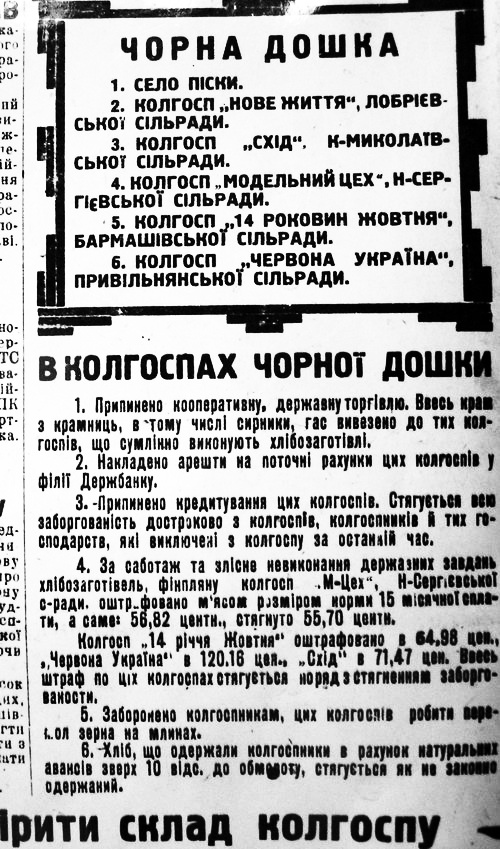
The aggressive agricultural policies of Stalin's regime resulted in one of the largest national catastrophes in the modern history for the Ukrainian nation. A famine known as the Holodomor caused a direct loss of human life estimated between 2.6 million to 10 million. The famine was exacerbated by the fact, that grain storages in Soviet Ukraine were controlled by the Soviet Union's central authorities. In addition, transportation of private grain was outlawed, and peasants from famine-affected areas leaving Ukraine to buy goods in other regions of the USSR were turned back by guards. The Law of Spikelets, adopted by the Council of People's Commissars on 7 August 1932, introduced execution by firing squad for appropriation of collective farms' property, including grain from uncultivated fields. Along with mass requisitions of grain, the employment of such methods in Ukraine had a political nature, aiming to eliminate all resistance to the central government. Weakened by the campaign of dekulakization and confiscation of weapons by the Cheka, Ukrainian peasants were unable to effectively resist the regime's policies. The campaign of government terror against rural inhabitants relied on part of the local cadres, which received preferential treatment, including access to food supplies. The practice of blacklisting resulted in a blockade of numerous settlements, whose inhabitants were deprived of all food and died of starvation. According to a telegram sent by Stalin on 1 January 1933 to Ukrainian Communist leadership, all peasants suspected of hiding grain were to have their entire property, including food products, confiscated. Any mention of the famine was banned by Soviet authorities until the 1980s.
Some scholars and the World Congress of Free Ukrainians assert that the famine was an act of genocide. The International Commission of Inquiry Into the 1932–1933 Famine in Ukraine found no evidence that the famine was part of a preconceived plan to starve Ukrainians, and concluded in 1990 that the famine was caused by a combination of factors, including Soviet policies of compulsory grain requisitions, forced collectivization, dekulakization, and Russification. The General Assembly of the UN has stopped shy of recognizing the Holodomor as genocide, calling it a "great tragedy" as a compromise between tense positions of United Kingdom, United States, Russia, and Ukraine on the matter, while some nations went on to individually categorize it as genocide, including France, Germany, and the United States after the 2022 Russian invasion of Ukraine.
Stalinist terror
Beginning from the late 1920s, Stalin's dictatorial regime introduced a system of total and permanent terror against perceived "remnants of ruling classes", "counterrevolutionaries", "enemies of the people", "saboteurs", spies and even party members. Even supporters of the regime were persecuted for mere criticism of some of its practices. In order to physically liquidate potential dissenters, GPU and its successor NKVD was involved in creation of fictional "counterrevolutionary organizations", with people accused of participating in them being put on trial and executed.
Among the first groups to become victims of Stalinist terror were National Communists, followed by technical specialists and engineers (Shakhty Trial) and members of intelligentsia ("Union for the Freedom of Ukraine"). As a result of government persecution, several prominent Ukrainian Communists were driven to suicide, among them Mykola Khvylyovy, Mykola Skrypnyk and Panas Liubchenko. Millions of Ukrainians ended up in concentration camps, where they were used as cheap labour force, and hundreds of thousands became victims of mass executions, such as Vinnytsia massacre. Mass terror continued until 1938, reaching its peak during the tenure of Nikolay Yezhov. In Ukraine its main executors were security officers Martin Latsis and Vsevolod Balitsky, as well as party secretaries Pavel Postyshev and Nikita Khrushchev.
World War II: 1939–1945
Annexation of Western Ukraine
In September 1939, following the signing of Molotov-Ribbentrop Pact, the Soviet Union invaded Poland. Official Soviet propaganda depicted the invasion as a "campaign of liberation" aimed to "free" ethnic Ukrainians and Belarusians from Polish rule. According to the Treaty on Friendship and Borders from 28 September 1939, Soviet Union and Nazi Germany partitioned the Polish state, as a result of which approximately 200,000 sq km of territory with a population of 12 million people was incorporated into the USSR. Following the campaign against Poland, as well as the subsequent Soviet annexation of Bessarabia and Northern Bukovina from Romania in 1940, newly incorporated territories were divided into oblasts, of which Volyn, Drohobych, Lviv, Rivne, Stanislaviv, Ternopil, Chernivtsi and Izmail oblasts were attached to the Ukrainian SSR. As a result, the republic increased its territory to 560,000 sq km, with its population reaching 41,657,000 inhabitants. Despite government propaganda, the attachment of Western Ukraine to the Soviet Union was seen by many Ukrainians not as a unification of their country, but as an illegitimate partition of Poland. The newly annexed territories underwent rapid Sovietization, with landowners' holdings being divided between peasants. Between February 1940 and June 1941 320,000 people were forcibly deported from Western Ukraine and Western Belarus. Polish prisoners of war were interned in special camps, and more than 14,000 of them were extrajudicially executed in Katyn, Kharkiv and Tver. The repressions by Stalinist regime had a preventive character, with all people potentially able to resist the regime being eliminated.
German–Soviet War
Immediately after the start of German-Soviet War in June 1941, Ukraine became a theatre of major battles between Wehrmacht and the Red Army. In the Battle of Brody mechanized units of the Soviet Southwestern Front suffered a crushing defeat from German forces. Stavka was reluctant to allow Red Army units an organized retreat, which led to their failure to organize defence on the "Stalin Line". By 10 July 1941, German forces found themselves on distant approaches to Kyiv. In August, German forces broke the Southern Front and encircled over 100,000 Red Army soldiers at Uman. Advancing from the Moscow direction, tank divisions of Guderian and Kleist on 15 September closed another ring of encirclement in the vicinity of Bakhmach, Lokhvytsia and Lubny. According to Soviet data, 453,000 Soviet soldiers and officers were captured by Germans in the area. On 18 September Red Army troops left Kyiv, but only a small number of them succeeded to break through German lines and reach Soviet positions. On 30 September Stavka ordered the withdrawal of troops located in Odesa defensive area to Crimea. By October, the Germans had captured Kharkiv and Stalino, advancing to Mariupol, Taganrog and Rostov.
During the first months of 1942, Soviet forces engaged in fierce battles against Germans in the Donbas. However, a Red Army counteroffensive near Kharkiv ended in failure, leading to deaths of 171,000 Soviet troops and capture of another 240,000. In July German forces captured Sevastopol, eliminating all Soviet regular forces in Crimea. On 27 July 1942 last Soviet troops retreated from Shchotove in Luhansk Oblast, signifying the occupation of the whole territory of Soviet Ukraine by Nazi Germany. In the course of Soviet retreat, starting from June 1941 over 550 industrial enterprises and over 3,5 million workers were evacuated from Ukraine. All objects which couldn't be evacuated were to be destroyed as part of scorched earth tactics. Among structures demolished during the retreat were the Dnieper Hydroelectric Station, numerous coal mines and many streets in Kyiv, Kharkiv and other cities. The heavy damage to infrastructure produced by such policies exacerbated the state of civilians in occupied territories.
According to various data, between 2,4 and 3,4 million Red Army soldiers were captured by Germans during 1941 only. In Ukraine, most of local captives were released in order not to provoke resistance. However, in many cases captured soldiers would be shot by Germans due to lack of personnel which could be used for guarding them. Mass release of prisoners was stopped in November 1941. Nevertheless, mass surrender of Soviet troops continued well into 1942, demonstrating the lack of support for the Soviet regime, which many recognized to be responsible for deportations, famines and mass repressions. Captured soldiers were forced to live in terrible conditions, with millions of Red Army soldiers perishing in prisoner camps. According to statistics, up to two-thirds of Soviet prisoners of war captured in the Eastern Front had died by the end of 1944.
Nazi occupation
According to the plans of Hitler and his closest circle, occupied Ukraine was to become part of the Greater German Reich. After a treaty signed between Germany and the regime of Ion Antonescu, Odesa, southern parts of Vinnytsia and western part of Mykolaiv oblasts were unified into Transnistria Governorate, and along with Izmail and Chernivtsi oblasts attached to Romania. Lviv, Drohobych, Stanislaviv and Ternopil oblasts were incorporated into the General Governorate along with most occupied Poland, meanwhile Right-bank and most of Left-bank Ukraine along with a number of southern areas were put under the civil administration of Reichskommissariat Ukraine. Crimea and Eastern Ukraine remained under control of the German military administration.
In advance to the invasion, Hitler's regime organized four Einsatzgruppen tasked with eliminating "ideological and racial enemies" of the Reich. During the years of German occupation, 1,554,000 Jews were murdered in the modern-day borders of Ukraine. Just in two days in late September 1941, members of Einsatzgruppe C killed 34,000 Jews in the Babi Yar ravine near Kyiv. Orders issued by the Wehrmacht supreme command de-facto removed any responsibility for killing of civilians from German soldiers and offciers. In order to support the German war effort, over 2 million of Ukrainians were forcibly mobilized as Ostarbeiter and sent to Germany. About 450,000 of them died due to lack of food, hard work, poor medical care and allied bombings. Nazi plans for Ukraine included the removal of industrial equipment from the country and its transformation into an agricultural colony. The German administration refused to disband collective farms, and used their infrastructure for requisition of grain and other products. These policies led to a massive wave of hunger in German-occupied cities, forcing many urban inhabitants to sell their personal belongings in exchange for food. The Nazi Hunger Plan was aimed to eliminate Ukraine's population and replace it with German settlers as part of the Lebensraum project.
Liberation movements
Starting from mid-1942, Nazi policies led to a significant growth in the partisan movement in Ukrainian lands. Soviet partisan squads in Ukraine were subordinated to a central headquarters led by Tymofiy Strokach, and by 1942 numbered over 3,000 members. Their biggest detachments were led by Sydir Kovpak, Alexander Saburov and Oleksiy Fedorov. Partisans aided the actions of the Red Army by sabotaging German-controlled railways and bridges, destroying enemy bases and storage facilities. At the same time, members of partisan squads frequently engaged in maraudery against local civilians, causing their hostile attitude to the resistance. After the Lvov-Sandomierz Offensive in August 1944, most partisans in Ukraine became regular members of the Soviet Army.
Simultaneously with Soviet partisans, Ukrainian nationalists also engaged in guerrilla activities in Ukraine during the Second World War. Between 1939 and 1941 the Organization of Ukrainian Nationalists (OUN) allied itself with Nazis due to their mutual hostility against Poland and the USSR. In April 1941, the OUN congress in Kraków signified a split in the movement, with the establishment of two separate organizations - the OUN-B led by Stepan Bandera and the OUN-M headed by Andriy Melnyk. Both groups created commissions tasked with establishment of institutions for a future sovereign Ukrainian state. OUN members were supported in their anti-Soviet actions by Abwehr leader Wilhelm Canaris, who allowed the creation of two Ukrainian nationalist battallions under code names Roland and Nachtigall. After the retreat of Soviet troops, the number of Bandera's armed supporters in western regions of Ukraine reached 12,000. On 29 June 1941 OUN members launched an uprising in Lviv, and after the entry of German troops on the next day OUN-B member Yaroslav Stetsko proclaimed the Act of restoration of the Ukrainian state. However, already on 15 July German police performed arrests of OUN-B members, with leaders of the organization being sent to Sachsenhausen concentration camp.
Starting from October 1942, Ukrainian nationalists initiated the formation of the Ukrainian Insurgent Army (UPA), whose units engaged in fighting against both German occupiers and Soviet partisans. In autumn 1943 UPA was formally subordinated to the Ukrainian Supreme Liberation Council dominated by members of OUN-B. Supporters of Melnyk refused to enter the organization. Blaming local Poles of collaboration with Nazis, in July 1943 UPA forces under command of Dmytro Klyachkivsky organized a campaign of ethnic cleansing against the Polish inhabitants in Volhynia. In November 1943 Klyachkivsky was removed from his post and replaced by Roman Shukhevych.
Soviet counteroffensive
Following the Battle of Stalingrad, between December 1942 and February 1943 Soviet forces expelled German troops from easternmost parts of Ukraine up to the Mius river. Following the Battle of Kursk, in Autumn 1943 Soviet armies advanced to the Dnieper, and on 6 November entered Kyiv. In the course of Korsun and Nikopol-Kryvyi Rih offensives, Soviet Union reestablished control over large parts of Right-bank Ukraine, and in March 1944 forces of the 1st Ukrainian Front took Vinnytsia, Proskuriv and Chernivtsi. In April armies of the 3rd Ukrainian Front took Odesa, and on 9 May units of the 4th Ukrainian Front entered Sevastopol, establishing control over Crimea. Following Operation Bagration, Soviet armies advanced through Western Ukraine into Poland, and by 28 October 1944 expelled German troops from Transcarpathia.
The return of Soviet authorities to Ukraine was accompanied with mass forced mobilization of locals, aimed to deprive Ukraianian nationalists of their pool for recruitment of new members. In order to combat nationalist guerrilla activities, Soviet NKVD organized special groups formed of captured UPA members, which were tasked with infiltrating the organization and eliminating its members. The Soviet regime also practiced collective punishment against family members of insurgents. According to official data, between 1944 and 1945 over 103,000 rebels were killed and over 110,000 captured. Over 30,000 people were deported from Western Ukraine to remote regions of the USSR for their cooperation with anti-Soviet resistance.
Post-war years: 1945–1953
Aftermath of war
While World War II (called the Great Patriotic War by the Soviet government) did not end before May 1945, the Germans were driven out of Ukraine between February 1943 and October 1944. The first task of the Soviet authorities was to reestablish political control over the republic which had been entirely lost during the war. This was an immense task, considering the widespread human and material losses. During World War II the Soviet Union lost about 8.6 million combatants and about 18 million civilians, of these, 6.8 million were Ukrainian civilians and military personnel. Also, an estimated 3.9 million Ukrainians were evacuated to the Russian Soviet Federative Socialist Republic during the war, and 2.2 million Ukrainians were sent to forced labour camps by the Germans.
The material devastation was huge; Adolf Hitler's orders to create "a zone of annihilation" in 1943, coupled with the Soviet military's scorched-earth policy in 1941, meant Ukraine lay in ruins. These two policies led to the destruction of more than 28,000 villages and 714 cities and towns. 85 percent of Kyiv's city centre was destroyed, as was 70 percent of the city centre of the second-largest city in Ukraine, Kharkiv. Because of this, 19 million people were left homeless after the war. The republic's industrial base, as so much else, was destroyed. The Soviet government had managed to evacuate 544 industrial enterprises between July and November 1941, but the rapid German advance led to the destruction or the partial destruction of 16,150 enterprises. 27,910 collective farms, 1,300 machine tractor stations and 872 state farms were destroyed by the Germans.
Expansion and international recognition
While the war brought to Ukraine an enormous physical destruction, victory also led to territorial expansion. As a victor, the Soviet Union gained new prestige and more land. During the Tehran Conference in 1943, British prime minister Winston Churchill negotiated a plan with Stalin, according to which lands of Poland populated by ethnic Ukrianians and Belarusians would be transferred to Soviet Ukraine and Soviet Belarus respectively, in exchange for which Poland would receive parts of German territory. The new Polish-Ukrainian border would generally follow the Curzon Line. Following the expulsion of Germans, between 1944 and 1946 Poland and Soviet Ukraine performed a population exchange, in course of which 810,400 Poles were resettled from Ukraine into Poland, and 482,900 Ukrainians had to leave Poland for Ukraine. Further 150,000 of Ukrainians would be deported from Polish territory during the Operation Vistula in 1947. A population exchange was also organized between Ukraine and Czechoslovakia.
On 26 November 1944, a council of people's committees in Transcarpathia adopted a resolution on the creation of a "People's Council" headed by Czechoslovak Communist Ivan Turyanytsia, and proclaimed the unification of the region with Soviet Ukraine. In May 1945 Avhustyn Voloshyn, the former president of Carpatho-Ukraine, was arrested by Soviet secret police, and on 29 June 1945 Czechoslovakia officially agreed to transfer Carpathian Ruthenia to the Ukrainian SSR. Ukraine was also expanded southwards, near the area Izmail, previously part of Romania. As a result, the territory of Ukraine expanded by 167,000 square kilometres (64,500 sq mi) and the republic increased its population by an estimated 11 million.
After World War II, amendments to the Constitution of the Ukrainian SSR were accepted, which allowed it to act as a separate subject of international law in some cases and to a certain extent, remaining a part of the Soviet Union at the same time. In particular, these amendments allowed the Ukrainian SSR to become one of the founding members of the United Nations (UN) together with the Soviet Union and the Byelorussian SSR. This was part of a deal with the United States to ensure a degree of balance in the General Assembly, which, the USSR opined, was unbalanced in favor of the Western Bloc. In its capacity as a member of the UN, the Ukrainian SSR was an elected member of the United Nations Security Council in 1948–1949 and 1984–1985. In 1954 Ukraine also became a member of UNESCO.
Soviet policies and resistance
Despite a severe drought in the country, in 1946 Soviet authorities refused to decrease the planned amounts of harvest in Ukraine, and signed agreements on grain exports to Poland, France, Bulgaria, Romania and Czechoslovakia in order to support the local Comunist movements. As a result, a new famine started in the Ukrainian province, leading to hundreds of thousands of deaths. Unlike in 1933, relief to the affected areas was provided both by the Soviet authorities and by the UNRRA. At the same time, in order to raise the productivity of agriculture, the Soviet central government adopted the Great Plan for the Transformation of Nature, introduced community trials for unproductive farmers and attempted to increase the size of collective farms. In 1955 the party leadership adopted a resolution, ordering local authorities to dispatch 30,000 young specialists for work in collective farms and sovkhozes. Starting from 1954, hundreds of thousands of agricultural workers were sent to the Kazakh SSR as part of Nikita Khrushchev's Virgin Lands campaign.