
Dr. Stephen Vincent Strange is a superhero appearing in American comic books published by Marvel Comics. Created by artist Steve Ditko with scripting by Stan Lee, the character first appeared in Strange Tales #110 (cover-dated July 1963). Doctor Strange serves as the Sorcerer Supreme, the primary protector of the Earth dimension against magical and mystical threats. Doctor Strange was introduced during the Silver Age of Comic Books in an attempt to bring a different kind of character and themes of mysticism to Marvel Comics.
The character starts as an intelligent and arrogant neurosurgeon who is injured in a car accident. Because his hands had suffered severe nerve damage from the accident, he was told that current medical therapy and rehabilitation would not be enough to enable him to practice again as a surgeon. Unable to accept this prognosis, he travels the world searching for alternative ways of healing, which leads him to the Ancient One, the Sorcerer Supreme. Strange becomes his student and learns to be a master of the mystical arts. He acquires an assortment of mystical objects, including the powerful Eye of Agamotto and Cloak of Levitation, and takes up residence in a mansion referred to as the Sanctum Sanctorum, located at 177A Bleecker Street, Greenwich Village, Manhattan, New York City. Strange assumes the title of Sorcerer Supreme and, with his friend and valet Wong, defends the world from mystical threats.
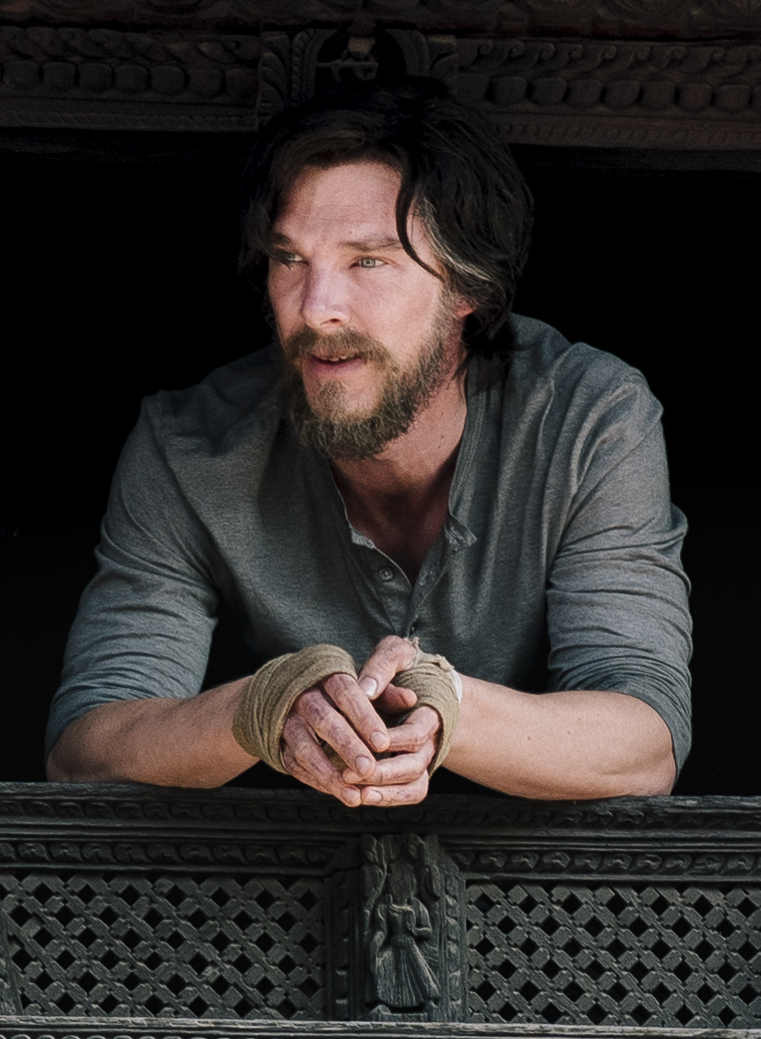
In live-action adaptations, the character was first portrayed by Peter Hooten in the 1978 television film Dr. Strange. Since 2016, Benedict Cumberbatch has portrayed the role of Stephen Strange in the Marvel Cinematic Universe.
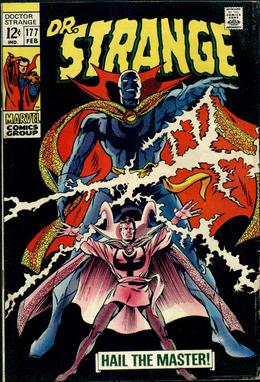
Publication history
Creation
Artist Steve Ditko and writer Stan Lee have described the character as having been originally the idea of Ditko, who wrote in 2008, "On my own, I brought in to Lee a five-page, penciled story with a page/panel script of my idea of a new, different kind of character for variety in Marvel Comics. My character wound up being named Dr. Strange because he would appear in Strange Tales." In a 1963 letter to Jerry Bails, Lee called the character Ditko's idea, saying:
Well, we have a new character in the works for Strange Tales (just a 5-page filler named Dr. Strange) Steve Ditko is gonna draw him. It has sort of a black magic theme. The first story is nothing great, but perhaps we can make something of him-- 'twas Steve's idea and I figured we'd give it a chance, although again, we had to rush the first one too much. Little sidelight: Originally decided to call him Mr. Strange, but thought the "Mr." bit too similar to Mister Fantastic -- now, however, I remember we had a villain called Dr. Strange just recently in one of our mags, hope it won't be too confusing!
Early years
Doctor Strange debuted in Strange Tales #110 (July 1963), a split book shared at the time with the feature "The Human Torch" and later with the feature "Nick Fury, Agent of S.H.I.E.L.D." Doctor Strange appeared in issues #110–111 and #114 before the character's eight-page origin story in #115 (December 1963). His origin was later retold in Doctor Strange #169 (February 1968). Scripter Lee's take on the character was inspired by the Chandu the Magician radio program that aired on the Mutual Broadcasting System in the 1930s. He had Doctor Strange accompany spells with elaborate artifacts, such as the "Eye of Agamotto" and the "Wand of Watoomb", as well as mystical-sounding vocabulary such as "Hoary Hosts of Hoggoth!" or "Shades of the Seraphim!" Although these names were sometimes evocative of established mythological or theological beings, such as the Biblical Seraphim, Lee has said he never had any idea what the incantations meant and used them simply because they sounded mystical and mysterious. Ditko showcased surrealistic mystical landscapes and increasingly vivid visuals that helped make the feature a favorite of college students at the time. Comics historian Mike Benton wrote:

The Dr. Strange stories of the 1960s constructed a cohesive cosmology that would have thrilled any self-respecting theosophist. College students, minds freshly opened by psychedelic experiences and Eastern mysticism, read Ditko and Lee's Dr. Strange stories with the belief of a recent Hare Krishna convert. Meaning was everywhere, and readers analyzed the Dr. Strange stories for their relationship to Egyptian myths, Sumerian gods, and Jungian archetypes.
"People who read Doctor Strange thought people at Marvel must be heads [i.e., drug users]," recalled then-associate editor and former Doctor Strange writer Roy Thomas in 1971, "because they had had similar experiences high on mushrooms. But I don't use hallucinogens, nor do I think any artists do."
Originating in the early 1960s, the character was a predictor of trends in the art prior to them becoming more established in the later counterculture of the 1960s. As historian Bradford W. Wright described:
Steve Ditko contributed some of his most surrealistic work to the comic book and gave it a disorienting, hallucinogenic quality. Dr. Strange's adventures take place in bizarre worlds and twisting dimensions that resembled Salvador Dalí paintings. Inspired by the pulp fiction magicians of Stan Lee's childhood as well as by contemporary Beat culture, Dr. Strange remarkably predicted the youth counterculture's fascination with Eastern mysticism and psychedelia. Never among Marvel's more popular or accessible characters, Dr. Strange still found a niche among an audience seeking a challenging alternative to more conventional superhero fare.
As co-plotter and later sole plotter in the Marvel Method of scripting, Ditko took Strange into ever-more-abstract realms. In a 17-issue story arc in Strange Tales #130–146 (March 1965 – July 1966), Ditko introduced the cosmic character Eternity, who personified the universe and was depicted as a silhouette filled with the cosmos. Golden Age of Comic Books artist/writer Bill Everett succeeded Ditko as an artist with issues #147–152, followed by Marie Severin through #160 and Dan Adkins through #168, the final issue before the Nick Fury feature moved to its own title and Strange Tales was renamed Doctor Strange. Expanded to 20 pages per issue, the Doctor Strange solo series ran 15 issues, #169–183 (June 1968 – November 1969), continuing the numbering of Strange Tales. Thomas wrote the run of new stories, joined after the first three issues by the art team of penciler Gene Colan and inker Tom Palmer through the end.
After plans were announced for a never-released split book series featuring Doctor Strange and Iceman, each in solo adventures, Strange next appeared in the first three issues (December 1971 – June 1972) of the quarterly showcase title Marvel Feature. He appeared in both the main story detailing the formation of superhero team the Defenders, and the related solo back-up story. The character then starred in a revival solo series in Marvel Premiere #3–14 (July 1972 – March 1974). This arc marked the debut of another recurring foe, the entity Shuma-Gorath, first alluded to by writer Gardner Fox in Marvel Premiere #5 and later fully imagined by writer Steve Englehart and artist Frank Brunner, who took over as the regular creative team starting with Marvel Premiere #9. Englehart and Brunner collaborated closely on the stories, meeting over dinner every two months to discuss the series, and their run became known for its psychedelic visuals and plots. In issues #8–10 (May–September 1973), Strange is forced to shut down the Ancient One's mind, causing his mentor's physical death. Strange then assumes the title of Sorcerer Supreme. Englehart and Brunner created another multi-issue storyline featuring sorcerer Sise-Neg ("Genesis" spelled backward) going back through history, collecting all magical energies, until he reaches the beginning of the universe, becomes all-powerful and creates it anew, leaving Strange to wonder whether this was, paradoxically, the original creation. Stan Lee, seeing the issue after publication, ordered Englehart and Brunner to print a retraction saying this was not God but a god, to avoid offending religious readers. According to Frank Brunner, he and Englehart concocted a fake letter from a fictitious minister praising the story, and mailed it to Marvel from Texas. Marvel unwittingly printed the letter in Doctor Strange #3 and dropped the retraction.
Due to the growing number of Doctor Strange readers, the Marvel Premiere series segued to the character's second ongoing title, Doctor Strange: Master of the Mystic Arts, also known as Doctor Strange vol. 2, which ran 81 issues (June 1974 – Feb. 1987). Doctor Strange #14 featured a crossover story with The Tomb of Dracula #44, another series which was being drawn by Gene Colan at the time. In Englehart's final story, he sent Strange back in time to meet Benjamin Franklin.
1980s
Strange met his allies Topaz in #75 (February 1986) and Rintrah in #80 (December 1986). The series ended on a cliffhanger as his home, the Sanctum Sanctorum, was heavily damaged during a battle. Among the losses were Doctor Strange's entire collection of mystic books and other important artifacts. As a consequence, Strange was now considerably weaker, and several spells designed to protect humanity from vampires and the evil serpent god Set expired.
The title was discontinued and the character's adventures transferred to another split-book format series. Strange Tales vol. 2, #1–19 (April 1987–Oct. 1988) was shared with street heroes Cloak and Dagger. This new Doctor Strange series resolved Strange's quest to reclaim his power and missing artifacts, and resurrected the Defenders, who had died in the last issue of that team's title.
1990s
Strange was returned to his own series, this time titled Doctor Strange: Sorcerer Supreme, which ran 90 issues (November 1988 – June 1996). The initial creative team was writer Peter B. Gillis and artists Richard Case and Randy Emberlin, soon replaced by returning writer Roy Thomas and artist Butch Guice, with storylines often spanning multiple issues. Strange lost the title of "Sorcerer Supreme" in issues #48–49 (Dec. 1992 – Jan. 1993) when he refused to fight a war on behalf of the Vishanti, the mystical entities that empower his spells. During this time the series became part of the "Midnight Sons" group of Marvel's supernatural comics. Doctor Strange found new sources of magical strength in the form of chaos magic, as well as a magic construct he used as a proxy. He would form the Secret Defenders with a rotating roster of heroes, and reunite with the original Defenders. Strange regained his title in Doctor Strange: Sorcerer Supreme #80 (August 1995).
Strange appeared with the Human Torch and the Thing in the one-shot publication Strange Tales vol. 3, #1 (Nov. 1994).
The character was featured in several limited series. The first was Doctor Strange: The Flight of Bones #1–4 (February–May 1999), with a series of spontaneous combustions by criminals instigated by old foe Dormammu. Strange was the catalyst for the creation of a trio of sorceresses in Witches #1–4 (August–November 2004). The Strange limited series (November 2004 – July 2005) by writers J. Michael Straczynski and Samm Barnes updated the character's origin. Another limited series, Doctor Strange: The Oath #1–5 (December 2006 – April 2007), written by Brian K. Vaughan and illustrated by Marcos Martin, focused on Strange's responsibilities as sorcerer and doctor.
Doctor Strange has appeared in four graphic novels: Doctor Strange: Into Shamballa (1986); Doctor Strange & Doctor Doom: Triumph and Torment (1989); Spider-Man/Dr. Strange: The Way to Dusty Death (1992); and Dr. Strange: What Is It That Disturbs You, Stephen? (1997).
2000s
Strange appeared as a supporting character for the bulk of the 2000s. He appeared regularly in The Amazing Spider-Man under J. Michael Straczynski, before being cast into a time loop by Baron Mordo. He later appeared on and off in New Avengers, where he was stated as being part of the secret group known as the Illuminati to deal with future threats to Earth. Ultimately Strange joined the team and allowed them to use his home as a base after the events of the 2006 "Civil War" storyline, which he sat out. Doctor Strange was critical of the federal Superhuman Registration Act and aided the anti-registration Avengers team led by Luke Cage.
During Brian Michael Bendis' time as writer, Doctor Doom attacked the Avengers and manipulated the Scarlet Witch into eliminating most of the mutant population. Doctor Strange's failure to recognize Doom's hand in the former and to stop the latter caused him to start to doubt his abilities. After he was forced to use dark magic to confront an enraged Hulk, followed by further use of dark spells to save the New Avengers from the Hood's supervillain army, Strange renounced his status as Sorcerer Supreme, as he felt that he was no longer worthy of it. The Eye of Agamotto passed the mantle on to Jericho Drumm.
He was also featured in The Order, which spun out of the 2001 Defenders revival, and the Indefensible Defenders mini-series.
2010s
Doctor Strange appeared as a regular character throughout the 2010-2013 The New Avengers series. Jericho Drumm, now newly appointed Sorcerer Supreme Doctor Voodoo, sacrifices himself to stop the powerful mystical entity Agamotto from reclaiming the Eye. A guilt-ridden Strange rejoins the New Avengers, and he offers the team his valet Wong to act as their housekeeper.
Strange eventually regains his position of Sorcerer Supreme, but is possessed by a demon and becomes leader of the Black Priests.
After the various Marvel universes merge into one, Doctor Strange acts as righthand man of Doctor Doom, who has become the ruler of this world after erasing all recollection of the previous separate realities that existed. Circumstances force Strange to open a pod that releases the surviving heroes of the original Marvel continuity, known as Earth-616. Doom kills Doctor Strange.
In 2015, Jason Aaron and Chris Bachalo teamed up for the fourth volume of Doctor Strange. A new character, reluctant librarian Zelma Stanton, agrees to reorganize Strange's magical library. Jericho Drumm returns, and the series and a spinoff, Dr. Strange: Last Days of Magic, sees such characters as Medico Mistico, Magik, Scarlet Witch, Mahatma Doom, Professor Xu, Monako, and Alice Gulliver. With the laws of magic fundamentally altered, and with the loss of his former resources, Doctor Strange is forced to depend on his own physical skills and inventive use of his few functional spells. He eventually no longer has access to most of his former spells or his levitating cape.
During the "Infinity Countdown" storyline, Doctor Strange goes on a space mission. He encounters Super-Skrull who has the Time Stone. After defeating Super-Skrull, Doctor Strange claims the Time Stone. Doctor Strange then tracks down the Mind Stone and finds it in Turk Barrett's possession as Turk manages to evade him. When Black Widow's clone arrives seeking out Doctor Strange where she wants to dispose of the Space Stone, he does not want to take it as he knows what would happen if they are in proximity. Using a magic spell, Doctor Strange speaks to the holders of the Infinity Stones and requests a parley to reform the Infinity Watch. He states to Adam Warlock, Black Widow's clone, Captain Marvel, Star-Lord, and Turk Barrett that they need to safeguard them from such calamities even if one of them is Thanos.
Fictional character biography
Stephen Vincent Strange, M.D., Ph.D., is a brilliant but highly egotistical doctor. He was born in Philadelphia and raised in New York City. After high school, he went to New York College as a pre-med student, entered medical school at Columbia University and completed his residency at New York-Presbyterian Hospital, where his success made him arrogant.
Despite his reputation for being able to handle even the most complicated surgical procedures, Strange is self-centered and greedy, and only treats patients who can afford to pay his exorbitant fees. One night, while speeding in his car, a terrible accident shatters the bones in his hands, leading to extensive nerve damage. He soon finds that his fingers tremble uncontrollably, rendering him unable to perform surgery. Too vain to accept a teaching job, Strange desperately searches for a way to fix his hands and subsequently wastes all of his money on expensive, but unsuccessful treatments.
Broke and ostracized from his colleagues, Strange becomes a drifter. He happens to overhear two sailors in a bar discussing a hermit called the Ancient One (who is actually the Earth's Sorcerer Supreme) in the Himalayas, who can heal any ailment. Despite not personally believing in magic, Strange uses the last of his money to track down the aged mystic. The Ancient One refuses to help Strange due to his arrogance but senses a good side that he attempts to bring to the surface. He fails, but Strange then commits a heroic act when he discovers the Ancient One's disciple, Baron Mordo, attempting to kill his mentor and usurp his power. After a confrontation with Mordo leads to him being shackled with restraining spells preventing him from either attacking Mordo or warning the Ancient One, Strange desperately and selflessly accepts the Ancient One's offer to become his apprentice to have some hope of helping the old man. The Ancient One, pleased at Strange's sincere change of heart, accepts Strange as his new student and promptly frees him from the restraining spells while explaining he was aware of Mordo's treachery all along. Strange soon becomes Mordo's most enduring enemy, as the Ancient One trains the doctor in the mystic arts.
After completing his training, Strange returns to New York City and takes up residence within the Sanctum Sanctorum, a townhouse located in Greenwich Village, Manhattan, accompanied by his personal assistant Wong.
As the Ancient One's disciple, Strange encounters the entity Nightmare, and other mystical foes before meeting Dormammu, a warlord from an alternate dimension called the "Dark Dimension" who wishes to conquer Earth. Strange is aided by a nameless girl, later called Clea, who is eventually revealed to be Dormammu's niece. When Strange helps a weakened Dormammu drive off the rampaging Mindless Ones and return them to their prison, he is allowed to leave the Dark Dimension unchallenged.
In The Unbelievable Gwenpool #3, Strange encounters Gwendolyn Poole, who explains herself to be from a reality where all Marvel characters are fictional characters in comic books. As Strange helps her locate her home reality to create a fake background for her in the Marvel Universe so that she can get a Social Security number, driver's license and other essential documents, he discovers that Benedict Cumberbatch has been cast to play him in Gwen's universe, remarking that he "could see that".
Powers and abilities
Powers and skills
Doctor Strange is a practicing sorcerer who draws his powers from mystical entities such as Agamotto, Cyttorak, Ikonn, Oshtur, Raggadorr, and Watoomb, who lend their energies for spells. Strange also wields mystical artifacts including the Cloak of Levitation which enables him to fly; the Eye of Agamotto, an amulet whose light is used to negate evil magic; the Book of the Vishanti, a grimoire which contains vast knowledge of white magic; and the Orb of Agamotto, a crystal ball which is used for clairvoyance.
In addition to his magical abilities, Strange is trained in several martial arts disciplines, including judo, and has shown proficiency with numerous magically conjured weapons including swords and axes. Strange was a skilled neurosurgeon before nerve damage impaired his hands.
Doctor Strange is described as "the mightiest magician in the cosmos" and "more powerful by far than any of your fellow humanoids" by Eternity, the sentience of the Marvel Universe. He holds the title of Sorcerer Supreme beginning with the 1973 storyline in which the Ancient One dies, and retains the title thereafter, except during an interruption from 1992 to 1995. He relinquishes the title once again in a 2009 storyline, but reclaims it in a 2012 story when he proves himself willing to protect the world even without the title.
Artifacts and technology
Book of the Vishanti
The Book of the Vishanti, portrayed as being written by unknown authors, is closely associated with Doctor Strange and is the greatest known source of white magical knowledge on Earth. The Book of the Vishanti contains spells of defensive magic and is indestructible. Its counterpart, the Darkhold, contains all the knowledge of black magic in the Marvel Universe and is likewise indestructible. It is possible to destroy single pages of either book, but the balancing spell in the other book must be destroyed as well to maintain a mystical balance. A collective of the three powerful magical beings—Agamotto, Oshtur, and Hoggoth—known as the Vishanti must allow the spell to be destroyed.
Even though the book is a tome of benevolent magic, the spells within can still be dangerous when used improperly. This is proven when a young, inexperienced Strange tried to use the Book of the Vishanti to resurrect his dead brother Victor, but the spell, known as the Vampire Verses, caused Victor to become the vampire Baron Blood years later.
The first known owner of the book was the Atlantean sorcerer Varnae, who lived around 18,500 BC. The next known owner was the Babylonian god Marduk Kurios. Marduk set a griffin to guard the Book. The sorcerer known as the Ancient One traveled back in time to c. 4000 BC, defeated the griffin, and returned to the 20th century. The Ancient One would remain the book's owner, despite a brief loss when the dark wizard Kaluu returned the Book to the Griffin, until he deemed his student, Doctor Strange, worthy of taking it.
Doctor Strange keeps the book in his townhouse library in New York City's Greenwich Village. He briefly lost the book when he destroyed his home to prevent the alien wizard Urthona from taking his magical artifacts, but the book was saved by Agamotto, who transported it to his realm and returned it to Strange some time later.
Cloak of Levitation
The Cloak of Levitation is a potent mystical cloak worn by Doctor Strange. The cloak allows the wearer to fly and can alter its shape, being often used to act as "another set of hands" to attack an opponent when Strange's own body has been incapacitated.
There were two distinctly different cloaks worn by Doctor Strange bequeathed to him by his mentor, the Ancient One: a blue cloak, which had minor abilities and spells woven into it, and the later, red cloak that Strange is usually seen wearing. The first appearance of the blue cloak was in Strange Tales #114 (November 1963). The first appearance of the red cloak was in Strange Tales #127 (December 1964). The Cloak of Levitation is seen in a great many battles where it often plays a very significant role. While it is extremely durable, there are a few occasions when it is damaged. Its repair requires that Strange engage an ally, Enitharmon the Weaver.
Eye of Agamotto
The Eye of Agamotto is the name commonly given to the amulet Strange wears on his chest, though the Eye resides within the amulet and is released from time to time.
Created by writer Stan Lee and artist Steve Ditko, it first appeared in "The Origin of Dr. Strange", an eight-page story in Strange Tales #115 (December 1963). In designing the Eye, Ditko drew inspiration from the Eyes of Buddha, a Nepali symbol meant to protect its wearer against evil.
The Eye of Agamotto appears in several forms of Marvel-related media, such as the Marvel Cinematic Universe, in which it contains the Time Stone, one of the Infinity Stones.
Orb of Agamotto
The Orb of Agamotto is a scrying crystal ball powered by Agamotto that can detect the use of magic anywhere in the world, providing Strange with a location and visual. It can also be used to monitor the shields that protect the planets created by the three sanctums. If Agamotto is inside the Orb, it becomes Strange's ultimate source of knowledge.