
Professional wrestling, often referred to as pro wrestling, or simply, wrestling, is a form of athletic theater centered around mock combat, with the premise that its performers are competitive wrestlers. The legitimate sport of wrestling has never been popular enough in the United States to sustain a professional scene because the action is considered too slow-paced. In the late 19th century, wrestlers dealt with this by quietly fixing their matches so that they could display more entertaining action. Through improvisation and choreography, they could perform more spectacular moves that rarely (if ever) occurred in a real wrestling match, and thus managed to draw sustainable audiences.
Match fixing in sports was frowned upon then as much as it is now, so the wrestlers kept the practice a secret. Wrestling promoters scripted victories for their more charismatic wrestlers to please the fans. Since charisma mattered more than skill to a wrestler's success, wrestlers adopted personae and gimmicks to make themselves more entertaining. As promotions grew more sophisticated, they started writing dramatic stories for their wrestlers, pitting heroic "faces" against villainous "heels". Professional wrestlers were required to remain in character whenever they were in public, a practice known as "kayfabe". This requirement was relaxed in the 1990s as by then fans had not only become fully aware of the fakery, but had come to accept it. Despite a series of high-profile exposés, professional wrestling retained enough fans to remain viable.
Professional wrestling is performed around the world through various promotions, which are roughly analogous to production companies or sports leagues. Promotions vary considerably in size, scope, and creative approach, ranging from local shows on the independent circuit to internationally broadcast events at major arenas. The largest and most influential professional wrestling promotions are in the United States, Mexico, Japan, and Europe (particularly the United Kingdom, France, and Germany/Austria), which have each developed distinct styles, traditions, and subgenres within professional wrestling. Many professional wrestlers also perform as freelancers and make appearances for different promotions.

Professional wrestling has developed its own culture and community, including a unique glossary of terms. It has achieved mainstream success and influence within popular culture; many wrestling phrases, tropes, and concepts are now referenced in everyday language and in film, television, music, and video games. Numerous professional wrestlers have become national or international sports icons with recognition by the wider public, with some finding further fame and success through other endeavors such as acting, music, and even national politics.
Context
In the United States, wrestling is generally practiced in an amateur context. There is no professional league for competitive wrestling in most Western countries, mainly due to a lack of popularity. A case in point is Real Pro Wrestling, an American professional league for freestyle wrestling that dissolved in 2007 after just two seasons. In numerous American states, professional wrestling is legally defined as a non-sport. For instance, the New York Athletic Commission defines professional wrestling thus:
Professional wrestling means an activity in which participants struggle hand-in-hand primarily for the purpose of providing entertainment to spectators and which does not comprise a bona fide athletic contest or competition. Professional wrestling is not a combative sport. Wrestling constituting bona fide athletic contests and competitions, which may be professional or amateur combative sport, shall not be deemed professional wrestling under this Part. Professional wrestling as used in this Part shall not depend on whether the individual wrestlers are paid or have been paid for their performance in a professional wrestling exhibition. All engagements of professional wrestling shall be referred to as exhibitions, and not as matches.

The state of Washington instead refers to professional wrestling as "theatrical wrestling". In other countries such as India and Mongolia, legitimate wrestling enjoys widespread popularity, and the phrase "professional wrestling" thus carries a more literal meaning in those places. A notable example is India's Pro Wrestling League, which governs competitive wrestling. In the industry's slang, a fixed match is referred to as a worked match, derived from the slang word for manipulation, as in "working the crowd". A shoot match is a genuine contest where both wrestlers fight to win and are therefore "straight shooters", which comes from a carnival term for a shooting gallery gun whose sights were not deliberately misaligned. A fan who believes professional wrestling matches are real sport is referred to as a mark, whereas a fan who sees through the facade is a smart.
History in the United States
Wrestling in early America
Wrestling in early America was typically a localized affair. Wrestlers would fight opponents from the same town or nearby towns within walking distance. Wrestlers sometimes competed for money but the winnings were usually small, not enough to live on. Because the winnings were small and the wrestlers were usually from the same community, the wrestling styles they practiced emphasized subduing opponents without inflicting injury, allowing the wrestlers to go back to their regular jobs the next day and avoid making enemies. The most common styles of wrestling during the early 19th century were Greco-Roman, collar-and-elbow, and catch-as-catch-can.
Transition to theater
Spectator sports grew increasingly popular in late 19th-century America due to rising income levels, urbanization, railroads, mass transit, and mass media. Before this time, sports were mostly a hobby, but now a star athlete could make a living touring the country and playing before large paying crowds. Wrestlers who attempted professional careers faced a problem: most spectators found wrestling boring. The wrestlers spent a lot of time on the mat just shoving each other or locked in unchanging positions. Matches could drag on for hours if the wrestlers were evenly matched. Matches were typically decided when a wrestler placed his opponent in a submission hold. A submission hold is impossible to break and typically easy to establish if the opponent's defense is lax.
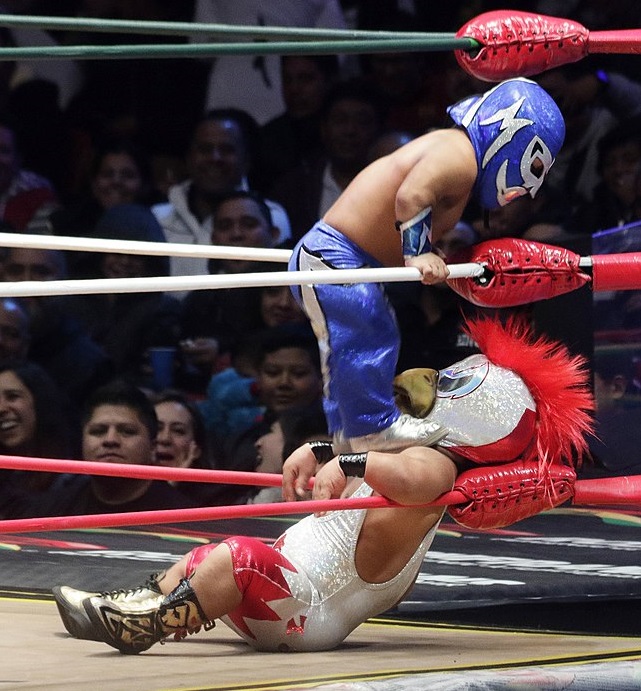
In wrestling, the most successful attacks are often counterattacks, where a wrestler takes advantage of his opponent's aggression to create openings for his own offense. This motivated the wrestlers to fight defensively, which resulted in matches with little activity. This was in contrast to boxing, whose rules encouraged more dynamic and aggressive play.
To solve this problem, wrestlers experimented with different styles and rules, but eventually they settled on quietly staging their matches (or "working" them, as they say in the industry). Through choreography and improvisation, the wrestlers could perform more spectacular moves and stunts. A wrestler might allow his opponent to perform a spectacular throw on him and put him in a hold, and seconds later his opponent would allow him to make a spectacular escape. The action flowed at a pace that pleased the audience. Fixed matches could also be kept short, which audiences preferred. Short matches were also easier to schedule and allowed wrestlers to perform more frequently. Audiences hated above all matches that ended in a draw, but fixed matches always produced a winner. The "winner" had to be agreed upon in advance by the wrestlers. This was not unique to America. Spectators in the United Kingdom also found legitimate wrestling too boring, and British professional wrestlers likewise were forced to "work" their bouts.
They wrestled in the Graeco-Roman style, which permits holds only above the waist, and can be intolerably slow when two well-matched men meet. ... I found this was generally the case where straight matches were concerned; whereas when a good exhibition wrestler would allow his opponent to slip away, and get out of dangerous-looking holds, with extraordinary head-spins and all sorts of monkey tricks which were nothing more or less than showmanship, the audience would go mad with excitement.

A second benefit of fixed matches was to reduce the risk of injury. Competitive wrestling matches, particularly the ones where large quantities of money were wagered, often ended with sprains or broken bones. A serious injury could prematurely end the career of a wrestler. Furthermore, around the start of the 20th century, the American public was increasingly disgusted by excessive violence in sports, which had led to bans on boxing in various parts of the country. In a fixed match, the wrestlers had no need to be so brutal. Unlike punches in boxing, wrestling holds can be faked convincingly without inflicting injury. Shorter matches also suited aging wrestlers who no longer had the stamina for a long fight. It allowed wrestlers to perform more frequently. In later decades, audience tastes shifted and professional wrestling became more brutal, but in those early years, there was a strong desire to minimize injury.
A major influence on professional wrestling was carnival culture. Some wrestlers in the late 19th century worked in carnival shows. For a fee, a visitor could challenge the wrestler to a quick match. If the challenger defeated the champion in a short time frame, usually 15 minutes, they won a prize. To encourage challenges, the carnival operators staged matches in which an accomplice posing as a visitor challenged the champion and won, giving the audience the impression that the champion was easy to beat. This practice taught wrestlers the art of staging matches and fostered a mentality that spectators were marks to be duped. The term kayfabe comes from carny slang. By the start of the 20th century, nearly all professional wrestling matches were fixed, and the press had caught on.
American wrestlers are notorious for the amount of faking they do. It is because of this fact that suspicion attaches to so many bouts that the game is not popular here. Nine out of ten bouts, it has been said, are pre-arranged affairs, and it would be no surprise if the ratio of fixed matches to honest ones was really so high.
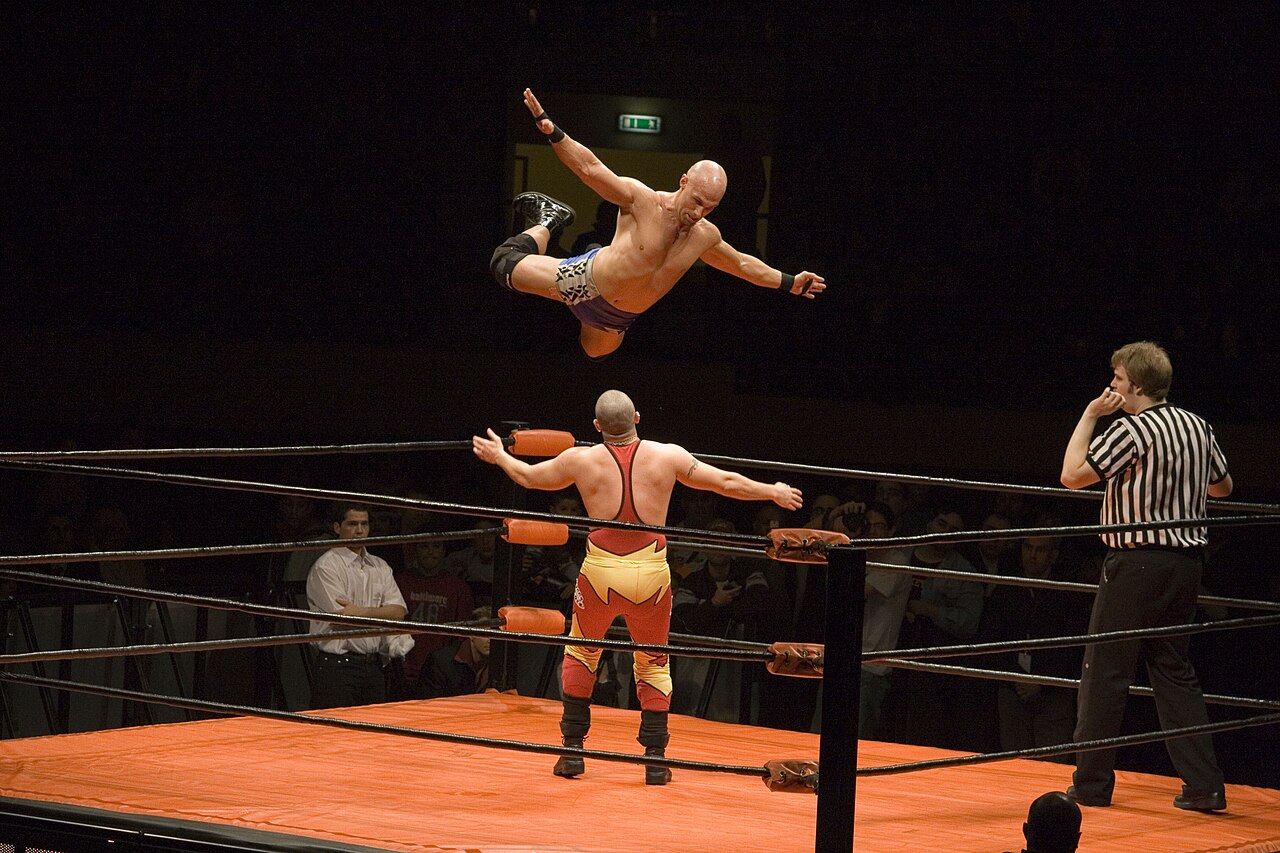
In the 1910s, promotion cartels for professional wrestling emerged in the East Coast, outside its traditional heartland in the Midwest. These promoters made long-term plans with their wrestlers, and ensured their more charismatic and crowd-pleasing wrestlers received championships. This meant further suppression of legitimate matches, which by this point were largely limited to challenges by independent wrestlers. A wrestler could claim that the rules of their promotion did not allow them to fight independent challengers. In other cases promoters would respond to such challenges by requiring the challenger to first defeat a "policeman": a powerful wrestler employed not for their star power but their ability to defeat, and often seriously injure, outside challengers. As the promotions grew, there were fewer independent wrestlers to make such challenges anyway.
The cartels suppressed double-crosses. A double-cross was when a wrestler broke his promise to throw a match and instead fought to win. At times a promoter had to award a victorious double-crosser the title of champion to preserve the facade of competition. However, promoters punished such wrestlers by blacklisting them, making it quite challenging for these troublemakers to find work. Double-crossers could also be sued for breach of contract, as Dick Shikat was in 1936. Despite the growing awareness that fixed matches were pervasive, professional wrestlers did not publicly admit that it had become the norm. The public preferred the staged matches but wanted to believe they were legitimate. Some people placed bets on the outcomes, and spectators would boo if they thought a match was faked.
If we put on a match that is on the level, it is often dull and tiresome and the crowd doesn't like it. So we have to fake most of our bouts to get by. And then the fake gets out in some way and the crowd still hollers. ... You're wrong any way you try it.

According to Lou Thesz, what few legitimate matches happened back in the 1930s tended to be either double-crosses or done to settle business disputes between rival wrestling groups.
In April 1930, the New York State Athletic Commission decreed that all professional wrestling matches held in the state had to be advertised as exhibitions unless certified as contests by the commission. This requirement did not apply to amateur wrestling, which the commission had no authority over. The former wrestler William Muldoon was the chairman of the commission when this decree was made. On rare occasions, the commission handed out such certifications, such as for a championship match between Jim Londos and Jim Browning in June 1934. The Seattle Athletic Commission passed a similar rule in April 1931 for professional wrestlers in Seattle. The rule imposed by the New York commission didn't hurt professional wrestling's popularity. On the contrary, it seems to have helped the industry because the following year, boxing promoters in New York asked the commission to impose the same rule on boxing matches. Since wrestlers in New York no longer had to worry about legal repercussions for match fixing, they were free to perform more absurd antics on the mat for the amusement of the crowds. Boxing promoters, who were reeling from numerous match-fixing scandals of their own, wanted to copy the wrestling business model.
In 1933, wrestling promoter Jack Pfefer divulged the inner workings of the industry with the New York Daily Mirror, maintaining no pretense that wrestling was legitimate and sharing planned results just before the matches took place. He exposed the truth to undermine his rival wrestling promoters when they excluded him from their cartels. Pfefer and a number of promoters including Jack Curley and Toots Mondt were questioned by the New York State Athletic Commission on 9 January 1934; despite being under oath, the others fiercely denied Pfefer's allegations. Pfefer's promotion subsequently saw a decline in attendance, but so did those of his rivals, and all spectator sports suffered during the Great Depression (1929–1939), so it is uncertain to what extent his indiscretion cost him; however, his business did not collapse. In fact, Pfefer outlasted most of his rivals from the 1930s. Pfefer adapted by leaning in to the theatricality. He promoted "freakishly" ugly wrestlers such as The French Angel, wrote crazier storylines, and popularized novelties such as tag-teams, midget wrestlers, and women wrestlers. He wanted the public to appreciate professional wrestling as an art form, not a sport. Other promoters who did not agree maintained the facade of kayfabe.
Newspapers refused to cover professional wrestling as if it were a sport, so promoters resorted to publishing their own magazines in order to attain press coverage and communicate with fans. The first professional wrestling magazine, Wrestling As You Like It, printed its first issue in 1946. These magazines were faithful to kayfabe.
In the 1980s, Vince McMahon began discretely lobbying various state governments to recognize professional wrestling as a non-sport so that his promotion, the World Wrestling Federation (WWF), could be exempted from sports licensing fees and health-and-safety oversight. In 1985, McMahon rebranded the World Wrestling Federation as a "sports entertainment" company. In 1985, he testified in a lawsuit that professional wrestling is rigged.
In 1989, McMahon testified before the New Jersey State legislature that professional wrestling is not a legitimate sport and therefore should be exempted from sports regulations and taxes. McMahon's testimonies were exposed in The New York Times and the New York Post. This was not the first time a promoter admitted in court that professional wrestling is all theater, but Vince McMahon controlled more than half of the industry in America by 1989, and The New York Times was one of the most important newspapers in the country if not the world. Consequently, the revelation caused irreversible damage to the facade of professional wrestling. McMahon had only wanted to avoid taxes, not do away with kayfabe, and for a few years he kept punishing his wrestlers for violating it. In May 1996, during an untelevised wrestling match at Madison Square Garden, which was the final performances of Kevin Nash and Scott Hall for the WWF, the wrestlers all climbed into the ring and embraced each other, faces and heels together, to the confusion of the audience. Although McMahon fined each of these transgressors $2,500, the incident further eroded kayfabe, and McMahon decided there was no going back. He was willing to reveal some truths to the public, but on his own terms. McMahon began incorporating actual backstage politics into WWF storylines using a new dramatic conceit called the "worked shoot", which was a performance that appeared to be wrestlers breaking character backstage but in fact was scripted.
Evolution in the television age
Professional wrestling's fanbase had traditionally largely consisted of children, the elderly, blue-collar workers, and ethnic minorities. The rise of television in the 1950s brought unprecedented national exposure to a broader audience, as networks were short on content. Professional wrestling enjoyed a period of mainstream popularity that was buoyed by the visual spectacles and showmanship of performers such as Gorgeous George and Buddy Rogers.
Beginning in the 1960s, networks increasingly shifted to more mainstream interests such as baseball, and professional wrestling was dropped from primetime slots, if not altogether; the core audience then shrank back to a profile similar to that of the 1930s. Nevertheless, this period saw some a brief boost in ratings and signs of strength; the American Wrestling Association's (AWA), which had emerged as an independent promotion in 1960, was setting new standards in how professional wrestling was presented on television, while the National Wrestling Alliance (NWA) maintained a strong following in the South. By the 1970s, professional wrestling entered a more pronounced and sustained decline that persisted into the 1980s.
Development of stylistic conventions
In the early 20th century, the style of wrestling that was mimicked in professional wrestling matches was catch wrestling. Promoters at the time wanted their matches to look realistic and so preferred to recruit wrestlers with real grappling skills. In his memoir, Lou Thesz recalled that when he started wrestling as a boy in the 1920s, only people trained in legitimate wrestling could see that professional wrestling matches were staged. In the 1920s, a group of wrestlers and promoters known as the Gold Dust Trio introduced moves that have since become staples of the mock combat of professional wrestling, such as body slams, suplexes, punches, finishing moves, and out-of-ring count-outs.
By the early 1930s, most wrestlers had adopted personas to generate public interest. These personas could broadly be characterized as either faces (heroes) or heels (villains). Native Americans, cowboys, and English aristocrats were staple characters in the 1930s and 1940s. Some wrestlers played different personas depending on the region they were performing in; with the rise of television and thus national exposure, most wrestlers maintained a single persona and narrative. Wrestlers also often used some sort of gimmick, such as a finishing move, eccentric mannerisms, or out-of-control behavior (in the case of heels). The matches could also have gimmicks, such as wrestlers fighting in mud or piles of tomatoes. The most successful and enduring gimmick to emerge from the 1930s were tag-team matches. Promoters noticed that matches slowed down as the wrestlers in the ring tired, so they gave them partners to relieve them. It also gave heels another way to misbehave by double-teaming.
Towards the end of the 1930s, faced with declining revenues, promoters chose to focus on grooming charismatic wrestlers with no regard for their skill as they believed it was charisma that drew the crowds, and wrestlers who were both skilled and charming were very rare. After this time, matches became more theatrical and any semblance professional wrestling had to legitimate wrestling styles faded. The personas of the wrestlers likewise grew more outlandish. Gorgeous George, who performed throughout the 1940s and 1950s, was the first wrestler whose entrance into the arena was accompanied by a theme song played over the arena's loudspeakers, his being Pomp and Circumstance. He also wore a costume—a robe and hairnet, which he removed after getting in the ring—and had a pre-match ritual where his "butler" would spray the ring with perfume. In the 1980s, Vince McMahon made entrance songs, costumes, and rituals standard for his star wrestlers; for instance, McMahon's top star, Hulk Hogan, would entertain the audience by tearing his shirt off before each match.
Evolution of regional cartels
The first major promoter cartel emerged on the East Coast, although up to that point, wrestling's heartland had been in the Midwest. Notable members of this cartel included Jack Curley, Lou Daro, Paul Bowser, and Tom and Tony Packs. The promoters colluded to solve a number of problems that hurt their profits. Firstly, they could force their wrestlers to perform for less money. As the cartel grew, there were fewer independent promoters where independent wrestlers could find work, and many were forced to sign a contract with the cartel to receive steady work. The contracts forbade them from performing at independent venues. A wrestler who refused to play by the cartel's rules was barred from performing at its venues. A second goal of the wrestling cartels was to establish an authority to decide who was the "world champion". Before the cartels, there were multiple wrestlers in the U.S. simultaneously calling themselves the "world champion", and this sapped public enthusiasm for professional wrestling. Likewise, the cartel could agree on a common set of match rules that the fans could keep track of. The issue over who got to be the champion and who controlled said champion was a major point of contention among the members of wrestling cartels as the champion drew big crowds wherever he performed, and this would occasionally lead to schisms. By 1925, this cartel had divided the country up into territories which were the exclusive domains of specific promoters. This system of territories endured until Vince McMahon drove the fragmented cartels out of the market in the 1980s. This cartel fractured in 1929 after one of its members, Paul Bowser, bribed Ed "Strangler" Lewis to lose his championship in a match against Gus Sonnenberg in January 1929.
Bowser then broke away to form his own cartel, the Boston-based American Wrestling Association, in September 1930, declaring Sonnenberg as AWA World Heavyweight Championship. Curley reacted to this move by convincing the National Boxing Association to form the National Wrestling Association, which in turn crowned a champion that Curley put forth: Dick Shikat. In 1948, several promoters from across the country came together to form the National Wrestling Alliance (NWA); Bowser's AWA would join the following year. The NWA recognized one "world champion", voted on by its members, but allowed member promoters to crown their own local champions in their territories. If a member poached wrestlers from another member, or held matches in another member's territory, they risked being ejected from the NWA, at which point his territory became fair game for everyone. The NWA would blacklist wrestlers who worked for independent promoters or who publicly criticized an NWA promoter or who did not throw a match on command. If an independent promoter tried to establish himself in a certain area, the NWA would send their star performers to perform for the local NWA promoter to draw the customers away from the independent.
By 1956, the NWA controlled 38 promotions in the United States and several more in Canada, Mexico, Australia and New Zealand. The NWA's monopolistic practices became so stifling that independent promotions appealed to the government for help. In October 1956 the U.S. Attorney General's office filed an antitrust lawsuit against the NWA in an Iowa federal district court. The NWA settled with the government: It pledged to stop allocating exclusive territories to its promoters, to stop blacklisting wrestlers who worked for outsider promoters, and to admit any promoter into the Alliance. The NWA would flout many of these promises, but its power was nonetheless weakened by the lawsuit. In 1957, just one year after settlement, the AWA withdrew from the Alliance and renamed itself the Atlantic Athletic Corporation (AAC); the AAC shut down in 1960. In 1958, Omaha promoter and NWA member Joe Dusek recognized Verne Gagne as the world champion without the approval of the NWA. Gagne asked for a match against the recognized NWA champion Pat O'Connor. The NWA refused to honor the request, so Gagne and Minneapolis promoter Wally Karbo established the American Wrestling Association in 1960. This AWA should not be confused with Paul Bowser's AWA, which ceased operations just two months prior. Gagne's AWA operated out of Minnesota. Unlike the NWA, which only allowed faces to be champions, Gagne occasionally allowed heels to win the AWA championship so that they could serve as foils for him.
Consolidation and renewed growth
In August 1983, the World Wrestling Federation (WWF), a promotion in the northeast, withdrew from the NWA; Vince McMahon then took over as its boss. No longer bound by the territorial pact of the NWA, McMahon began expanding his promotion into the territories of his former NWA peers, now his rivals. By the end of the 1980s, the WWF would become the sole national wrestling promotion in the US. This was in part made possible by the rapid spread of cable television in the 1980s. The national broadcast networks generally regarded professional wrestling as too niche an interest, and had not broadcast any national wrestling shows since the 1950s. The widespread success of the WWF led to the 1980s professional wrestling boom, turning the sport consciously mainstream in society.
Before cable TV, a typical American household only received four national channels by antenna, and ten to twelve local channels via UHF broadcasting. Cable television could carry a much larger selection of channels and therefore had room for niche interests. The WWF started with a show called All-American Wrestling on the USA Network in September 1983. McMahon's TV shows made his wrestlers national celebrities, so when he held matches in a new city, attendance was high because there was a waiting fanbase cultivated in advance by the cable TV shows. The NWA attempted to centralize and create their own national cable television shows to counter McMahon's rogue promotion, but it failed in part because the members of the NWA, protective of their territories, did not wish to be beholden to a central authority. They also did not wish to leave the NWA to compete directly with McMahon, for that would mean their territories would compete against other NWA members. McMahon also had a creative flair for TV that his rivals lacked. For instance, the AWA's TV productions during the 1980s were amateurish, low-budget, and out-of-touch with contemporary culture, which lead to the promotion's closing in 1991.
In the spring of 1984, the WWF purchased Georgia Championship Wrestling (GCW), which had been ailing for some time due to financial mismanagement and internal squabbles. In the deal, the WWF acquired the GCW's timeslot on TBS. McMahon agreed to keep showing Georgia wrestling matches in that timeslot, but he was unable to get his staff to Atlanta every Saturday to fulfill this obligation, so McMahon sold GCW and its TBS timeslot to Jim Crockett Promotions (JCP). JCP started informally calling itself World Championship Wrestling (WCW). In 1988, Ted Turner bought JCP and formally renamed it World Championship Wrestling. Professional wrestling experienced a second boom in the late 1990s. During this period, WCW became a credible rival to the WWF (see also Monday Night War), while the WWF's output, coinciding with the rise of "trash TV", became increasingly crude. By the turn of the century, WCW suffered from a series of creative missteps that led to its failure and purchase by the WWF. One of the company's mistakes was the diminished glamor of the WCW World Heavyweight Championship. Between January 2000 and March 2001, the WCW title changed hands eighteen times, which sapped fan enthusiasm, particularly for the climactic pay-per-view matches.
Industry conventions
Professional wrestling performances are governed primarily by a script and overarching storyline devised by producers, who often are professional wrestlers themselves. Real-life events, such as a performer's contract status and legitimate injuries, may be incorporated into storylines, and some wrestlers integrate elements of their genuine personalities or background into their performances or personas; for example, Kurt Angle, who performed his fictional persona eponymously, often utilized his genuine Olympic gold medal in wrestling as a defining aspect of his character. The actions of the character in shows are considered fictional and wholly separate from the life of the performer, although some performers will remain in character outside the ring, such as in promotional videos, interviews, and even social media; consequently, the line between real-life and scripted events and personas are often blurred. For example, Maxwell Jacob Friedman (MJF) is well known for staying in character at all times while in public, going so far as to insult his fans, often to their delight as they are aware of his persona.
Kayfabe
Kayfabe is the term given to the fictional element of professional wrestling. Wrestlers would at all times flatly deny allegations that they fixed their matches, and they often remained in-character in public even when not performing. When in public, wrestlers would sometimes say "kayfabe" to each other as a coded signal that there were fans present for whom they needed to be in character. Professional wrestlers in the past strongly believed that if they admitted the truth, their audiences would desert them; accordingly, promotions have often disciplined or punished performers for breaking kayfabe.
Today's performers don't "protect" the industry like we did, but that's primarily because they've already exposed it by relying on silly or downright ludicrous characters and gimmicks to gain popularity with the fans. It was different in my day, when our product was presented as an authentic, competitive sport. We protected it because we believed it would collapse if we ever so much as implied publicly that it was something other than what it appeared to be. I'm not sure now the fear was ever justified given the fact that the industry is still in existence today, but the point is no one questioned the need then. "Protecting the business" in the face of criticism and skepticism was the first and most important rule a pro wrestler learned. No matter how aggressive or informed the questioner, you never admitted the industry was anything but a competitive sport.
The first wrestling promoter to publicly admit to routinely fixing matches was Jack Pfefer. In 1933, he started talking about the industry's inner workings to the New York Daily Mirror, resulting in a huge exposé. The exposé neither surprised nor alienated most wrestling fans, although some promoters like Jack Curley were furious and tried to restore the facade of kayfabe as best as they could. In 1989, Vince McMahon testified before the New Jersey government that professional wrestling was not a true sport and therefore should be exempted from sports-related taxes. Many wrestlers and fans resented McMahon for this, but Lou Thesz accepted it as the smart move as it gave the industry more freedom to do as it pleased, and because by that point professional wrestling no longer attempted to appear real. The demise of WCW in 2001 provided some evidence that kayfabe still mattered to a degree. Vince Russo, the boss of WCW in 2000, completely disregarded kayfabe by routinely discussing business matters and office politics in public, which alienated fans.
Sports entertainment
The wrestling industry convention of kayfabe has increasingly been challenged by the modern concept of sports entertainment, which openly acknowledges professional wrestling's predetermined nature and celebrates its roots in both competitive sport and dramatic theater. The term "sports entertainment" was coined by World Wrestling Federation chairman Vince McMahon during the 1980s as a marketing term to describe the professional wrestling industry, primarily to potential advertisers; however, precursors date back to at least February 1935, when Toronto Star sports editor Lou Marsh described professional wrestling as "sportive entertainment". In 1989, the WWF used the phrase in a case before the New Jersey Senate to classify professional wrestling as "sports entertainment" and thus not subject to regulation like a directly competitive sport.
In subsequent years, WWE insisted that its talent use "sports entertainment" rather than "pro wrestling" to describe its business, to the point that the term was sometimes used in other promotions to generate "heat" (fan reaction and engagement). The line between sports entertainment and competitive sports was further blurred in 2023, when WWE merged (as TKO Group Holdings) with the parent company of Ultimate Fighting Championship (UFC), a genuinely competitive mixed martial arts promotion, in what was officially announced as an effort to "bring together two leading pureplay sports and entertainment companies" and provide "significant operating synergies" between them. The following year, WWE moved away from its insistence on being a sports entertainment company after Vince McMahon's departure from the company, but still uses "sports entertainment" in some contexts.
Whether professional wrestling is a genuine sport often reflects a broader debate as to the nature and qualities of a sport categorically. Some commentators and analysts identify baseline commonalities between professional wrestling and other sports, such as performance entailing "physical activity governed by a set of rules of customs" and there still being competition among pro wrestlers with respect to their performances.
Just because there's a script involved it doesn't take away from the competitive environment of professional wrestling. Ask any former wrestler, read an autobiography on a wrestler or use common sense. There is tremendous competition within the WWE. Not performing to the high standards in the ring? "You're Fired". Not getting over with the fans? "You're Fired." Being a nuisance and refusing to be a team player? "You're fired." Don't want to continually train, live the grueling road schedule and establish connections...see where I'm going with all this? While NFL, NBA, NHL, MLB and overseas soccer players (football, I know, I apologize) are getting paid ridiculous contracts (with a lump sum up front, and a lot of the contract guaranteed), professional wrestlers do much more work for a lot less. We can safely take the competition argument out of the discussion. So ultimately, if you can look past the script, then professional wrestling is a sport.
Others retort that while professional wrestling is comparable in its physical and athletic requirements—including "shared values of resilience and excellence" and similar risks of bodily injury—its scripted nature preempts one of the purported defining characteristics of a sport: genuine competition over the outcome. The ambiguity of professional wrestling as a form of sports entertainment is further heightened by news media, which often cover professional wrestling matches and events as if they were genuine sports; for example, in 2024, Forbes ranked professional wrestling promotions WWE and All Elite Wrestling (AEW) among the world's "most valuable combat sports promotions" alongside bona fide competitive sport organizations UFC, ONE Championship, and Matchroom Boxing.
Performance aspects
I watch championship wrestling from Florida with wrestling commentator Gordon Solie. Is this all "fake"? If so, they deserve an Oscar.
Professional wrestling shows can be considered a form of theater in the round, with the ring, ringside area, and entryway comprising a stage. There is less of a fourth wall than in most theatric performances; like pantomime, audience involvement is expected and encouraged. Attendees are recognized and acknowledged by performers as spectators to the sporting event being portrayed and are encouraged to interact as such; their reactions can dictate how the performance unfolds, leading to a high level of audience participation. Often, individual matches will be part of a longer storyline conflict between "babyfaces" (often shortened to just "faces") and "heels". "Faces" (the "good guys") are those whose actions are intended to encourage the audience to cheer, while "heels" (the "bad guys") act to draw the spectators' ire.
In pro wrestling matches, performers often execute a series of pre-planned moves and attacks, ranging from grappling and throws found in some traditional forms of wrestling, to more spectacular stunts, sometimes involving props and special effects. Although match outcomes and narratives are predetermined, wrestlers are expected to improvise and weave elements of their character. Attacks are designed to appear dramatic while reducing the risk of serious injury as much as possible; the overall aim is to minimize the actual injurious impact of their moves while maximizing their entertainment value. Shows produced by the largest professional wrestling promotions like WWE are traditionally performed in indoor venues, while flagship events like WrestleMania are sometimes taking place at outdoor venues; these shows are generally video recorded for live or delayed broadcasting. Additionally filmed footage known as "segments" or "promos" are usually used to accompany the drama in these shows.
Prior experience in legitimate wrestling is not a requirement for aspiring professional wrestlers but is seen as an advantageous background. Despite its scripted format, several notable performers have had prior experience in legitimate wrestling before transitioning to its theatrical form. A popular performer, Kurt Angle, is the first Olympic gold medalist in professional wrestling history, having won his gold medal at the 1996 Summer Olympic Games in freestyle wrestling. Another prominent performer is Brock Lesnar, a former NCAA wrestler who won the NCAA Division I Wrestling Championships in 2000.