
Judas Priest are an English heavy metal band formed in Birmingham in 1969. They have sold over 50 million albums and are frequently ranked as one of the greatest metal bands of all time. They have been referred to as one of the pioneers of the new wave of British heavy metal (NWOBHM) movement, and cited as a formative influence on various metal subgenres, including speed metal, thrash metal, and power metal, as well as the hard rock and glam metal scene of the 1980s. Despite an innovative and pioneering body of work in the latter half of the 1970s, the band struggled with poor record production and a lack of major commercial success until 1980, when their sixth studio album British Steel brought them notable mainstream attention.
During the 1970s, the core of bassist Ian Hill, lead singer Rob Halford and guitarists Glenn Tipton and K. K. Downing saw a revolving cast of drummers (with Les Binks being the only one who played on more than one album), before Dave Holland joined them for ten years beginning in 1979. Since Holland's departure in 1989, Scott Travis has been the band's drummer. Halford left Judas Priest in 1992, and after a four-year hiatus, they regrouped in 1996 with Tim "Ripper" Owens (formerly of Winter's Bane) replacing him. After two albums with Owens, Halford returned to the band in 2003. Downing left Judas Priest in 2011, replaced by Richie Faulkner. The current line-up consists of Hill, Tipton, Travis, Halford and Faulkner; although Tipton remains as an official member of the band, he has limited his touring activities since 2018 due to Parkinson's disease, with Andy Sneap filling in for him. Hill and Tipton are the only two members of the band to appear on every album.
Halford's falsetto vocal style and the twin guitar sound of Downing and Tipton have been a major influence on heavy metal bands. Judas Priest's image of leather, spikes, and other taboo articles of clothing was widely influential during the glam metal era of the 1980s. The Guardian referred to British Steel as the record that defines heavy metal. Despite a decline in exposure during the mid-1990s, the band have once again seen a resurgence, including worldwide tours, being inaugural inductees into the VH1 Rock Honors in 2006, receiving a Grammy Award for Best Metal Performance in 2010, and having their songs featured in video games such as Guitar Hero and the Rock Band series. In 2022, the band were inducted into the Rock and Roll Hall of Fame via the Award for Musical Excellence.
History
Origins (1969–1974)
Judas Priest were formed in 1969 in Birmingham, England, by lead vocalist Al Atkins and bassist Brian "Bruno" Stapenhill, with John Perry on guitars and John "Fezza" Partridge on drums. Perry took his own life at age 18, and amongst the replacements the band auditioned was future Judas Priest guitarist Kenneth "K.K." Downing; at the time, they turned him down in favour of 17-year-old multi-instrumentalist Ernest Chataway, who had played with Birmingham band Black Sabbath when they were still called Earth. Stapenhill came up with the name Judas Priest from Bob Dylan's song "The Ballad of Frankie Lee and Judas Priest" on the album John Wesley Harding. Partridge was replaced in 1970 by drummer Fred Woolley, who later re-joined Chataway and Stapenhill in the band Bullion. No member of that early line-up lasted long enough to play on the band's recordings, though several songs co-written by Atkins appeared on their first two albums.
The band recorded a two-song demo "Good Time Woman" and "We'll Stay Together" and eventually gained a three-album recording contract with the label Immediate in late 1969 after a gig in Walsall, but the label went out of business before an album could be recorded, and the band split in 1970. Late in the year, Atkins found a heavy rock band called Freight rehearsing without a singer, made up of K. K. Downing on guitars, his childhood friend Ian "Skull" Hill on bass, and drummer John Ellis. He joined them, and they took on Atkins' defunct band's name. Their first gig was on 6 March 1971. Ellis quit later that year and was replaced by Alan Moore. Early shows included Jimi Hendrix, Pink Floyd and Quatermass covers, and in 1972, the set list included the originals "Never Satisfied", "Winter", and the show-closer "Caviar and Meths". July 1971 also saw them making a 45 rpm demo of "Mind Conception" with "Holy is the Man" on the B-side for the Zella Records label.
Moore left and was replaced with Chris "Congo" Campbell, and the band joined the management agency of Black Sabbath guitarist Tony Iommi, Iommi Management Agency. Atkins continued to write material for the band—including "Whiskey Woman", which became the base for the Judas Priest staple "Victim of Changes"—but as finances were tight and he had a family to support, he played his last gigs with the band in December 1972 and left the band in May 1973. Campbell left soon afterwards, later to surface in the band Machine, and the band enlisted two members of the band Hiroshima: drummer John Hinch and vocalist Rob Halford, the brother of Hill's girlfriend. Halford and Hinch played their first show with the band in May 1973 at the Townhouse in Wellington. The show was recorded, and part of it was released in 2019 on the compilation Downer-Rock Asylum on the Audio Archives label along with one live song from the Atkins era.

Judas Priest made their first tour of continental Europe in early 1974, and they returned to England that April to sign a recording deal with the label Gull. Gull suggested adding a fifth member to fill in the band's sound; they took on as a second lead guitarist Glenn Tipton, whose group the Flying Hat Band were also managed by Iommi's agency.
Rocka Rolla (1974–1975)
Judas Priest went into the studio in June–July 1974 with Black Sabbath producer Rodger Bain. The band released their debut single "Rocka Rolla" and followed it with the album of the same name in September. The album features a variety of styles—straight-up rock, heavy riffing, and progressive.
Technical problems during the recording contributed to the poor sound quality of the record. Producer Rodger Bain, whose resume included Black Sabbath's first three albums and Budgie's first album, dominated the production of the album and made decisions with which the band did not agree. Bain also chose to leave fan favourites from the band's live set, such as "Tyrant", "Genocide" and "The Ripper", from the album and he cut the song "Caviar and Meths" from a 10-minute song down to a 2-minute instrumental.

The tour for Rocka Rolla was the band's first international tour with dates in Germany, the Netherlands, Norway and Denmark including one show at Hotel Klubben in Tønsberg, one hour from Oslo, Norway, which scored them a somewhat negative review in the local press. The album flopped upon release, leaving Priest in dire financial straits. Priest attempted to secure a deal with Gull Records to get a monthly pay of £50, however, because Gull Records were struggling as well, they declined.
Sad Wings of Destiny (1975–1977)
Judas Priest performed "Rocka Rolla" on BBC Two's The Old Grey Whistle Test in 1975, as well as the "Dreamer Deceiver"–"Deceiver" pair the year before the songs appeared on Sad Wings of Destiny. Hinch left the band for reasons that are disputed and was replaced with Alan Moore, who returned to the band in October 1975. Finances were tight: band members restricted themselves to one meal a day—and several took on part-time work—while they recorded their follow-up album on a budget of £2,000. The group intended to make an album mixing straight-ahead rock with a progressive edge.
The band recorded Sad Wings of Destiny over two weeks in November and December 1975 at Rockfield Studios in Wales. The band stayed sober during the 12-hour recording sessions. The cover depicts a struggling, grounded angel surrounded by flames and wearing a devil's three-pronged cross, which became the band's symbol. The album was released in March 1976, with "The Ripper" as its lead single. The band supported the album with a headlining tour of the UK from April to June 1976. By this time Halford joked that fans should burn their copies of Rocka Rolla.

The album had little commercial success at first and had difficulty getting noticed due to critical competition from the rise of punk rock, though it had a positive review in Rolling Stone. Fans, critics, and the band have since come to see Sad Wings of Destiny as the album on which Judas Priest consolidated their sound and image. It features heavy riffing and complex song arrangements that Tipton and Downing have said were inspired by the factories of the Black Country. The album's centrepiece "Victim of Changes" evolved from a combination of Atkins' "Whiskey Woman" and Halford's "Red Light Woman", and went on to become a fan favourite.
The band grew dissatisfied with Gull; the tight finances led Moore to leave the band a second time—this time permanently. Sad Wings of Destiny caught the attention of CBS Records, and with the help of new manager David Hemmings, the band signed with CBS and received a £60,000 budget for their next album. The signing required breaking their contract with Gull, resulting in the rights to the first two albums and all related recordings—including demos—becoming property of Gull. Gull periodically repackaged and re-released the material from these albums.
Sin After Sin, Stained Class and Killing Machine (1977–1979)
Judas Priest recorded their major-label debut, Sin After Sin, in January 1977 at the Who's Ramport Studios, with Deep Purple bassist Roger Glover as producer. Moore left again during the album's sessions and was replaced by session drummer Simon Phillips. The album features significant developments in heavy metal technique, in particular its use of double-kick drumming on tracks such as "Dissident Aggressor", and includes a pop-metal cover of "Diamonds & Rust" by folk singer Joan Baez.
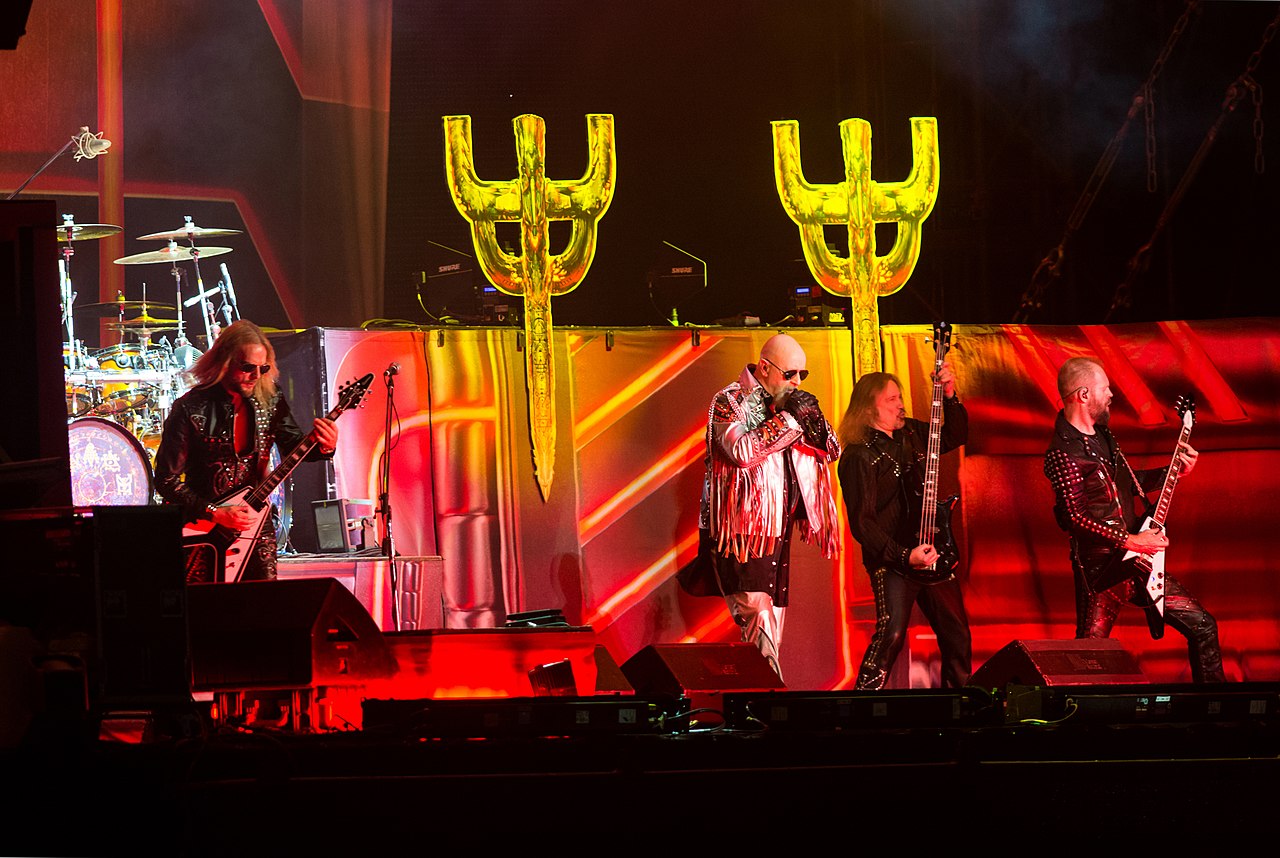
Sin After Sin appeared in April 1977. It was the first Priest record under a major label, CBS, and the first of eleven consecutive albums to be certified Gold or Platinum by the Recording Industry Association of America (RIAA). Phillips declined to become a permanent member of Judas Priest, so the band hired Les Binks on Glover's recommendation. Together, they recorded Stained Class, produced by Dennis MacKay, and Killing Machine (released in North America as Hell Bent for Leather), both released in 1978. Binks was credited with co-writing "Beyond the Realms of Death". Binks also played on Unleashed in the East (1979), which was recorded live in Japan during the Killing Machine tour. Killing Machine was the first nod to a more commercial sound, with simpler songs that brought back some blues influences. At about the same time, the band members adopted their now-famous "leather-and-studs" image.
Mainstream success years (1979–1991)
From Killing Machine's supporting tour came the live album Unleashed in the East (1979). It was the first of many Judas Priest albums to go platinum. There was some criticism of the band's use of studio enhancements and overdubbing in what was marketed as a live album. By this point the playing style of the band had grown progressively heavier, with live versions of songs such as "Exciter", "Tyrant" and "Diamonds and Rust" sounding much heavier and faster than their studio counterparts.
Les Binks quit in late 1979, as he was unhappy with the band's manager Mike Dolan's decision not to pay him for his performance on the live album, so they replaced him with Dave Holland, formerly of the band Trapeze. With this line-up, Judas Priest recorded six studio and one live album, which garnered different degrees of critical and financial success.

In 1980, the band released British Steel. The songs were shorter and had more mainstream radio hooks, but retained the familiar heavy metal feel. Tracks such as "United", "Breaking the Law", and "Living After Midnight" were frequently played on the radio. The next release, 1981's Point of Entry, followed the same formula, and the tour in support of the album featured new songs such as "Solar Angels" and "Heading Out to the Highway".
In late 1981, the group wrote a number of songs at Ibiza Sound Studios in Ibiza, Spain, continuing their collaboration with producer Tom Allom. Initially, it was planned for a release in early 1982, but it was decided that they would resume recording after their 1981 World Wide Blitz Tour have been concluded. In January 1982, the group recorded their material, which it showcased their continuing success in straightforward heavy rock tunes. Their resulting record, Screaming for Vengeance, was released on 1 July 1982. Charting in nine countries, it peaked at number 11 in the UK and number 17 in the US. The latter contained their most popular track of their discography, "You've Got Another Thing Comin'", which ultimately gained heavy rotation across multiple radio stations in North America. The song charted at number 67 on the US Billboard Hot 100, the band's only song to chart towards crossover pop airplay and sales. It charted at number four on its Mainstream Rock chart position at that region. "(Take These) Chains" was also released as a single, but did not chart. Multiple tracks from Screaming for Vengeance also included "Electric Eye" and "Riding on the Wind", which received adequate airplay and has been proven to be popular in live performances. The album was certified gold by the Recording Industry Association of America (RIAA) within four months of release, then platinum in 1983, later double platinum by 2001. The group followed up that year with their World Vengeance Tour to support the album. On 29 May 1983, the band appeared as headliners on Heavy Metal Day of the US Festival in San Bernardino, California, sponsored by Steve Wozniak. The band was fourth in the line-up that also included Quiet Riot, Mötley Crüe, Ozzy Osbourne, Triumph, Scorpions, and Van Halen.
Priest continued their success through the mid-1980s. "Freewheel Burning", released in 1983, was a regular on rock radio. Its album Defenders of the Faith was released the following year. Some critics dubbed it "Screaming for Vengeance II", due to its musical similarity to the previous album.
On 13 July 1985, Judas Priest, along with Black Sabbath and other performers, played Live Aid at JFK Stadium in Philadelphia. Their setlist included "Living After Midnight", "The Green Manalishi (With the Two-Pronged Crown)" and "(You've Got) Another Thing Comin'".
Turbo was released in April 1986 and it is the last album to be certified Platinum by the RIAA. The band adopted a more colourful stage look and gave their music a more mainstream feel by adding guitar synthesisers. The band had a successful arena tour, with 100 concerts in North America, Europe and Japan in 1986. A live album recorded on the tour, titled Priest...Live!, was released the next year, offering live tracks from the era. The video documentary Heavy Metal Parking Lot was created by Jeff Krulik and John Heyn in 1986. It documents the heavy metal fans waiting on 31 May 1986 for Priest's concert (with special guests Dokken) at the Capital Center (later renamed US Airways Arena) in Landover, Maryland.
In May 1988, Ram It Down was released, featuring several reworked songs left over from Turbo, in addition to new songs. The band recorded three tracks with pop producers Stock-Aitken-Waterman: two originals, "Runaround" and "I Will Return", and a cover of the Stylistics' hit "You Are Everything". Producer Matt Aitken said of the sessions, "I think it was ill-conceived, it was unlikely it was going to work. But we went into it with the spirit of optimism, and we did the best with them, within the parameters within which we would be prepared to work. We weren't going to use live drum kits and stuff, and that probably made it a no go from the start. I have no idea why we were working with Judas Priest really, but I think we made a good fist of a heavy metal song. I think it sounded alright." The tracks were ultimately not included on this album due to a management decision.
A reviewer has called Ram It Down a "stylistic evolution" that resulted from the band's "attempt to rid themselves of the tech synthesiser approach ... and return to the traditional metal of their fading glory days". The reviewer argued the album showed "how far behind they were lagging ... the thrashers they helped influence" in earlier years. In 1989, longtime drummer Dave Holland left the band due to personal problems.
In September 1990, the Painkiller album featured new drummer, Scott Travis (formerly from Racer X), who gave the band an edgier sound thanks to his heavy use of double bass. This comeback album also dropped the 1980s-style synthesisers for all songs except "A Touch of Evil". The tour used bands such as Annihilator, Megadeth, Pantera, Sepultura and Testament as opening bands, and culminated in the Rock in Rio performance in Brazil in front of 100,000+ fans.
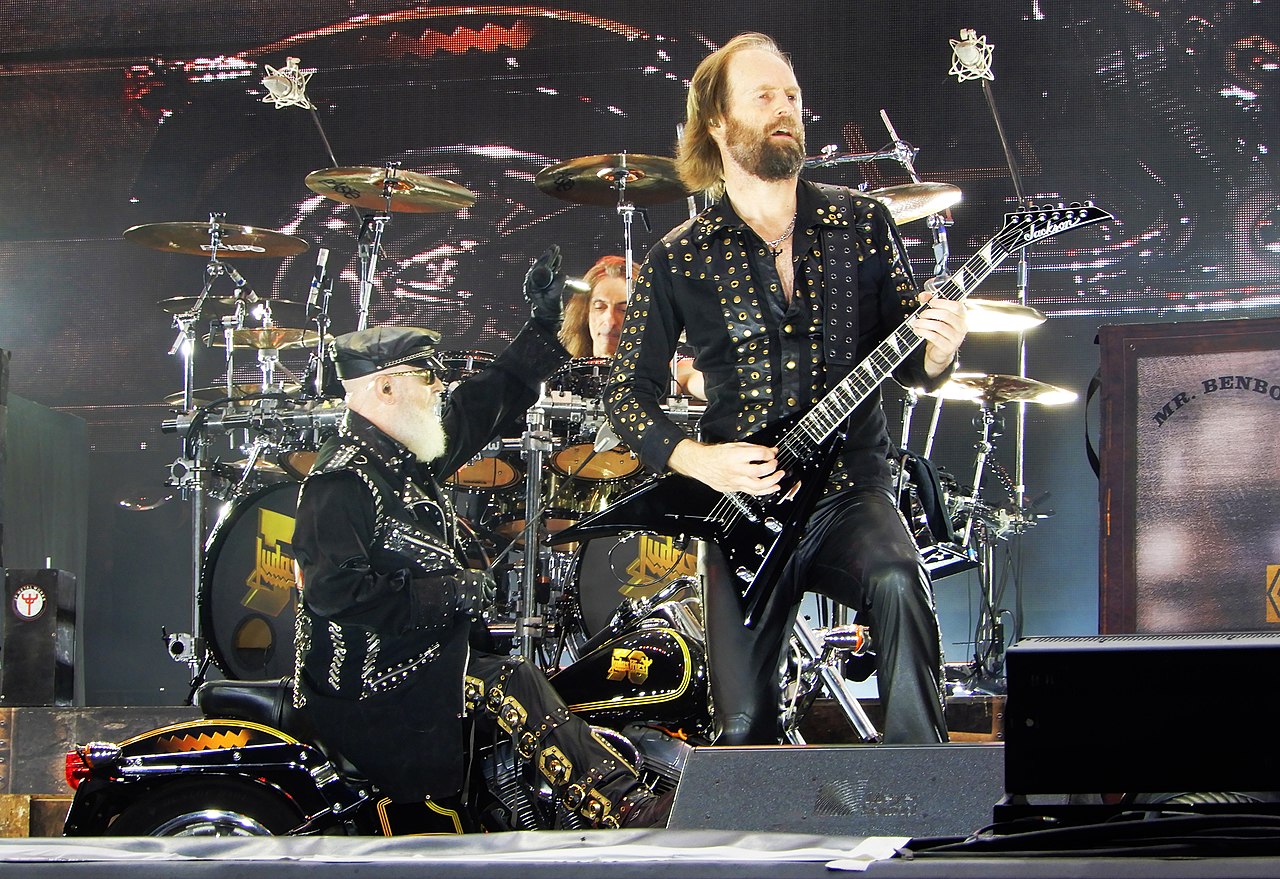
Part of the Judas Priest stage show often featured Halford riding onstage on a Harley-Davidson motorbike, dressed in motorcycle leathers and sunglasses. During a Toronto show in August 1991, Halford was seriously injured as he rode on stage, when he collided with a drum riser hidden behind clouds of dry ice mist. Though the show was delayed, he performed the set before going to a hospital. Hill later noted "he must have been in agony". In a 2007 interview, Halford said the accident had nothing to do with his departure from the band.
Subliminal message trial
In 1990, Judas Priest was the subject of civil action in the United States which alleged that the band was responsible for an incident in Sparks, Nevada, in 1985 in which 20-year-old James Vance and 18-year-old Raymond Belknap shot themselves. On the evening of 23 December 1985, Vance and Belknap went to a church playground with a 12-gauge shotgun with the purpose of committing suicide. They had consumed alcohol and marijuana earlier that evening. The lawsuit alleged that the pair had been listening to Judas Priest's 1978 album Stained Class that night. Belknap was the first to place the shotgun under his chin, and died instantly after pulling the trigger. Some time later, Vance also shot himself, but succeeded only in disfiguring himself by blowing away the lower half of his face. Vance died three years later of a suspected drug overdose.
The Belknap and Vance families sued Judas Priest and its members, alleging that the band had embedded subliminal messages such as "try suicide", "do it" and "let's be dead" in the band's cover of the 1969 Spooky Tooth song "Better by You, Better than Me". Judas Priest had recorded the cover at the urging of their record company after the rest of Stained Class had been completed. The plaintiffs alleged that this subliminal command was the trigger which led directly to the pair deciding to shoot themselves. Vance's parents said that their son had been troubled for a long time prior to the suicide pact, but had recently "changed for the better" and had re-embraced his family's Christian faith before the "garbage music" of Judas Priest had again led him astray.
Local fans of heavy metal protested during the trial, calling for Judas Priest to be exonerated. The plaintiffs played the song at various speeds and backward, alleging the use of backmasking. The trial lasted from 16 July to 24 August 1990, when the judge dismissed the lawsuit on the basis that the so-called subliminal message "was a coincidental convergence of a guitar chord with an exhalation pattern". One of the defense witnesses, Dr. Timothy E. Moore, wrote an article for Skeptical Inquirer chronicling the trial. The trial was covered in a 1991 documentary film, Dream Deceivers: The Story Behind James Vance Vs. Judas Priest.
Halford's departure and Ripper years (1991–2003)
After the Painkiller tour ended in August 1991, there were indications of internal tensions within the band. Halford went on to form a street-style thrash metal group named Fight, with Scott Travis on drums for the recording sessions. He formed this band to explore new musical territory, but due to contractual obligations, he remained with Judas Priest until May 1992. In his 2020 memoir Confess, Halford blamed his departure on a "miscommunication", rather than an intentional desire to quit the band.
Halford collaborated with Judas Priest in the release of a compilation album entitled Metal Works '73–'93 to commemorate their 20th anniversary. He also appeared in a video by the same title, documenting their history, in which his departure from the band was officially announced later that year.
Although Judas Priest went on hiatus following Halford's departure, the remaining members of the band spent the next few years searching for a replacement for him. Known singers who auditioned for, or were offered to join, the band during this period include Steve Grimmett (Grim Reaper, Lionsheart and ex-Onslaught), Ralf Scheepers (Primal Fear and ex-Gamma Ray), Whitfield Crane (Ugly Kid Joe), former Accept singer David Reece, and a then-unknown Devin Townsend. Tim "Ripper" Owens (who had previously sung in Winter's Bane and a Judas Priest tribute band called British Steel) was hired in 1996 as Judas Priest's new singer. This line-up released two studio albums, Jugulator in 1997 (in 1999, the song "Bullet Train" was nominated for a Grammy Award for Best Metal Performance) and Demolition in 2001. A considerable stylistic departure from prior releases, the former has been characterised as groove metal and the latter as nu metal, both receiving mixed reviews. The line-up also gave rise to two live double-albums – '98 Live Meltdown (1998) and Live in London (2003), the latter of which had a live DVD counterpart.
In a February 1998 interview on MTV, Halford came out as gay.
Reunion and Angel of Retribution (2003–2006)
After eleven years apart, faced with an ever-growing demand for a reunion, Judas Priest and Rob Halford announced they would reunite in July 2003, to coincide with the release of the Metalogy box set (despite Halford's earlier insistence that he "would never do it"). They did a concert tour in Europe in 2004, and co-headlined the 2004 Ozzfest, being named as the "premier act" by almost all US media coverage of the event. Judas Priest and "Ripper" Owens parted amicably, with Owens joining American heavy metal band Iced Earth.
A new studio album, Angel of Retribution, was released on 1 March 2005 (US) on Sony Music/Epic Records to critical and commercial success, earning the band a 2005 Metal Hammer Golden Gods Award for Best Album. A global tour in support of the album ensued. As for the band Halford, writing for the fourth release was cut off. After the Retribution tour in June 2006, however, Halford announced he would create his own record company, Metal God Entertainment, where he would release all his solo material under his own control. In November 2006 he remastered his back catalogue and released it exclusively through Apple's iTunes Store. Two new songs allegedly set for the fourth release, "Forgotten Generation" and "Drop Out", were released through iTunes as well.
Along with Queen, Kiss and Def Leppard, Judas Priest was an inaugural inductee into the "VH1 Rock Honors". The ceremony took place on 25 May 2006 in Las Vegas, Nevada, and first aired on 31 May. Their presentation was preceded by Godsmack performing a medley of "Electric Eye"/"Victim of Changes"/"Hell Bent for Leather." Judas Priest then played "Breaking the Law", "The Green Manalishi (With the Two Prong Crown)" and "You've Got Another Thing Comin'", before which Halford rode a Harley-Davidson motorcycle onstage.
Nostradamus (2006–2010)
In a June 2006 interview with MTV.com, Halford said of the group's concept album about the 16th-century French writer Nostradamus, "Nostradamus is all about metal, isn't he? He was an alchemist as well as a seer – a person of extraordinary talent. He had an amazing life that was full of trial and tribulation and joy and sorrow. He's a very human character and a world-famous individual. You can take his name and translate it into any language and everybody knows about him, and that's important because we're dealing with a worldwide audience." In addition to digging new lyrical ground for the band, the album would contain musical elements which might surprise fans. "It's going to have a lot of depth", Halford said. "There'll be a lot of symphonic elements. We might orchestrate it, without it being overblown. There may be a massive choir at parts and keyboards will be featured more prominently, whereas they've always been in the background before." Nostradamus was released on 16 June 2008 in the UK, where it peaked at number 30 in their native and number 11 in the US, where it has sold over 500,000 copies worldwide by the following year. The band also began the album's supporting tour the following month.
In early February 2009, the band joined the ranks of bands speaking out against ticket-touting ("scalping"), issuing a statement condemning the practice of selling tickets at well above face value, and urging fans to buy tickets only from official sources. In the same month, Judas Priest continued their tour, bringing their "Priest Feast" (with guests Megadeth and Testament) to multiple arenas in England, Wales, Scotland, and Ireland in February and March 2009. From there the tour progressed to multiple venues in Sweden. Later in March, Judas Priest performed in Portugal (at Lisbon on the Atlantic Pavilion), which they had not visited since 2005. The tour then continued to Milan, Italy, and then Paris, France; Halford had last performed with Judas Priest in Paris in 1991.
From June through August 2009, Judas Priest completed a North American tour to commemorate the 30th anniversary of the release of British Steel (1980); the album was performed in its entirety on each tour date, with some other songs thrown in. This tour was to be a joint effort with fellow Englishman David Coverdale and Whitesnake. Unfortunately, Whitesnake would have to leave the tour after the show in Denver, Colorado on 11 August 2009 due to Coverdale falling ill with a serious throat infection; he was advised to stop singing immediately to avoid permanently damaging his vocal cords.
On 14 July 2009, Judas Priest released a new live album, featuring 11 previously unreleased live tracks from the 2005 and 2008 world tours, titled A Touch of Evil: Live. The performance of "Dissident Aggressor" won the 2010 Grammy Award for Best Metal Performance.
In May 2010, Halford said the band had been offered a star on the Hollywood Walk of Fame, but "we've just never been there when they wanted to do the ceremony." He also revealed that a Nostradamus tour was still being contemplated: "We were in Hollywood recently and met with some producers and agents, so there are a lot of things going on behind the scenes."
Downing's retirement and Epitaph World Tour (2010–2011)
Judas Priest announced on 7 December 2010, that their Epitaph World Tour would be the band's farewell tour and would run up until 2012. In a January 2011 interview, Halford said about the band's impending retirement: "I think it's time, you know. We're not the first band to say farewell, it's just the way everyone comes to at some point and we're gonna say a few more things early next year, so I think the main thing that we just want to ask everybody to consider is don't be sad about this, start celebrating and rejoicing over all the great things we've done in Judas Priest."
On 27 January 2011, it was announced that Judas Priest were in the process of writing new material; the band also clarified their plans for the future, saying, "this is by no means the end of the band. In fact, we are presently writing new material, but we do intend this to be the last major world tour." Speaking at a press conference in Los Angeles on 26 May of the new material Glenn Tipton said: "It's quite a mixed bag. Really, there's more sentiment on this album. In a way, I suppose, it's also our farewell album, although it might not be our last one. There are some anthems on there, which pay tribute to our fans".
On 20 April 2011, it was announced that K. K. Downing had retired from the band and would not complete the Epitaph World Tour. Downing cited differences with the band and the management, and a breakdown in their relationship. Richie Faulkner, guitarist for Lauren Harris' band, was announced as his replacement for the Epitaph World Tour. Downing's retirement left bassist Ian Hill as the longest-serving member of the band.
On 25 May 2011, Judas Priest played during the finale of American Idol season 10 with James Durbin, making it their first live performance without K.K. Downing. The band played a mixture of two songs: "Living After Midnight" and "Breaking the Law".
On 7 June 2011, the band announced that it planned to release the box set Single Cuts, a collection of singles, the following August.
Redeemer of Souls (2011–2015)
In an August 2011 interview with Billboard, Halford explained that he and Tipton had "about 12 or 14 tracks completely mapped out" for a new studio album, with four of those tracks already recorded and mixed. The band made a point to take its time with the album, with Halford explaining "I'm of the attitude it'll be ready when it's ready ... I don't think we're going to slack off. We're determined to do a lot of work and be just as dedicated as we've always been and take a lot of care and attention with all the songs. We're not going to just bang this one out, so to speak."