
The American Indian Wars, also known as the American Frontier Wars, and the Indian Wars, were initially fought by European colonial empires, the United States, and briefly the Confederate States of America and Republic of Texas against various American Indian tribes in North America. These conflicts occurred from the time of the earliest colonial settlements in the 17th century until the end of the 19th century. The various wars resulted from a wide variety of factors, the most common being the desire of settlers and governments for Indian tribes' lands. The European powers and their colonies enlisted allied Indian tribes to help them conduct warfare against each other's colonial settlements. After the American Revolution, many conflicts were local to specific states or regions and frequently involved disputes over land use; some entailed cycles of violent reprisal.
As American settlers spread and expanded westward across the United States after 1780, armed conflicts increased in size, duration, and intensity between settlers and various Indian tribes. The climax came in the War of 1812, when major Indian coalitions in the Midwestern United States and the Southern United States fought against the United States and lost. Conflict with settlers became less common and was usually resolved by treaties between the federal government and specific tribes, which often required the tribes to sell or surrender land to the United States. These treaties were frequently broken by the U.S. federal government.
The Indian Removal Act of 1830 that was passed by the United States Congress neither authorized the unilateral abrogation of treaties guaranteeing Native American land rights within the states, nor the forced relocation of the eastern Indians. Yet both occurred, and on a massive scale it forced Indian tribes to move from east of the Mississippi River to the west on the American frontier, especially to Indian Territory which became Oklahoma. As settlers expanded onto the Great Plains and the Western United States, the nomadic and semi-nomadic Indian tribes of those regions were forced to relocate to Indian reservations.

Indian tribes and coalitions often won battles with the encroaching settlers and soldiers, but lacked the numbers and resources to secure lasting concessions. Some scholars characterize the whole conflict, or parts of it, as a genocide against Native Americans, though this is disputed by other scholars.
Colonial periods (1609–1774)
The colonization of North America by English, Spanish, French, Russian and Dutch was resisted by some Indian tribes and assisted by other tribes. Wars and other armed conflicts in the 17th and 18th centuries included:
Beaver Wars (1609–1701) between the Iroquois and the French, who allied with the Algonquians
Anglo-Powhatan Wars (1610–1614, 1622–1632, 1644–1646), including the 1622 Jamestown Massacre, between English colonists and the Powhatan Confederacy in the Colony of Virginia
Pequot War of 1636–38 between the Pequot tribe and colonists from the Massachusetts Bay Colony and Connecticut Colony and allied tribes
Kieft's War (1643–1645) in the Dutch territory of New Netherland (New Jersey and New York) between colonists and the Lenape people
Peach War (1655), the large-scale attack by the Munsee on several New Netherland settlements
Esopus Wars (1659–1663), conflicts between the Esopus tribe of Lenape Indians and colonial New Netherlanders in Ulster County, New York
King Philip's War (Metacom's Rebellion) (1675–78) in New England between colonists and the local tribes including, but not limited to, the Nipmuc, Wampanoag, and Narragansett

Chowanoc War (1675–1677) in the Province of Carolina
King William's War (1688–1697) between England and France, and their Indian allies, in New France, New England, and the Province of New York
Tuscarora War (1711–1715) in the Province of North Carolina

Yamasee War (1715–1717) in the Province of South Carolina
Dummer's War (1722–1725) in northern New England and French Acadia (New Brunswick and Nova Scotia)
Pontiac's War (1763–1766) in the Great Lakes region

Lord Dunmore's War (1774) in western Virginia (Kentucky and West Virginia)
In several instances, the conflicts were a reflection of European rivalries, with Indian tribes splitting their alliances among the powers, generally siding with their trading partners. Various tribes fought on each side in King William's War, Queen Anne's War, Dummer's War, King George's War, and the French and Indian War, allying with British or French colonists according to their own self interests. On 14 August 1784, Russian colonists had massacred 200–3,000 Koniag Alutiiq tribesmen in Sitkalidak Island, Alaska. This massacre is known as Awa'uq Massacre. Despite the incidents that occurred between European colonists and the Native population, most Indian tribes were friendly towards the Swedes in New Sweden as result of Swedish authorities respecting tribal land.
East of the Mississippi (1775–1842)
British merchants and government agents began supplying weapons to Indians living in the United States following the Revolution (1783–1812) in the hope that, if a war broke out, they would fight on the British side. The British further planned to set up an Indian nation in the Ohio-Wisconsin area to block further American expansion. The US protested and declared war in 1812. Most Indian tribes supported the British, especially those allied with Tecumseh, but they were ultimately defeated by General William Henry Harrison. The War of 1812 spread to Indian rivalries, as well.
Many refugees from defeated tribes went over the border to Canada; those in the South went to Florida while it was under Spanish control as they would be considered free, and not slaves, under the Viceroyalty of New Spain. During the early 19th century, the federal government was under pressure by settlers in many regions to expel Indians from their areas. The Indian Removal Act of 1830 stated the "authorizing of the President to grant lands west of the Mississippi in exchange for Indian lands within existing state borders." Some tribes resisted relocation fiercely, most notably the Seminoles in a series of wars in Florida. They were never defeated, although some Seminoles migrated to Indian Territory. Other tribes were forced to move to reservations west of the Mississippi River, most famously the Cherokee whose relocation was called the "Trail of Tears".
American Revolutionary War (1775–1783)
The American Revolutionary War was essentially two parallel wars for the American Patriots. The war in the east was a struggle against British rule, while the war in the west was an "Indian War". The newly proclaimed United States competed with the British for control of the territory east of the Mississippi River. Some Indians sided with the British, as they hoped to reduce American settlement and expansion. In one writer's opinion, the Revolutionary War was "the most extensive and destructive" Indian war in United States history.
Some Indian tribes were divided over which side to support in the war, such as the Iroquois Confederacy based in New York and Pennsylvania who split: the Oneida and Tuscarora sided with the American Patriots, and the Mohawk, Seneca, Cayuga, and Onondaga sided with the British. The Iroquois tried to avoid fighting directly against one another, but the Revolution eventually forced intra-Iroquois combat, and both sides lost territory following the war. The Crown aided the landless Iroquois by rewarding them with a reservation at Grand River in Ontario and some other lands. In the Southeast, the Cherokee split into a pro-patriot faction versus a pro-British faction that the Americans referred to as the Chickamauga Cherokee; they were led by Dragging Canoe. Many other tribes were similarly divided.
When the British made peace with the Americans in the 1783 Treaty of Paris, they ceded a vast amount of Indian territory to the United States. Indian tribes who had sided with the British and had fought against the Americans were enemy combatants, as far as the United States was concerned; they were a conquered people who had lost their land.
Cherokee–American wars
The frontier conflicts were almost non-stop, beginning with Cherokee involvement in the American Revolutionary War and continuing through late 1794. The so-called "Chickamauga Cherokee", later called "Lower Cherokee", were from the Overhill Towns and later from the Lower Towns, Valley Towns, and Middle Towns. They followed war leader Dragging Canoe southwest, first to the Chickamauga Creek area near Chattanooga, Tennessee, then to the Five Lower Towns where they were joined by groups of Muskogee, white Tories, runaway slaves, and renegade Chickasaw, as well as by more than a hundred Shawnee. The primary targets of attack were the Washington District colonies along the Watauga, Holston, and Nolichucky Rivers, and in Carter's Valley in upper eastern Tennessee, as well as the settlements along the Cumberland River beginning with Fort Nashborough in 1780, even into Kentucky, plus against the Franklin settlements, and later states of Virginia, North Carolina, South Carolina, and Georgia. The scope of attacks by the Chickamauga and their allies ranged from quick raids by small war parties to large campaigns by four or five hundred warriors, and once more than a thousand. The Upper Muskogee under Dragging Canoe's close ally Alexander McGillivray frequently joined their campaigns and also operated separately, and the settlements on the Cumberland came under attack from the Chickasaw, Shawnee from the north, and Delaware. Campaigns by Dragging Canoe and his successor John Watts were frequently conducted in conjunction with campaigns in the Northwest Territory. The colonists generally responded with attacks in which Cherokee settlements were completely destroyed, though usually without great loss of life on either side. The wars continued until the Treaty of Tellico Blockhouse in November 1794.
Northwest Indian War
In 1787, the Northwest Ordinance officially organized the Northwest Territory for settlement, and American settlers began pouring into the region. Violence erupted as Indian tribes resisted, and so the administration of President George Washington sent armed expeditions into the area. However, in the Northwest Indian War, a pan-tribal confederacy led by Blue Jacket (Shawnee), Little Turtle (Miami), Buckongahelas (Lenape), and Egushawa (Ottawa) defeated armies led by Generals Josiah Harmar and Arthur St. Clair. General St. Clair's defeat was the most severe loss ever inflicted upon an American army by Indians. Following the successive defeats, the United States sent delegates to discuss peace with the Northwestern Confederacy, but the two sides could not agree on a boundary line. The United States dispatched a new expedition led by General Anthony Wayne, which defeated the confederacy at the 1794 Battle of Fallen Timbers. Realizing that British assistance was not forthcoming, the native nations were compelled to sign the Treaty of Greenville in 1795, which ceded Ohio and part of Indiana to the United States.
Tecumseh, the Creek War, and the War of 1812
By 1800, the Indian population was approximately 600,000 in what would become the contiguous United States. By 1890, their population had declined to about 250,000. In 1800, William Henry Harrison became governor of the Indiana Territory, under the direction of President Thomas Jefferson, and he pursued an aggressive policy of obtaining titles to Indian lands. Shawnee brothers Tecumseh and Tenskwatawa organized Tecumseh's War, another pan-tribal resistance to westward settlement.
Tecumseh was in the South attempting to recruit allies among the Creeks, Cherokees, and Choctaws when Harrison marched against the Indian confederacy, defeating Tenskwatawa and his followers at the Battle of Tippecanoe in 1811. The Americans hoped that the victory would end the militant resistance, but Tecumseh instead chose to ally openly with the British, who were soon at war with the Americans in the War of 1812. The Creek War (1813–1814) began as a tribal conflict within the Creek tribe, but it became part of the larger struggle against American expansion. Tecumseh was killed by Harrison's army at the Battle of the Thames, ending the resistance in the Old Northwest. The First Seminole War in 1818 resulted in the transfer of Florida from Spain to the United States in 1819.
Second Seminole War
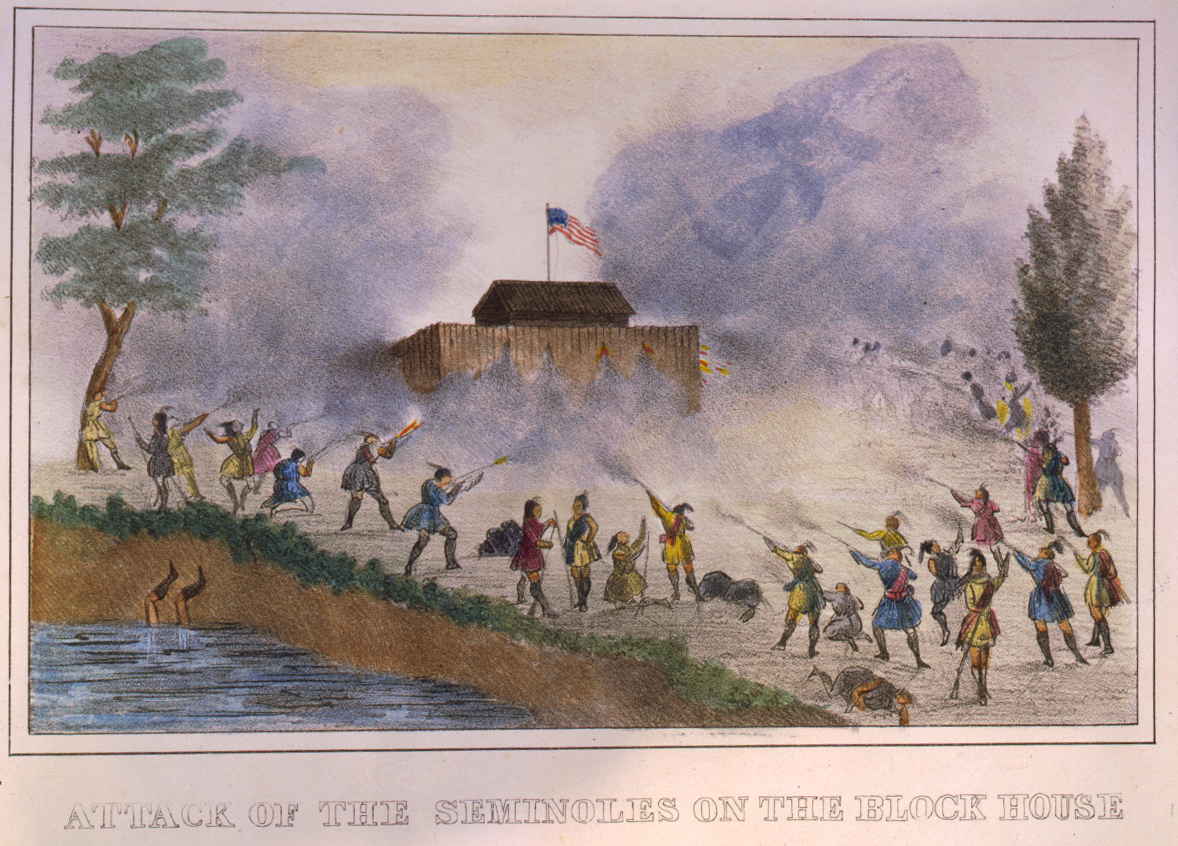
American settlers began to push into Florida, which was now an American territory and had some of the most fertile lands in the nation. Paul Hoffman claims that covetousness, racism, and "self-defense" against Indian raids played a major part in the settlers' determination to "rid Florida of Indians once and for all". To compound the tension, runaway black slaves sometimes found refuge in Seminole camps. The result was clashes between white settlers and the Indians residing there. Andrew Jackson sought to alleviate this problem by signing the Indian Removal Act in 1830, which stipulated the relocation of Indians out of Florida – by force if necessary. Many Seminole groups were relatively new arrivals in Florida, led by such powerful leaders as Aripeka (Sam Jones), Micanopy, and Osceola, and they had no intention of leaving their lands. They retaliated against the settlers, and this led to the Second Seminole War, the longest and most costly war that the Army ever waged against Indians.
In May 1830, the Indian Removal Act was passed by Congress which stipulated forced removal of Indians to Oklahoma. The Treaty of Paynes Landing was signed in May 1832 by a few Seminole chiefs who later recanted, claiming that they were tricked or forced to sign and making it clear that they would not consent to relocating to a reservation out west. The Seminoles' continued resistance to relocation led Florida to prepare for war. The St. Augustine Militia asked the US War Department for the loan of 500 muskets, and 500 volunteers were mobilized under Brig. Gen. Richard K. Call. Indian war parties raided farms and settlements, and families fled to forts or large towns, or out of the territory altogether. A war party led by Osceola captured a Florida militia supply train, killing eight of its guards and wounding six others; most of the goods taken were recovered by the militia in another fight a few days later. Sugar plantations were destroyed along the Atlantic coast south of St. Augustine, Florida, with many of the slaves on the plantations joining the Seminoles.
The US Army had 11 companies (about 550 soldiers) stationed in Florida. Fort King had only one company of soldiers, and it was feared that they might be overrun by the Seminoles. Three companies were stationed at Fort Brooke, with another two expected imminently, so the army decided to send two companies to Fort King. On December 23, 1835, the two companies totaling 110 men left Fort Brooke under the command of Major Francis L. Dade. Seminoles shadowed the marching soldiers for five days, and they ambushed them and wiped out the command on December 28. Only three men survived, and one was hunted down and killed by a Seminole the next day. Survivors Ransome Clarke and Joseph Sprague returned to Fort Brooke. Clarke died of his wounds later, and he provided the only account of the battle from the army's perspective. The Seminoles lost three men and five wounded. On the same day as the massacre, Osceola and his followers shot and killed Agent Wiley Thompson and six others during an ambush outside of Fort King.
On December 29, General Clinch left Fort Drane with 750 soldiers, including 500 volunteers on an enlistment due to end January 1, 1836. The group was traveling to a Seminole stronghold called the Cove of the Withlacoochee, an area of many lakes on the southwest side of the Withlacoochee River. When they reached the river, the soldiers could not find the ford, so Clinch ferried his regular troops across the river in a single canoe. Once they were across and had relaxed, the Seminoles attacked. The troops fixed bayonets and charged them, at the cost of four dead and 59 wounded. The militia provided cover as the army troops then withdrew across the river.
In the Battle of Lake Okeechobee, Colonel Zachary Taylor saw the first major action of the campaign. He left Fort Gardiner on the upper Kissimmee River with 1,000 men on December 19 and headed towards Lake Okeechobee. In the first two days, 90 Seminoles surrendered. On the third day, Taylor stopped to build Fort Basinger where he left his sick and enough men to guard the Seminoles who had surrendered. Taylor's column caught up with the main body of the Seminoles on the north shore of Lake Okeechobee on December 25.
The Seminoles were led by "Alligator", Sam Jones, and the recently escaped Coacoochee, and they were positioned in a hammock surrounded by sawgrass. The ground was thick mud, and sawgrass easily cuts and burns the skin. Taylor had about 800 men, while the Seminoles numbered fewer than 400. Taylor sent in the Missouri volunteers first, moving his troops squarely into the center of the swamp. His plan was to make a direct attack rather than encircle the Indians. All his men were on foot. As soon as they came within range, the Indians opened with heavy fire. The volunteers broke and their commander Colonel Gentry was fatally wounded, so they retreated back across the swamp. The fighting in the sawgrass was deadliest for five companies of the Sixth Infantry; every officer but one was killed or wounded, along with most of their non-commissioned officers. The soldiers suffered 26 killed and 112 wounded, compared to 11 Seminoles killed and 14 wounded. No Seminoles were captured, although Taylor did capture 100 ponies and 600 head of cattle.
By 1842, the war was winding down and most Seminoles had left Florida for Oklahoma. The US Army officially recorded 1,466 deaths in the Second Seminole War, mostly from disease. The number killed in action is less clear. Mahon reports 328 regular army killed in action, while Missall reports that Seminoles killed 269 officers and men. Almost half of those deaths occurred in the Dade battle, Battle of Lake Okeechobee, and Harney Massacre. Similarly, Mahon reports 69 deaths for the Navy, while Missal reports 41 for the Navy and Marine Corps. Mahon and the Florida Board of State Institutions agree that 55 volunteer officers and men were killed by the Seminoles, while Missall says that the number is unknown. A northern newspaper carried a report that more than 80 civilians were killed by Indians in Florida in 1839. By the end of 1843, 3,824 Indians had been shipped from Florida to the Indian Territory.
West of the Mississippi (1804–1924)
The series of conflicts in the western United States between Indians, American settlers, and the United States Army are generally known as the Indian Wars. Many of these conflicts occurred during and after the Civil War until the closing of the frontier in about 1890. However, regions of the West that were settled before the Civil War saw significant conflicts prior to 1860, such as Texas, New Mexico, Utah, Oregon, California, and Washington state.
Various statistics have been developed concerning the devastation of these wars on the peoples involved. Gregory Michno used records dealing with figures "as a direct result of" engagements and concluded that "of the 21,586 total casualties tabulated in this survey, military personnel and civilians accounted for 6,596 (31%), while Indian casualties totaled about 14,990 (69%)" for the period of 1850–90. However, Michno says that he "used the army's estimates in almost every case" and "the number of casualties in this study are inherently biased toward army estimations". His work includes almost nothing on "Indian war parties", and he states that "army records are often incomplete".
According to Michno, more conflicts with Indians occurred in the states bordering Mexico than in the interior states. Arizona ranked highest, with 310 known battles fought within the state's boundaries between Americans and Indians. Also, Arizona ranked highest of the states in deaths from the wars. At least 4,340 people were killed, including both the settlers and the Indians, over twice as many as occurred in Texas, the second highest-ranking state. Michno also says that 51 percent of the battles took place in Arizona, Texas, and New Mexico between 1850 and 1890, as well as 37 percent of the casualties in the country west of the Mississippi River.
Background
American settlers and fur trappers had spread into the western United States territories and had established the Santa Fe Trail and the Oregon Trail. Relations were generally peaceful between American settlers and Indians. The Bents of Bent's Fort on the Santa Fe Trail had friendly relations with the Cheyenne and Arapaho, and peace was established on the Oregon Trail by the Treaty of Fort Laramie signed in 1851 between the United States and the Plains Indians and the Indians of the northern Rocky Mountains. The treaty allowed passage by settlers, building roads, and stationing troops along the Oregon Trail.
The Pike's Peak Gold Rush of 1859 introduced a substantial white population into the Front Range of the Rockies, supported by a trading lifeline that crossed the central Great Plains. Advancing settlement following the passage of the Homestead Act of 1862 and the growing transcontinental railways following the Civil War further destabilized the situation, placing white settlers into direct competition for the land and resources of the Great Plains and the Rocky Mountain West. Additional factors included discovery of gold in Montana during the Montana Gold Rush of 1862–1863 and the opening of the Bozeman Trail, which led to Red Cloud's War, and later discovery of gold in the Black Hills resulting in the gold rush of 1875–1878 and the Great Sioux War of 1876–77.
Miners, ranchers, and settlers expanded into the plain, and this led to increasing conflicts with the Indian populations of the West. Many tribes fought American settlers at one time or another, from the Utes of the Great Basin to the Nez Perce tribe of Idaho. But the Sioux of the Northern Plains and the Apaches of the Southwest waged the most aggressive warfare, led by resolute, militant leaders such as Red Cloud and Crazy Horse. The Sioux were relatively new arrivals on the Plains, as they had been sedentary farmers in the Great Lakes region previously. They moved west, displacing other Indian tribes and becoming feared warriors. The Apaches supplemented their economy by raiding other tribes, and they practiced warfare to avenge the death of a kinsman.
During the American Civil War, Army units were withdrawn to fight the war in the east. They were replaced by the volunteer infantry and cavalry raised by the states of California and Oregon, by the western territorial governments, or by the local militias. These units fought the Indians and kept open communications with the east, holding the west for the Union and defeating the Confederate attempt to capture the New Mexico Territory. After 1865, national policy called for all Indians either to assimilate into the American population as citizens, or to live peacefully on reservations. Raids and wars between tribes were not allowed, and armed Indian bands off a reservation were the responsibility of the Army to round up and return.
Texas
The 18th and early 19th centuries in Texas were characterized by competition and warfare between the Comanches in the north and west of the state and Spanish settlements in the south and east. In the Battle of the Twin Villages in 1759, the Comanche and their Wichita allies defeated a Spanish and Apache army of more than 500 men and halted Spanish expansion in Texas. Comanche raids on Spanish settlements and their Lipan Apache allies in Texas and a defensive Spanish posture characterized the next 70 years. In the 1830s large numbers of Americans began to settle in Texas and they encroached on Comancheria, the proto-empire of the Comanches. A series of battles between Americans and Comanches and their Kiowa and Kiowa Apache allies continued until the 1870s.
The first notable battle between American settlers and Comanche was the Fort Parker massacre in 1836, in which a war party of Comanches, Kiowas, Wichitas, and Delawares attacked the Texan outpost at Fort Parker. A small number of settlers were killed during the raid, and the abduction of Cynthia Ann Parker and two other children caused widespread outrage among Texans.
The Republic of Texas gained independence from Mexico in 1836. The Texas government under President Sam Houston pursued a policy of engagement with the Comanches and Kiowas. Houston had lived with the Cherokees, but the Cherokees joined with Mexican forces to fight against Texas. Houston resolved the conflict without resorting to arms, refusing to believe that the Cherokees would take up arms against his government. The administration of Mirabeau B. Lamar followed Houston's and took a very different policy towards the Indians. Lamar removed the Cherokees to the west and then sought to deport the Comanches and Kiowas. This led to a series of battles, including the Council House Fight, in which the Texas militia killed 33 Comanche chiefs at a peace parley. The Comanches retaliated with the Great Raid of 1840, and the Battle of Plum Creek followed several days later.
The Lamar Administration was known for its failed and expensive Indian policy; the cost of the war with the Indians exceeded the annual revenue of the government throughout his four-year term. It was followed by a second Houston administration, which resumed the previous policy of diplomacy. Texas signed treaties with all of the tribes, including the Comanches. In the 1840s and 1850s, the Comanches and their allies shifted most of their raiding to a weak and newly independent Mexico. Comanche armies numbering in the hundreds raided deep into Mexico for horses and captives and used Texas as a safe haven from Mexican retaliation (see Comanche–Mexico Wars).
Texas joined the Union in 1845, and the Federal government and Texas took up the struggle between the Plains Indians and the settlers. The conflicts were particularly vicious and bloody on the Texas frontier in 1856 through 1858, as settlers continued to expand their settlements into Comancheria. The first Texan incursion into the heart of the Comancheria was in 1858, the so-called Antelope Hills Expedition marked by the Battle of Little Robe Creek.
The battles between settlers and Indians continued in 1860, and Texas militia destroyed an Indian camp at the Battle of Pease River. In the aftermath of the battle, the Texans learned that they had recaptured Cynthia Ann Parker, the little girl captured by the Comanches in 1836. She returned to live with her family, but she missed her children, including her son Quanah Parker. He was the son of Parker and Comanche Chief Peta Nocona, and he became a Comanche war chief at the Second Battle of Adobe Walls. He ultimately surrendered to the overwhelming force of the federal government and moved to a reservation in southwestern Oklahoma in 1875.
Pacific Northwest
On 1–4 October 1804, Russian America (now the state of Alaska) had suppressed a revolt by the Tlingit Kiks.ádi Clan during the battle of Sitka.