
Harlan Jay Ellison (May 27, 1934 – June 28, 2018) was an American writer, known for his prolific and influential work in New Wave speculative fiction and for his outspoken, combative personality. His published works include more than 1,700 short stories, novellas, screenplays, comic-book scripts, teleplays, essays, and a wide range of criticism covering literature, film, television, and print media.
Some of his best-known works include the 1967 Star Trek episode "The City on the Edge of Forever", which is regarded as one of the best episodes in the Star Trek franchise (he subsequently wrote a book about the experience that includes his original teleplay), his A Boy and His Dog cycle (which was made into a film), and his short stories "I Have No Mouth, and I Must Scream" (later adapted by Ellison into a video game) and "'Repent, Harlequin!' Said the Ticktockman". He was also editor and anthologist for Dangerous Visions (1967) and Again, Dangerous Visions (1972). Ellison won numerous awards, including multiple Hugos, Nebulas, and Edgars.
Biography
Early life and career
Ellison was born to a Jewish family in Cleveland, Ohio, on May 27, 1934, the son of Serita (née Rosenthal) and Louis Laverne Ellison, a dentist and jeweler. His older sister Beverly was born in 1926. Some time after Beverly's birth, his family moved to Painesville, Ohio, but returned to Cleveland in 1949, following his father's death. Ellison frequently ran away from home. In an interview with Tom Snyder, he would later claim it was due to discrimination by his high school peers. Throughout Ellison's childhood, antisemitism was widespread throughout America, which led to his early life spent in isolation. According to Ellison, by age 18 he had completed a series of odd jobs as a "tuna fisherman off the coast of Galveston, itinerant crop-picker down in New Orleans, hired gun for a wealthy neurotic, nitroglycerine truck driver in North Carolina, short-order cook, cab driver, lithographer, book salesman, floorwalker in a department store, door-to-door brush salesman, and as a youngster, an actor in several productions at the Cleveland Play House". In 1947, a fan letter he wrote to Real Fact Comics became his first published writing.
Ellison attended Ohio State University for 18 months (1951–53) before being expelled for verbally abusing a creative writing professor who excoriated the science fiction genre and Ellison's writing. Over the next 20 or so years he claimed to have sent the professor a copy of every story he published.
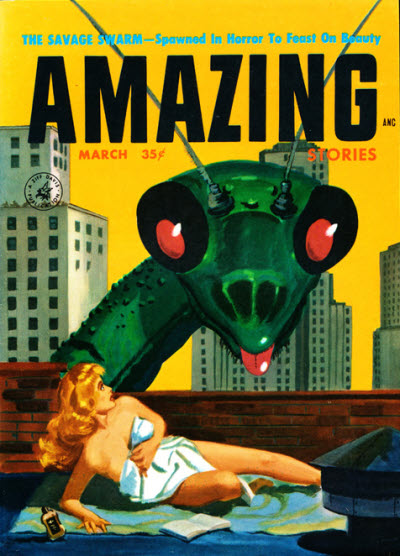
Ellison published two serialized stories in the Cleveland News during 1949, and he sold a story to EC Comics early in the 1950s. During this period, Ellison was an active member of science fiction fandom. He published his own science fiction fanzines, such as Dimensions, which had previously been the Bulletin of the Cleveland Science Fantasy Society and later Science Fantasy Bulletin. Ellison moved to New York City in 1955 and lived with Robert Silverberg as they both pursued writing careers. Over the next two years, he published more than 100 short stories and articles. The short stories collected as Sex Gang — which Ellison described in a 2012 interview as "mainstream erotica"—date from this period.
He served in the U.S. Army from 1957 to 1959. His first novel, Web of the City (originally titled Rumble), was published during his military service in 1958, and he said that he had written the bulk of it while undergoing basic training at Fort Benning, Georgia. He served in the Public Information Office at Fort Knox, Kentucky, where he wrote articles and reviews for the post's weekly newspaper.

After leaving the army, he relocated to Chicago, where he edited Rogue magazine.
Hollywood and beyond
Ellison moved to California in 1962 and began selling his writing to Hollywood. Ellison sold scripts to many television shows: Burke's Law (4 episodes), Route 66, The Outer Limits, The Alfred Hitchcock Hour, Star Trek, The Man from U.N.C.L.E. (2 episodes), Cimarron Strip and The Flying Nun.
Ellison's screenplay for the Star Trek episode "The City on the Edge of Forever" is often considered the best of the 79 episodes in the series.

He co-wrote the screenplay for The Oscar (1966), starring Stephen Boyd and Tony Bennett.
In 1965, he participated in the second and third Selma to Montgomery marches, led by Martin Luther King Jr.
In 1966, the journalist Gay Talese wrote a profile of Frank Sinatra for Esquire, which the magazine later named as the best magazine piece ever written. The article, entitled "Frank Sinatra Has a Cold", briefly describes a verbal clash between Sinatra and Ellison, in which the crooner took exception to Ellison's boots during a billiards game Ellison was playing with Omar Sharif, Leo Durocher, and Peter Falk.
Ellison was hired as a writer for Walt Disney Studios, but was fired on his first day after Roy O. Disney overheard him in the studio commissary joking about making a pornographic animated film featuring Disney characters.
Ellison continued to publish short fiction and nonfiction pieces in various publications, including some of his best known stories. "'Repent, Harlequin!' Said the Ticktockman" (1965) is a celebration of civil disobedience against repressive authority. "I Have No Mouth, and I Must Scream" (1967) is a story where five humans are tormented by an all-knowing computer throughout eternity. The story was the basis of a 1995 computer game; Ellison participated in the game's design and provided the voice of the god-computer AM. Another story, "A Boy and His Dog", examines the nature of friendship and love in a violent, post-apocalyptic world and was made into the 1975 film of the same name, starring Don Johnson.
In 1967, Ellison edited the Dangerous Visions collection, which attracted a "special citation at the 26th World SF Convention for editing 'the most significant and controversial SF book published in 1967.'" In his introduction Isaac Asimov described it as epitomising a "second revolution" in science fiction as "science receded and modern fictional techniques came to the fore."

From 1968 to 1970, Ellison wrote a regular column on television for the Los Angeles Free Press. Titled "The Glass Teat", Ellison's column examined television's impact on the politics and culture of the time, including its presentations of sex, politics, race, the Vietnam War, and violence. The essays were collected in two anthologies, The Glass Teat: Essays of Opinion on Television followed by The Other Glass Teat.
Ellison served as creative consultant to the 1980s version of The Twilight Zone science fiction TV series and as a conceptual consultant for Babylon 5. As a member of the Screen Actors Guild (SAG), he had voice-over credits for shows, including The Pirates of Dark Water, Mother Goose and Grimm, Space Cases, Phantom 2040, and Babylon 5, and made an onscreen appearance in the Babylon 5 episode "The Face of the Enemy".
A frequent guest on the Los Angeles science fiction/fantasy culture radio show Hour 25, hosted by Mike Hodel, Ellison took over as host when Hodel died. Ellison's tenure was from May 1986 to June 1987.

Ellison's short story "The Man Who Rowed Christopher Columbus Ashore" (1992) was selected for inclusion in the 1993 edition of The Best American Short Stories.
Ellison, as an audio actor/reader, was nominated for a Grammy Award for Best Spoken Word Album for Children twice and won several Audie Awards.
In 2014, Ellison made a guest appearance on the album Finding Love in Hell by the stoner rock band Leaving Babylon, reading his piece "The Silence" (originally published in Mind Fields) as an introduction to the song "Dead to Me."
Ellison's official website, harlanellison.com, was launched in 1995 as a fan page; for several years, Ellison was a regular poster in its discussion forum.
Ellison's voice is one of 80 used in the NPRmageddon podcast (which is unrelated to National Public Radio), which appeared after his death.
Personal life and death
Ellison married five times; each relationship ended within a few years, except the last. His first wife was Charlotte Stein, whom he married in 1956. They divorced in 1960, and he later described the marriage as "four years of hell as sustained as the whine of a generator." Later that year he married Billie Joyce Sanders; they divorced in 1963. His 1966 marriage to Loretta Patrick lasted only seven weeks. In 1976, he married Lori Horowitz. He was 41 and she was 19, and he later said of the marriage, "I was desperately in love with her, but it was a stupid marriage on my part." They were divorced after eight months. He briefly had a relationship with actress Grace Lee Whitney, allegedly ending it when he caught her smoking cannabis in his house. He and Susan Toth (1960–2020) married in 1986, and they remained together, living in Sherman Oaks, until his death 32 years later. He referred to his home as "The Lost Aztec Temple of Mars". Susan died in August 2020, age 60.
Ellison was a longtime friend of actor Robert Culp, whom he had in mind when writing the script for The Outer Limits episode "Demon with a Glass Hand".
Ellison described himself as a Jewish atheist. In his writing, his work resembles traditional Jewish storytelling and works such as I'm Looking for Kadak (1974) and Mom (1976) include glossaries of Yiddish phrases.
In 1994, he had a heart attack and was hospitalized for quadruple coronary artery bypass surgery. From 2010, he received treatment for clinical depression.
In September 2007, Ellison attended the Midwestern debut of the documentary about his life, Dreams with Sharp Teeth, at the Cleveland Public Library in his hometown of Cleveland, Ohio. This would be Ellison's last public appearance in his hometown.
On about October 10, 2014, Ellison had a stroke. Although his speech and cognition were unimpaired, he suffered paralysis on his right side, for which he was expected to spend several weeks in physical therapy before being released from the hospital.
Ellison died in his sleep at his home in Los Angeles on the morning of June 28, 2018. His literary estate is executed by Babylon 5 creator J. Michael Straczynski.
Pseudonyms
Ellison on occasion used the pseudonym Cordwainer Bird to alert members of the public to situations in which he felt his creative contribution to a project had been mangled by others, beyond repair, typically Hollywood producers or studios (see also Alan Smithee). The first such work to which he signed the name was "The Price of Doom", an episode of Voyage to the Bottom of the Sea (though it was misspelled as Cord Wainer Bird in the credits). An episode of Burke's Law ("Who Killed Alex Debbs?") credited to Ellison contains a character given this name, played by Sammy Davis Jr.
The "Cordwainer Bird" moniker is a tribute to fellow science fiction writer Paul M. A. Linebarger, better known by his pen name, Cordwainer Smith. The origin of the word "cordwainer" is shoemaker (from working with shell cordovan leather for shoes). The term used by Linebarger was meant to imply the industriousness of the pulp author. Ellison said, in interviews and in his writing, that his version of the pseudonym was meant to mean "a shoemaker for birds". Since he used the pseudonym mainly for works from which he wanted to distance himself, it may be understood to mean that "this work is for the birds" or that it is of as much use as shoes to a bird. Stephen King once said he thought that it meant that Ellison was giving people who mangled his work a literary version of "the bird" (given credence by Ellison himself in his own essay titled "Somehow, I Don't Think We're in Kansas, Toto", describing his experience with the Starlost television series).
The Bird moniker became a character in one of Ellison's own stories. In his 1978 book Strange Wine, Ellison explains the origins of the Bird and goes on to state that Philip José Farmer wrote Cordwainer into the Wold Newton family that the latter writer had developed. The thought of such a whimsical object lesson being related to such lights as Doc Savage, The Shadow, Tarzan, and all the other pulp heroes prompted Ellison to play with the concept, resulting in "The New York Review of Bird", in which an annoyed Bird uncovers the darker secrets of the New York literary establishment before beginning a pulpish slaughter of the same.
Other pseudonyms Ellison used during his career include Jay Charby, Sley Harson, Ellis Hart, Lee Archer, John Magnus, Paul Merchant, Pat Roeder, Ivar Jorgenson, Derry Tiger, Harlan Ellis and Jay Solo.
Controversies and disputes
Temperament
Ellison had a reputation for being abrasive and argumentative. He generally agreed with this assessment, and a dust jacket from one of his books described him as "possibly the most contentious person on Earth". Ellison filed numerous grievances and attempted lawsuits; during a contract dispute with Signet/NAL Books over binding cigarette ads into one of his paperbacks, he sent them dozens of bricks postage due, followed by a dead gopher. In an October 2017 piece in Wired, Ellison was dubbed "Sci-Fi's Most Controversial Figure".
According to Ellison, his impending trip to Israel was cancelled by its sponsor, the US Information Agency, after his irreverent comment on the Palestine–Israel situation to The Jerusalem Post.
At Stephen King's request, Ellison provided a description of himself and his writing in Danse Macabre (1981): "My work is foursquare for chaos. I spend my life personally, and my work professionally, keeping the soup boiling. Gadfly is what they call you when you are no longer dangerous; I much prefer troublemaker, malcontent, desperado. I see myself as a combination of Zorro and Jiminy Cricket. My stories go out from here and raise hell. From time to time some denigrator or critic with umbrage will say of my work, 'He only wrote that to shock.' I smile and nod. Precisely."
Health issues
Ellison suffered health issues regularly through his life, including severe depression toward the end, some of which he believed was Epstein–Barr virus and chronic fatigue syndrome, the latter two of which he believed he had had for 40–50 years. A few years before his death, J. Michael Straczynski convinced him to seek psychiatric diagnosis for the depression, resulting in a diagnosis and treatment of bipolar disorder; he commented, "Once you know he was bipolar, a lot of things that don't make sense suddenly make sense." The treatment "had a salutary effect for a while, until the stroke hit". Straczynski wrote a more detailed account of Ellison's struggles with mental illness, posthumously published in The Last Dangerous Visions.
Star Trek
Ellison repeatedly criticized how Star Trek creator and producer Gene Roddenberry (and others) rewrote his original script for the 1967 episode "The City on the Edge of Forever". Despite his objections, Ellison kept his own name on the shooting script instead of using "Cordwainer Bird" to indicate displeasure (see above).
Ellison's original script was first published in the 1976 anthology Six Science Fiction Plays, edited by Roger Elwood. The aired version was adapted for the Star Trek Fotonovel series in 1977.
At the start of an interview with Ellison entitled "Encounter with an Ellison", Sandra Cawson was interrupted when she said "Mr Ellison", and was told to address him as "Harlan". The interviewee stated "Mr Ellison was my father. He died in 1949". Cawson described the interviewee's home as a "calculated fall down a rabbit hole" and the author himself as "outgoing, charming, hospitable". In the course of the interview Cawson was given a long explanation about the process of television in omitting "small touches" and "special scenes" in favor of "straight action sequences" which "diminished the value of the script".
In 1995, Borderlands Press published The City on the Edge of Forever, with nearly 300 pages comprising an essay by Ellison, four versions of the teleplay, and eight "Afterwords" contributed by other parties. He greatly expanded the introduction for the paperback edition, in which he explained what he called a "fatally inept" treatment.
Both versions of the script won awards: Ellison's original script won the 1968 Writers Guild Award for best episodic drama in television, while the shooting script won the 1968 Hugo Award for Best Dramatic Presentation.
On March 13, 2009, Ellison sued CBS Paramount Television, seeking payment of 25 percent of net receipts from merchandising, publishing, and other income from the episode since 1967; the suit also names the Writers Guild of America for allegedly failing to act on Ellison's behalf. On October 23, 2009, Variety magazine reported that a settlement had been reached.
Vietnam War opposition and AggieCon I
Ellison was among those who in 1968 signed an anti-Vietnam War advertisement in Galaxy Science Fiction. In 1969, Ellison was Guest of Honor at Texas A&M University's first science fiction convention, AggieCon, where he reportedly referred to the university's Corps of Cadets as "America's next generation of Nazis", inspired in part by the Vietnam War. Although the university was no longer solely a military school (from 1965), the student body was predominantly made up of cadet members. Between Ellison's anti-military remarks and a food fight that broke out in the ballroom of the hotel where the gathering was held (although, according to Ellison in 2000, the food fight actually started in a Denny's because the staff disappeared and they could not get their check), the school's administration almost refused to approve the science fiction convention the next year and no guest of honor was invited for the next two AggieCons. Ellison was subsequently invited back as Guest of Honor for AggieCon V (1974).
The Last Dangerous Visions
The Last Dangerous Visions (TLDV), the third volume of Ellison's anthology series, was originally announced for publication in 1973, but not published until October 2024, six years after Ellison died. Nearly 150 writers, many now also dead, had submitted works for the volume. In 1993, Ellison threatened to sue the New England Science Fiction Association (NESFA) for publishing "Himself in Anachron", a short story written by Cordwainer Smith and originally sold by his widow to Ellison for the anthology. The NESFA later reached an amicable settlement after it was revealed that the story contract had expired, allowing them to legally acquire it for publication.
British science fiction author Christopher Priest criticized Ellison's editorial practices in an article entitled "The Book on the Edge of Forever", later expanded into a book. Priest documented a half-dozen unfulfilled promises by Ellison to publish The Last Dangerous Visions within a year of the statement. Priest claims that he submitted a story at Ellison's request, which Ellison retained for several months until Priest withdrew the story and demanded that Ellison return the manuscript. Ellison was incensed by "The Book on the Edge of Forever" and, personally or by proxy, threatened Priest on numerous occasions after its publication.
In November 2020, the executor of the Harlan Ellison estate, J. Michael Straczynski, announced on Patreon that he was proceeding with the final preparations for the publication of TLDV with the proceeds to go to the Harlan and Susan Ellison Trust. The book was expected to be published in April 2021, as significant publisher interest was expressed.
Christopher Priest was unimpressed, saying that Straczynski was "in the same sort of unenviable position as Trump's caddie", but as an experienced professional would possibly work something out. He added, "I kind of lost interest in all that years ago. Ellison clearly did too, along with everyone else. (Although I gather he went on with his magical thinking if anyone asked when he was going to deliver.) Many of the stories were withdrawn, because Ellison acted like a dick. Of the ones that remain, most of them are by writers who are now deceased, so the rights have expired and the estates would have to be traced. A lot of the writers have disowned their stories as juvenilia, or outdated, or simply because Ellison was acting like a dick."