
Frances Jane van Alstyne (née Crosby; March 24, 1820 – February 12, 1915), more commonly known as Fanny J. Crosby, was an American mission worker, poet, lyricist, and composer. A prolific hymnist, she wrote more than 8,000 hymns and gospel songs, with more than 100 million copies printed. She is also known for her teaching and rescue mission work. By the end of the 19th century, she had become a household name.
Crosby was known as the "Queen of Gospel Song Writers" and the "Mother of modern congregational singing in America", with most American hymnals containing her work. Her gospel songs were "paradigmatic of all revival music", and Ira Sankey attributed the success of the Moody and Sankey evangelical campaigns largely to Crosby's hymns. Some of Crosby's best-known works include "Pass Me Not, O Gentle Saviour", "Blessed Assurance", "Jesus Is Tenderly Calling You Home", "Praise Him, Praise Him", "Rescue the Perishing", and "To God Be the Glory". Some publishers were hesitant to have so many hymns by one person in their hymnals, so Crosby used nearly 200 different pseudonyms during her career.
Crosby also wrote more than 1,000 secular poems and had four books of poetry published, as well as two best-selling autobiographies. Additionally, she co-wrote popular secular songs, political and patriotic songs, and at least five cantatas on biblical and patriotic themes, including The Flower Queen, the first secular cantata by an American composer. She was committed to Christian rescue missions and was known for her public speaking.

Early life and education
Frances Jane Crosby was born on March 24, 1820, in the village of Brewster, about 50 miles (80 km) north of New York City. She was the only child of John Crosby and his second wife Mercy Crosby, both of whom were relatives of Revolutionary War spy Enoch Crosby. He was a widower who had a daughter from his first marriage. According to C. Bernard Ruffin, John and Mercy were possibly first cousins; however, "by the time Fanny Crosby came to write her memoirs [in 1906], the fact that her mother and father were related... had become a source of embarrassment, and she maintained that she did not know anything about his lineage".
Crosby was proud of her Puritan heritage. She traced her ancestry from Anna Brigham and Simon Crosby who arrived in Boston in 1635 (and were among the founders of Harvard College); their descendants married into Mayflower families, making Crosby a descendant of Elder William Brewster, Edward Winslow, and Thomas Prence, and a member of the exclusive Daughters of the Mayflower.
She was also a member of the Daughters of the American Revolution in Bridgeport, Connecticut, writing the verses of the state song of the Connecticut branch. Through Simon Crosby, Fanny was also a relative of Presbyterian minister Howard Crosby and his neoabolitionist son Ernest Howard Crosby, as well as singers Bing and Bob Crosby.

At six weeks old, Crosby caught a cold and developed inflammation of the eyes. Mustard poultices were applied to treat the discharges. According to Crosby, this procedure damaged her optic nerves and blinded her, but modern physicians think that her blindness was more likely congenital and, given her age, may simply not have been noticed by her parents.
Her father died in November 1820 when Fanny was only six months old, so she was raised by her mother and maternal grandmother Eunice Paddock Crosby (born about 1778; died about 1831). These women grounded her in Christian principles, helping her memorize long passages from the Bible, and she became an active member of the John Street Methodist Episcopal Church in Manhattan.
When Crosby was three, the family moved to North Salem, New York, where Eunice had been raised. In April 1825, she was examined by the surgeon Valentine Mott, who concluded that her condition was inoperable and that her blindness was permanent.

At age eight, Crosby wrote her first poem which described her condition. She later stated: "It seemed intended by the blessed providence of God that I should be blind all my life, and I thank him for the dispensation. If perfect earthly sight were offered me tomorrow I would not accept it. I might not have sung hymns to the praise of God if I had been distracted by the beautiful and interesting things about me." She also once said, "when I get to heaven, the first face that shall ever gladden my sight will be that of my Savior". According to biographer Annie Willis, "had it not been for her affliction she might not have so good an education or have so great an influence, and certainly not so fine a memory".
In 1828, Mercy and Fanny moved to the home of a Mrs. Hawley in Ridgefield, Connecticut. While residing in Ridgefield, they attended the Presbyterian church on the village green. Historian Edith L. Blumhofer described the Crosby home environment as sustained by "an abiding Christian faith". Crosby memorized five chapters of the Bible each week from age 10, with the encouragement of her grandmother and later Mrs. Hawley; by age 15, she had memorized the four gospels, the Pentateuch, the Book of Proverbs, the Song of Solomon, and many of the Psalms. From 1832, a music teacher came to Ridgefield twice a week to give singing lessons to her and some of the other children. Around the same time, she attended her first Methodist church services at the Methodist Episcopal Church, and she was delighted by their hymns.
Crosby enrolled at the New York Institution for the Blind (NYIB) in 1835, just before her 15th birthday. She remained there for eight years as a student, and another two years as a graduate pupil, during which time she learned to play the piano, organ, harp, and guitar, and became a good soprano singer. While she was studying at NYIB in 1838, her mother Mercy remarried and the couple had three children together. Mercy's husband abandoned her in 1844.

Early career (1843–1858)
After graduation from the NYIB in 1843, Crosby joined a group of lobbyists in Washington, D.C., arguing for support of education for the blind. She was the first woman to speak in the United States Senate when she read a poem there. She appeared before the joint houses of Congress and recited these lines:
Crosby was among the students from the NYIB who gave a concert for Congress on January 24, 1844. She recited an original composition calling for an institution for educating the blind in every state which was praised by John Quincy Adams, among others. Two days later, she was among a group of Blind Institution students who gave a presentation to notable people at Trenton, New Jersey, where she recited an original poem calling for the aid and education of the blind. President James K. Polk visited the NYIB in 1845 and Crosby recited a poem that she composed for the occasion which praised "republican government". In 1851, she addressed the New York state legislature.
In April 1846, Crosby spoke before a joint session of the United States Congress, with delegations from the Boston and Philadelphia Institutions for the Blind, "to advocate support for the education of the blind in Boston, Philadelphia, and New York". She testified before a special congressional subcommittee, and she performed in the music room at the White House for President Polk and his wife. Among the songs that she sang as she accompanied herself on the piano was her own composition:

In 1846, Crosby was an instructor at the NYIB and was listed as a "graduate pupil". She subsequently joined the school's faculty, teaching grammar, rhetoric, and history; she remained there until three days before her wedding on March 5, 1858. While teaching at the NYIB, she befriended future US president Grover Cleveland then aged 17. The two spent many hours together at the end of each day, and he often transcribed the poems that she dictated to him. He wrote for her a recommendation which was published in her 1906 autobiography. She wrote a poem that was read at the dedication of Cleveland's birthplace in Caldwell, New Jersey, in March 1913, being unable to attend due to her health.
Christian faith
Crosby was a longtime member of the Sixth Avenue Bible Baptist Church in Brooklyn, New York, which has been in existence continuously since 1867. She served as a consecrated Baptist missionary, deaconess, and lay preacher. She wrote hymns together with her minister Robert Lowry, such as "All the Way My Savior Leads Me" and many others.
There was a cholera epidemic in New York City from May to November 1849, and she remained at the NYIB to nurse the sick rather than leaving the city. Subsequently, according to Blumhofer, "Crosby seemed worn, languid, even depressed" when the Institution re-opened in November, forcing her to teach a lighter load. According to Bernard Ruffin:
In this atmosphere of death and gloom, Fanny became increasingly introspective over her soul's welfare. She began to realize that something was lacking in her spiritual life. She knew that she had gotten wrapped up in social, political, and educational reform, and did not have a true love for God in her heart.
In the Fall of 1850, after being troubled by a dream, Crosby went to revival meetings at the thirteenth Street Methodist Church in New York city where she twice vainly sought the peace with God she craved, but which she finally realized on November 30 during a congregational hymn of consecration while seeking God alone at the altar. Crosby stated that she then felt "flooded with celestial light."
Crosby attended churches of various denominations until spring 1887, including the Plymouth Church of the Pilgrims in Brooklyn Heights led by Congregationalist abolitionist Henry Ward Beecher who was an innovator with church music. She attended the Trinity Episcopal church, and liked to worship at the North West Dutch Reformed church and the Central Presbyterian Church (later known as the Brooklyn Tabernacle). In later life, she said that one of her favorite preachers was Theodore Ledyard Cuyler, minister of the North East Dutch Reformed Church.
Tradition insists that she was a member in good standing of the John Street Methodist Episcopal Church in Manhattan, but there are no contemporaneous records to confirm this. By 1869, she attended the Chelsea Methodist Episcopal Church.
Crosby was not identified publicly with the American holiness movement of the second half of the 19th century and left no record of an experience of entire sanctification. She was, however, a fellow traveler of the Wesleyan holiness movement, including prominent members of the American Holiness movement in her circle of friends and attending Wesleyan/Holiness camp meetings. For example, she was a friend of Walter and Phoebe Palmer, "the mother of the holiness movement" and "arguably the most influential female theologian in Christian history", and their daughter Phoebe Knapp, with whom she wrote "Blessed Assurance"; she often visited the Methodist camp grounds at Ocean Grove, New Jersey, as their guest. She vacationed each summer at Ocean Grove between 1877 and 1897 (and possibly longer), where she would speak in the Great Auditorium and hold receptions in her cottage to meet her admirers.
In 1877, Crosby met William J. Kirkpatrick, one of the most prolific composers of gospel song tunes and "the most prominent publisher in the Wesleyan/Holiness Movement". She called him "Kirkie" and wrote many hymns with him. Some of her hymns reflected her Wesleyan beliefs, including her call to consecrated Christian living in "I Am Thine, O Lord" (1875):
In 1887, she joined the Cornell Memorial Methodist Episcopal Church by "confession of faith".
Early writing career (1841–1865)
Poetry
Crosby's earliest published poem was sent without her knowledge to P. T. Barnum, who published it in his The Herald of Freedom. She was examined by George Combe, a visiting Scottish phrenologist, who pronounced her a "born poetess". She had experienced some temporary opposition to her poetry by the faculty of the Blind Institution, but her inclination to write was encouraged by this experience. The Institution found Hamilton Murray to teach her poetic composition, though he admitted his own inability to compose poetry.
In 1841, New York Herald published Crosby's eulogy on the death of President William Henry Harrison, thus beginning her literary career. Her poems were published frequently in The Saturday Evening Post, the Clinton Signal, the Fireman's Journal, and the Saturday Emporium.
Crosby was reluctant to have her poems published, as she considered them to be "unfinished productions", but she acquiesced eventually because it would publicize the Institution and raise funds for it. (She had had an illness that caused her to leave the NYIB in order to recuperate.) Her first book A Blind Girl and Other Poems was published in April 1844 after encouragement by the Institution, including "An Evening Hymn" based on Psalm 4:8, which she described as her first published hymn. In 1853, her Monterey and Other Poems was published which included poems focusing on the recent Mexican–American War, and a poem pleading for the US to help those affected by the Great Famine of Ireland. She stated in her 1903 autobiography, edited by Will Carleton, that she "was under a feeling of sadness and depression at this time".
In 1853, Crosby's poem "The Blind Orphan Girl" was included in Caroline M. Sawyer's The History of the Blind Vocalists. Her third book A Wreath of Columbia's Flowers was published in 1858 at about the time when she resigned from the Blind Institution and got married. It contains four short stories and 30 poems.
Popular songs
Crosby had been inspired by the success of the melodies of Stephen Foster, so she and George F. Root wrote at least 60 secular "people's songs" or parlour songs between August 1851 and 1857, some for the popular minstrel shows. (Root had taught music at the Blind Institution from 1845–50). The minstrel shows had a negative reputation among some Christians and classical musicians, so their participation in these compositions was deliberately obscured. "Like many cultured people of the day," writes Bernard Ruffin, "[Root] considered native American music rather crude." He chose to "Europeanize" his name (like many American artists and musicians of that era) to "George Friederich Wurzel" (German for Root), while Crosby's name was sometimes omitted altogether.
For many years, Crosby was usually paid only $1 or $2 per poem, with all rights to the song being retained by the composer or publisher of the music.
In the summer of 1851, George Root and Crosby both taught at the North Reading Musical Institute in North Reading, Massachusetts. Their first song was "Fare Thee Well, Kitty Dear" (1851) which evoked old-South imagery. Crosby's lyrics were based on a suggestion by Root, which she described as "the grief of a colored man on the death of his beloved." It was written for and performed exclusively by Henry Wood's Minstrels and published by John Andrews, who specialized in printing "neat, quick & cheap," according to Karen Linn. "This song was not a hit, and had no lasting influence," according to Linn, as "its style is far too literary, the words not in dialect, the cause of sorrow seems to be a lover (rather than 'massa', or Little Eva, or homesickness: all more appropriate causes for slave sorrow according to the popular culture)". In 1852, Root signed a three-year contract with William Hall & Son.
Despite this initial setback, Crosby continued to teach at North Reading during her vacations in 1852 and 1853, where she wrote the lyrics for many of her collaborations with Root. Among their joint compositions were "Bird of the North" (1852) and "Mother, Sweet Mother, Why Linger Away?" (1852).
Crosby and Root's first successful popular song was "The Hazel Dell" (1853), a sentimental ballad described by its publisher as "a very pretty and easy song, containing the elements of great popularity," released as the work of G.F. Wurzel toward the end of 1853. It was a hit that was "one of the most popular songs in the country" because of its performance by both Henry Wood's Minstrels and Christy's Minstrels, selling more than 200,000 copies of sheet music. It is described as being on "the fringes of blackface minstrelsy, although it lacks dialect or any hint of buffoonery", about a beautiful girl who died young.
An article in the December 1854 issue of New York Musical Review proclaimed the death of "Negro minstrelsy." It listed "Hazel Dell," along with Stephen Foster's songs "Old Folks at Home" (1851) and "My Old Kentucky Home" (1853), as popular songs that were evidence of the "bleaching process... observable in the gradual rejection of the plantation, and the adoption of sentiments and poetic forms of expression, characteristic rather of the intelligent Caucasian".
Toward the end of 1853, William Hall & Son released "Greenwood Bell" at the same time as "Hazel Dell", but credited it to Root and Crosby. "Greenwood Bell" describes the funerals of a child, a young man, and an aged person, and the tolling of the bell at the Greenwood Cemetery. Other songs written by Crosby and Root included "O How Glad to Get Home" and "They Have Sold Me Down the River (The Negro Father's Lament)" (1853). Their song "There's Music in the Air" (1854) became a hit song and was listed in Variety Music Cavalcade as one of the most popular songs of 1854; it was in songbooks until at least the 1930s and became a college song at Princeton University.
Crosby-Root songs were published by other publishers after the expiration of Root's contract with William Hall & Son in 1855 (and after being rejected by Nathan Richardson of Russell & Richardson of Boston), including Six Songs by Wurzel published in 1855 by S. Brainard's Sons of Cleveland, Ohio. These six Root-Crosby songs were "O How Glad to Get Home," "Honeysuckle Glen," "The Church in the Wood," "All Together Now," and "Proud World, Good-by." The most popular of these songs was "Rosalie, the Prairie Flower", about the death of a young girl. It was popularized in the 1850s by the Christy Minstrels; it sold more than 125,000 copies of sheet music and earned nearly $3,000 (~$17,950 in 2025) in royalties for Root — and almost nothing for Crosby. Crosby also wrote the words for popular songs for other composers, including "There is a Bright and Sunny Spot" (1856) for Clare W. Beames.
Cantatas
Between 1852 and 1854, Crosby wrote the librettos of three cantatas for Root. Their first was The Flower Queen; The Coronation of the Rose (1852), often described as "the first secular cantata written by an American." It is an opera "in all but name," described as a "popular operetta" which "illustrated nineteenth-century American romanticism." In her 1906 autobiography, Crosby explained the theme of this cantata:
an old man becoming tired of the world, decides to become a hermit; but, as he is about to retire to his lonely hut, he hears a chorus singing, "Who shall be queen of the flowers?" His interest is at once aroused; and on the following day he is asked to act as judge in a contest where each flower urges her claims to be queen of all the others. At length the hermit chooses the rose for her loveliness; and in turn she exhorts him to return to the world and to his duty.
The Flower Queen was written as "a work for teenage girls (scored for first and second soprano and alto)." It was performed first on March 11, 1853, by the young ladies of Jacob Abbott's Springer Institute, and almost immediately repeated by Root's students at the Rutgers Female Institute; it was praised by R. Storrs Willis. It was performed an estimated 1,000 times throughout the United States in the first four years after its publication. The success of The Flower Queen and subsequent cantatas brought great acclaim and fortune to Root, with little of either for Crosby.
The second Root-Crosby cantata was Daniel, or the Captivity and Restoration, based on the Old Testament's story of Daniel. It was composed in 1853 for Root's choir at the Mercer Street Presbyterian Church in Manhattan. This cantata comprised 35 songs, with music composed with William Batchelder Bradbury and words by Crosby and Union Theological Seminary student Chauncey Marvin Cady. Some of its principal choruses were first performed on July 15, 1853, by the students at Root's New York Normal Institute.
In 1854, Root and Crosby collaborated to compose The Pilgrim Fathers, described as an "antebellum landmark" in dramatic cantatas. According to Blumhofer, it "featured the contemporary evangelical reading of American history." Crosby wrote the libretto for a cantata entitled The Excursion, with music by Baptist music professor Theodore Edson Perkins, one of the founders of New York music publishing house Brown & Perkins. In 1886, Crosby and William Howard Doane wrote Santa Claus' Home; or, The Christmas Excursion, a Christmas cantata published by Biglow & Main.
Political songs
In addition to poems of welcome to visiting dignitaries, Crosby wrote songs of a political nature, such as about the major battles of the Mexican–American War and the American Civil War.
By the 1840 US Presidential election, she was "an ardent Democrat" and wrote verse against Whig candidate (and ultimate winner) William Henry Harrison. By 1852, she switched her political allegiance from support for the pro-slavery Democrats to the anti-slavery Whigs, writing the poem "Carry Me On" for them in 1852. After the election of Democrat Franklin Pierce as US President in November 1852, she wrote:
Though she considered herself a Democrat at the time, Crosby was a keen admirer of the leading Whig, U.S. Senator Henry Clay of Kentucky, who in 1848 made a tour of large eastern cities. He visited the New York Institution for the Blind in New York City, where Crosby lived. The visit came two years after the death of Henry Clay Jr., in the Mexican–American War. Crosby recalled that "the great statesman was never quite himself after his son's death, and I purposely avoided all mention of it in the address of welcome on the day he came to visit us, lest I mighty wound the heart of the man whom I had learned not only to venerate but to love; for Mr. Clay was always an especial favorite among public men. There was a strength in his character and an earnestness in his speeches that appealed to me more than I can tell. ... I would have challenged any person, whether Whig or Democrat, Northerner or Southerner to come within range of the man's eloquence without being moved to admiration and profound respect; for his personal magnetism was wonderful."
Crosby was a strict abolitionist and supported Abraham Lincoln and the newly created Republican Party. After the Civil War, she was a devoted supporter of the Grand Army of the Republic and its political aims.
Patriotic songs
During the American Civil War, according to Edith Blumhofer, Crosby "vented patriotism in verse," and it evoked "an outpouring of songs—some haunting, some mournful, some militaristic, a few even gory", but "her texts testified to her clear moral sense about the issues that fomented in the war years." She wrote many poems supporting the Union cause, including "Dixie for the Union" (1861), written before the outbreak of hostilities to the tune of Dixie (the tune adopted later by the Confederate States of America as a patriotic anthem). The first of the five stanzas is:
Crosby wrote the words and William B. Bradbury composed the music, soon after they met in February 1864, for the popular patriotic Civil War song "There is a Sound Among the Forest Trees". Her text encourages volunteers to join the Union forces and incorporates references to the history of the United States, including the Pilgrim Fathers and the Battle of Bunker Hill.
Also during the American Civil War, Crosby wrote "Song to Jeff Davis" directed at Jefferson Davis, the president of the Confederate States of America, which expressed her belief in the morality of the Union cause: "Our stars and stripes are waving, And Heav'n will speed our cause". She also wrote "Good-By, Old Arm," a tribute to wounded soldiers with music by Philip Philips, "Our Country," and "A Tribute (to the memory of our dead heroes)."
As late as September 1908, Crosby wrote patriotic poems for the Daughters of the American Revolution, including "The State We Honor" which extolls the virtues of her adopted state of Connecticut.
Marriage and family
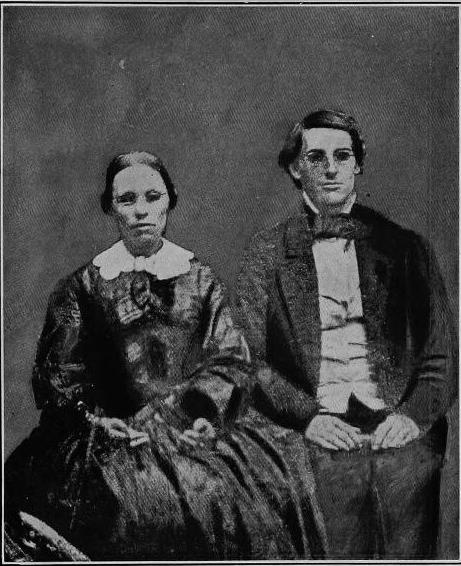
In the summer of 1843, Crosby met Alexander van Alstyne Jr. (sometimes spelled van Alstine or van Alsteine), called "Van" by his friends. He also was blind and enrolled at the NYIB, where he was a casual acquaintance of Crosby and sometimes a student in her classes. He was a teacher at NYIB for two years from 1855; during this time, the couple were engaged to be married, necessitating her resignation from NYIB three days prior to their wedding at Maspeth, New York, on March 5, 1858.