
Corporate law (also known as company law or enterprise law) is the body of law governing the rights, relations, and conduct of persons, companies, organizations, and businesses. The term refers to the legal practice of law relating to corporations, or to the theory of corporations. Corporate law often describes the law relating to matters that derive directly from the life-cycle of a corporation. It thus encompasses the formation, funding, governance, and death of a corporation.
While the minute nature of corporate governance as personified by share ownership, capital market, and business culture rules differ, similar legal characteristics and legal problems exist across many jurisdictions. Corporate law regulates how corporations, investors, shareholders, directors, employees, creditors, and other stakeholders such as consumers, the community, and the environment interact with one another. Whereas the terms company law or business law may be colloquially used interchangeably with corporate law, the term business law in fact refers to wider concepts of commercial law, which is the law governing commercial and business-related activities. Depending on the legal system, this may include matters relating to corporate governance, financial law, contract law and other pertinent areas.
Overview
Academics identify five legal characteristics universal to business enterprises. These are:

Separate legal personality of the corporation (access to tort and contract law in a manner similar to a person)
Limited liability of the shareholders (a shareholder's personal liability is limited to the value of their shares in the corporation)
Transferable shares (if the corporation is a public company, the shares are publicly listed and traded)

Delegated management under a board structure; the board of directors delegates day-to-day management of the company to executives.
shared ownership: people can own stock and it can be distributed either by shareholders selling it or it can be issued by the corporation [Note: this doesn’t mean there can’t be one owner. It just means there can be more than one owner as a result of share distribution or issuing.
Widely available and user-friendly corporate law enables business participants to possess these four legal characteristics and thus transact as businesses. Thus, corporate law is a response to three endemic forms of opportunism: conflicts between managers and shareholders, between controlling and non-controlling shareholders, and between shareholders and other contractual counterparts (including creditors and employees).

A corporation may accurately be called a company; however, a company should not necessarily be called a corporation, which has distinct characteristics. In the United States, a company may or may not be a separate legal entity, and is often used synonymously with "firm" or "business." According to Black's Law Dictionary, in America, a company means "a corporation — or, less commonly, an association, partnership or union — that carries on industrial enterprise." Other types of business associations can include partnerships (in the UK governed by the Partnership Act 1890), or trusts (such as a pension fund), or companies limited by guarantee (like some community organizations or charities). Corporate law deals with companies that are incorporated or registered under the corporate or company law of a sovereign state or its sub-national states.
The defining feature of a corporation is its legal independence from the shareholders that own it. Under corporate law, corporations of all sizes have a separate legal personality, with limited or unlimited liability for its shareholders. Shareholders control the company through a board of directors, which, in turn, typically delegates control of the corporation's day-to-day operations to a full-time executive. Shareholders' losses, in the event of liquidation, are limited to their stake in the corporation, and they are not liable for any remaining debts owed to the corporation's creditors. This rule is known as limited liability, and it is why the names of corporations typically end with "Ltd." or a similar designation, such as "Inc." or "plc."
Under almost all legal systems corporations have much the same legal rights and obligations as individuals. In some jurisdictions, this extends to allow corporations to exercise human rights against real individuals and the state, and they may be responsible for human rights violations. Just as they are "born" into existence through their members obtaining a certificate of incorporation, they can "die" when they lose money into insolvency. Corporations can even be convicted of criminal offences, such as corporate fraud and corporate manslaughter.
History
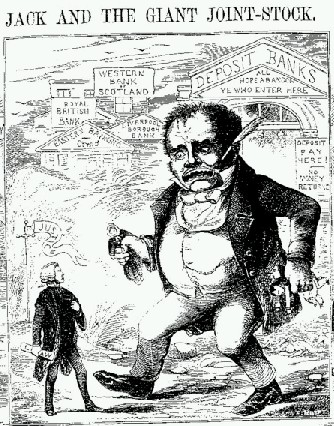
Although some forms of companies are thought to have existed during Ancient Rome and Ancient Greece, the closest recognizable ancestors of the modern company did not appear until the 16th century. With increasing international trade, Royal charters were granted in Europe (notably in England and Holland) to merchant adventurers. The Royal charters usually conferred special privileges on the trading company (including, usually, some form of monopoly). Originally, traders in these entities traded stock on their own account, but later the members came to operate on a joint account and with joint stock, and the new Joint stock company was born.
Early companies were purely economic ventures; it was only a belatedly established benefit of holding joint stock that the company's stock could not be seized for the debts of any individual member. The development of company law in Europe was hampered by two notorious "bubbles" (the South Sea Bubble in England and the Tulip Bulb Bubble in the Dutch Republic) in the 17th century, which set the development of companies in the two leading jurisdictions back by over a century in popular estimation.
Companies returned to the forefront of commerce, although in England, to circumvent the Bubble Act 1720, investors had reverted to trading the stock of unincorporated associations, until it was repealed in 1825. However, the process of obtaining Royal charters was insufficient to keep up with demand. In England, there was a lively trade in the charters of defunct companies. It was not until the Joint Stock Companies Act 1844 that the first equivalent of modern companies, formed by registration, appeared. Soon after came the Limited Liability Act 1855, which, in the event of a company's bankruptcy, limited the liability of all shareholders to the amount of capital they had invested.

The beginning of modern company law came when the two pieces of legislation were codified under the Joint Stock Companies Act 1856 at the behest of the then Vice President of the Board of Trade, Mr Robert Lowe. That legislation shortly gave way to the railway boom, and from there the number of companies formed soared. In the late nineteenth century, depression took hold, and just as company numbers had boomed, many began to implode and fall into insolvency. Much stronger academic, legislative and judicial opinion was opposed to the notion that businessmen could escape accountability for their role in the failing businesses. The last significant development in the history of companies was the decision of the House of Lords in Salomon v. Salomon & Co. where the House of Lords confirmed the separate legal personality of the company, and that the liabilities of the company were separate and distinct from those of its owners.
Corporate structure
The law of business organizations originally derived from the common law of England, and has evolved significantly in the 20th century. In common law countries today, the most commonly addressed forms are:
Corporation

Limited company
Unlimited company
Limited liability partnership
Limited partnership
Not-for-profit corporation
Company limited by guarantee
Partnership
Sole proprietorship
Privately held company
The proprietary limited company is a statutory business form in several countries, including Australia. Many countries have forms of business entity unique to that country, although there are equivalents elsewhere. Examples are the limited liability company (LLC) and the limited liability limited partnership (LLLP) in the United States. Other types of business organizations, such as cooperatives, credit unions and publicly owned enterprises, can be established with purposes that parallel, supersede, or even replace the profit maximization mandate of business corporations.
Various types of company can be formed in different jurisdictions, but the most common forms of companies are:
a company limited by guarantee. Commonly used where companies are formed for non-commercial purposes, such as clubs or charities. The members guarantee the payment of certain (usually nominal) amounts if the company goes into insolvent liquidation, but otherwise they have no economic rights in relation to the company.
a company limited by guarantee with a share capital. A hybrid entity, usually used where the company is formed for non-commercial purposes, but the activities of the company are partly funded by investors who expect a return.
a company limited by shares. The most common form of company used for business ventures.
an unlimited company either with or without a share capital. This is a hybrid company, a company similar to its limited company (Ltd.) counterpart but where the members or shareholders do not benefit from limited liability should the company ever go into formal liquidation.
There are, however, many specific categories of corporations and other business organizations which may be formed in various countries and jurisdictions throughout the world.
Corporate legal personality
One of the key legal features of corporations are their separate legal personality, also known as "personhood" or being "artificial persons". However, the separate legal personality was not confirmed under English law until 1895 by the House of Lords in Salomon v. Salomon & Co. Separate legal personality often has unintended consequences, particularly in relation to smaller, family companies. In B v. B [1978] Fam 181 it was held that a discovery order obtained by a wife against her husband was not effective against the husband's company as it was not named in the order and was separate and distinct from him. And in Macaura v. Northern Assurance Co Ltd a claim under an insurance policy failed where the insured had transferred timber from his name into the name of a company wholly owned by him, and it was subsequently destroyed in a fire; as the property now belonged to the company and not to him, he no longer had an "insurable interest" in it and his claim failed.
Separate legal personality allows corporate groups flexibility in relation to tax planning, and management of overseas liability. For instance, in Adams v. Cape Industries plc it was held that victims of asbestos poisoning at the hands of an American subsidiary could not sue the English parent in tort. Whilst academic discussion highlights certain specific situations where courts are generally prepared to "pierce the corporate veil", to look directly at, and impose liability directly on the individuals behind the company, the actual practice of piercing the corporate veil is, at English law, non-existent. However, the court will look beyond the corporate form where the corporation is a sham or perpetuates a fraud. The most commonly cited examples are:
where the company is a mere façade
where the company is effectively just the agent of its members or controllers
where a representative of the company has taken some personal responsibility for a statement or action
where the company is engaged in fraud or other criminal wrongdoing
where the natural interpretation of a contract or statute is as a reference to the corporate group and not the individual company
where permitted by statute (for example, many jurisdictions provide for shareholder liability where a company breaches environmental protection laws)
Capacity and powers
Historically, because companies are artificial persons created by operation of law, the law prescribed what the company could and could not do. Usually, this was an expression of the commercial purpose for which the company was formed for, and came to be referred to as the company's objects, and the extent of the objects is referred to as the company's capacity. If an activity fell outside the company's capacity, it was said to be ultra vires and void.
By way of distinction, the organs of the company were expressed to have various corporate powers. If the objects were the things that the company was able to do, then the powers were the means by which it could do them. Usually, expressions of powers were limited to methods of raising capital, although from earlier times, distinctions between objects and powers have caused lawyers difficulty. Most jurisdictions have now modified the position by statute, and companies generally have capacity to do all the things that a natural person could do, and power to do it in any way that a natural person could do it.
However, references to corporate capacity and powers have not quite been consigned to the dustbin of legal history. In many jurisdictions, directors can still be liable to their shareholders if they cause the company to engage in businesses outside its objects, even if the transactions are still valid as between the company and the third party. And many jurisdictions also still permit transactions to be challenged for lack of "corporate benefit", where the relevant transaction has no prospect of being for the commercial benefit of the company or its shareholders.
As artificial persons, companies can only act through human agents. The main agent who deals with the company's management and business is the board of directors, but in many jurisdictions, other officers can be appointed too. The board of directors is normally elected by the members, and the other officers are normally appointed by the board. These agents enter into contracts on behalf of the company with third parties.
Although the company's agents owe duties to the company (and, indirectly, to the shareholders) to exercise those powers for a proper purpose, generally speaking, third parties' rights are not impugned if the officers were acting improperly. Third parties are entitled to rely on the ostensible authority of agents held out by the company to act on its behalf. A line of common law cases reaching back to Royal British Bank v Turquand established in common law that third parties were entitled to assume that the internal management of the company was being conducted properly, and the rule has now been codified into statute in most countries.
Accordingly, companies will normally be liable for all the acts and omissions of their officers and agents. This will include almost all torts, but the law relating to crimes committed by companies is complex, and varies significantly between countries.
Corporate crime
Corporate Manslaughter and Corporate Homicide Act 2007
Corporate governance
Corporate governance is primarily the study of the power relations among a corporation's senior executives, its board of directors and those who elect them (shareholders in the "general meeting" and employees), as well as other stakeholders, such as creditors, consumers, the environment and the community at large. One of the main differences between different countries in the internal form of companies is between a two-tier and a one tier-board. The United Kingdom, the United States, and most Commonwealth countries have single unified boards of directors. In Germany, companies have two tiers, so that shareholders (and employees) elect a "supervisory board", and then the supervisory board chooses the "management board". There is the option to use two tiers in France, and in the new European Companies (Societas Europaea).
Recent literature, especially from the United States, has begun to discuss corporate governance in the terms of management science. While post-war discourse centred on how to achieve effective "corporate democracy" for shareholders or other stakeholders, many scholars have shifted to discussing the law in terms of principal–agent problems. On this view, the basic issue of corporate law is that when a "principal" party delegates his property (usually the shareholder's capital, but also the employee's labour) into the control of an "agent" (i.e. the director of the company) there is the possibility that the agent will act in his own interests, be "opportunistic", rather than fulfill the wishes of the principal. Reducing the risks of this opportunism, or the "agency cost", is said to be central to the goal of corporate law.
Constitution
The rules for corporations derive from two sources. These are the country's statutes: in the US, usually the Delaware General Corporation Law (DGCL); in the UK, the Companies Act 2006 (CA 2006); in Germany, the Aktiengesetz (AktG) and the Gesetz betreffend die Gesellschaften mit beschränkter Haftung (GmbH-Gesetz, GmbHG). The law will set out which rules are mandatory, and which rules can be derogated from. Examples of important rules which cannot be derogated from would usually include how to fire the board of directors, what duties directors owe to the company or when a company must be dissolved as it approaches bankruptcy. Examples of rules that members of a company would be allowed to change and choose could include what kind of procedure general meetings should follow, when dividends get paid out, or how many members (beyond a minimum set out in the law) can amend the constitution. Usually, the statute will set out model articles, which the corporation's constitution will be assumed to have if it is silent on a particular procedure.