
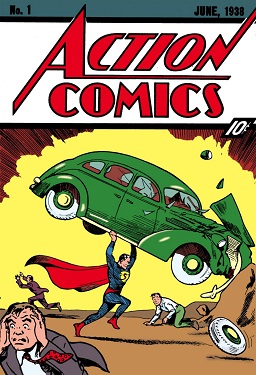
Superman is a superhero created by writer Jerry Siegel and artist Joe Shuster, first appearing in issue #1 of Action Comics, published in the United States on April 18, 1938. Superman has been regularly published in American comic books published by DC Comics since then, and has been adapted to other media including radio serials, novels, films, television shows, theater, and video games. Superman is the archetypal superhero: he wears an outlandish costume, uses a codename, and fights evil and averts disasters with the aid of extraordinary abilities. Although there are earlier characters who arguably fit this definition, it was Superman who popularized the superhero genre and established its conventions. He was the best-selling superhero in American comic books up until the 1980s and remains the highest grossing superhero if one considers the entire history of the genre (starting in 1938).
Superman was born Kal-El, on the fictional planet Krypton. As a baby, his parents Jor-El and Lara sent him to Earth in a small spaceship shortly before Krypton was destroyed in an apocalyptic cataclysm. His ship landed in the American countryside near the fictional town of Smallville, Kansas, where he was found and adopted by farmers Jonathan and Martha Kent, who named him Clark Kent. The Kents quickly realized he was superhuman; due to the Earth's yellow sun, all of his physical and sensory abilities are far beyond those of a human, and he is nearly impervious to harm and capable of unassisted flight. His adoptive parents having instilled him with strong morals, he chooses to use his powers to benefit humanity, and to fight crime as a vigilante. To protect his personal life, he changes into a primary-colored costume and uses the alias "Superman" when fighting crime. Clark resides in the fictional American city of Metropolis, where he works as a journalist for the Daily Planet alongside supporting characters including his love interest and fellow journalist Lois Lane, photographer Jimmy Olsen, and editor-in-chief Perry White. His enemies include Brainiac, General Zod, and archenemy Lex Luthor.
Since 1939, Superman has been featured in both Action Comics and his own Superman comic. He exists within the DC Universe, where he interacts with other heroes including fellow Justice League members like Wonder Woman and Batman, and appears in various titles based on the team. Different versions of the character exist in alternative universes; the Superman from the Golden Age of comic books was later labeled as the Earth-Two version while the version appearing in Silver Age and Bronze Age comics has been labeled the Earth-One Superman. His persona has also inspired the creation of characters such as Supergirl, Superboy and Krypto the Superdog.
Superman has been adapted outside of comics. The radio series The Adventures of Superman ran from 1940 to 1951 and would feature Bud Collyer as the voice of Superman. Collyer would also voice the character in a series of animated shorts produced by Fleischer/Famous Studios and released between 1941 and 1943. Superman also appeared in film serials in 1948 and 1950, played by Kirk Alyn. Christopher Reeve would portray Superman in the 1978 film and its sequels, and define the character in cinema for generations. Superman would continue to appear in feature films, including a series starring Henry Cavill and a 2025 film starring David Corenswet. The character has also appeared in numerous television series, including Adventures of Superman, played by George Reeves, and Superman: The Animated Series, voiced by Tim Daly.
Development
Jerry Siegel and Joe Shuster met in 1932 while attending Glenville High School in Cleveland and bonded over their admiration of fiction. Siegel aspired to become a writer and Shuster aspired to become an illustrator. Siegel wrote amateur science fiction stories, which he self-published as a magazine called Science Fiction: The Advance Guard of Future Civilization. His friend Shuster often provided illustrations for his work. In January 1933, Siegel published a short story in his magazine titled "The Reign of the Super-Man". The titular character is a homeless man named Bill Dunn who is tricked by an evil scientist into consuming an experimental drug. The drug gives Dunn the powers of mind-reading, mind-control, and clairvoyance. He uses these powers maliciously for profit and amusement, but then the drug wears off, leaving him a powerless vagrant again. Shuster provided illustrations, depicting Dunn as a bald man.
Siegel and Shuster shifted to making comic strips, with a focus on adventure and comedy. They wanted to become syndicated newspaper strip authors, so they showed their ideas to various newspaper editors. However, the newspaper editors were not impressed, and told them that if they wanted to make a successful comic strip, it had to be something more sensational than anything else on the market. This prompted Siegel to revisit Superman as a comic strip character. Siegel modified Superman's powers to make him even more sensational. Like Bill Dunn, the second prototype of Superman is given powers against his will by an unscrupulous scientist, but instead of psychic abilities, he acquires superhuman strength and bullet-proof skin. Additionally, this new Superman was a crime-fighting hero instead of a villain, because Siegel noted that comic strips with heroic protagonists tended to be more successful. In later years, Siegel once recalled that this Superman wore a "bat-like" cape in some panels, but typically he and Shuster agreed there was no costume yet, and there is none apparent in the surviving artwork.

Siegel and Shuster showed this second concept of Superman to Consolidated Book Publishers, based in Chicago. In May 1933, Consolidated had published a comic book titled Detective Dan: Secret Operative 48. It contained all-original stories as opposed to reprints of newspaper strips, which was a novelty at the time. Siegel and Shuster put together a comic book in a similar format called The Superman. A delegation from Consolidated visited Cleveland that summer on a business trip and Siegel and Shuster took the opportunity to present their work in person. Although Consolidated expressed interest, they later pulled out of the comics business without ever offering a book deal because the sales of Detective Dan were disappointing.
Siegel believed publishers kept rejecting them because he and Shuster were young and unknown, so he looked for an established artist to replace Shuster. When Siegel told Shuster what he was doing, Shuster reacted by burning their rejected Superman comic, sparing only the cover. They continued collaborating on other projects, but for the time being Shuster was through with Superman.
Siegel wrote to numerous artists. The first response came in July 1933 from Leo O'Mealia, who drew the Fu Manchu strip for the Bell Syndicate. In the script that Siegel sent to O'Mealia, Superman's origin story changes: He is a "scientist-adventurer" from the far future when humanity has naturally evolved "superpowers". Just before the Earth explodes, he escapes in a time-machine to the modern era, whereupon he immediately begins using his superpowers to fight crime. O'Mealia produced a few strips and showed them to his newspaper syndicate, but they were rejected. O'Mealia did not send to Siegel any copies of his strips, and they have been lost.

In June 1934, Siegel found another partner, an artist in Chicago named Russell Keaton. Keaton drew the Buck Rogers and Skyroads comic strips. In the script that Siegel sent Keaton in June, Superman's origin story further evolved: In the distant future, when Earth is on the verge of exploding due to "giant cataclysms", the last surviving man sends his three-year-old son back in time to the year 1935. The time-machine appears on a road where it is discovered by motorists Sam and Molly Kent. They leave the boy in an orphanage, but the staff struggle to control him because he has superhuman strength and impenetrable skin. The Kents adopt the boy and name him Clark, and teach him that he must use his fantastic natural gifts for the benefit of humanity. In November, Siegel sent Keaton an extension of his script: an adventure where Superman foils a conspiracy to kidnap a star football player. The extended script mentions that Clark puts on a special "uniform" when assuming the identity of Superman, but it is not described. Keaton produced two weeks' worth of strips based on Siegel's script. In November, Keaton showed his strips to a newspaper syndicate, but they too were rejected, and he abandoned the project.
Siegel and Shuster reconciled and resumed developing Superman together. The character became an alien from the planet Krypton. Shuster designed the now-familiar costume: tights with an "S" on the chest, over-shorts, and a cape. They made Clark Kent a journalist who pretends to be timid, and conceived his colleague Lois Lane, who is attracted to the bold and mighty Superman but does not realize that he and Kent are the same person.
In June 1935 Siegel and Shuster finally found work with National Allied Publications, a comic magazine publishing company in New York owned by Malcolm Wheeler-Nicholson. Wheeler-Nicholson published two of their strips in New Fun Comics #6 (1935): "Henri Duval" and "Doctor Occult". Siegel and Shuster also showed him Superman and asked him to market Superman to the newspapers on their behalf. In October, Wheeler-Nicholson offered to publish Superman in one of his own magazines. Siegel and Shuster refused his offer because Wheeler-Nicholson had demonstrated himself to be an irresponsible businessman. He had been slow to respond to their letters and had not paid them for their work in New Fun Comics #6. They chose to keep marketing Superman to newspaper syndicates themselves. Despite the erratic pay, Siegel and Shuster kept working for Wheeler-Nicholson because he was the only publisher who was buying their work, and over the years they produced other adventure strips for his magazines.

Wheeler-Nicholson's financial difficulties continued to mount. In 1936, he formed a joint corporation with Harry Donenfeld and Jack Liebowitz called Detective Comics, Inc. in order to release his third magazine, which was titled Detective Comics. Siegel and Shuster produced stories for Detective Comics too, such as "Slam Bradley". Wheeler-Nicholson fell into deep debt to Donenfeld and Liebowitz, and in early January 1938, Donenfeld and Liebowitz petitioned Wheeler-Nicholson's company into bankruptcy and seized it.
In early December 1937, Siegel visited Liebowitz in New York, and Liebowitz asked Siegel to produce some comics for an upcoming comic anthology magazine called Action Comics. Siegel proposed some new stories, but not Superman. Siegel and Shuster were, at the time, negotiating a deal with the McClure Newspaper Syndicate for Superman. In early January 1938, Siegel had a three-way telephone conversation with Liebowitz and an employee of McClure named Max Gaines. Gaines informed Siegel that McClure had rejected Superman, and asked if he could forward their Superman strips to Liebowitz so that Liebowitz could consider them for Action Comics. Siegel agreed. Liebowitz and his colleagues were impressed by the strips, and they asked Siegel and Shuster to develop the strips into 13 pages for Action Comics. Having grown tired of rejections, Siegel and Shuster accepted the offer. At least now they would see Superman published. Siegel and Shuster submitted their work in late February and were paid US$130 (equivalent to $3,000 in 2025) for their work ($10 per page). In early March they signed a contract at Liebowitz's request in which they gave away the copyright for Superman to Detective Comics, Inc. This was normal practice in the business, and Siegel and Shuster had given away the copyrights to their previous works as well.
The duo's revised version of Superman appeared in the first issue of Action Comics, which was published on April 18, 1938. The issue was a huge success thanks to Superman's feature.

Influences
Siegel and Shuster read pulp science-fiction and adventure magazines, and many stories featured characters with fantastical abilities such as telepathy, clairvoyance, and superhuman strength. One character in particular was John Carter of Mars from the novels by Edgar Rice Burroughs. John Carter is a human who is transported to Mars, where the lower gravity makes him stronger than the natives and allows him to leap great distances. Another influence was Philip Wylie's 1930 novel Gladiator, featuring a protagonist named Hugo Danner who had similar powers.
Superman's stance and devil-may-care attitude were influenced by the characters of Douglas Fairbanks, who starred in adventure films such as The Mark of Zorro and Robin Hood. The name of Superman's home city, Metropolis, was taken from the 1927 film of the same name. Popeye cartoons were also an influence.
Clark Kent's harmless facade and dual identity were inspired by the protagonists of such movies as Don Diego de la Vega in The Mark of Zorro and Sir Percy Blakeney in The Scarlet Pimpernel. Siegel thought this would make for interesting dramatic contrast and good humor. Another inspiration was slapstick comedian Harold Lloyd. The archetypal Lloyd character was a mild-mannered man who finds himself abused by bullies but later in the story snaps and fights back furiously.
Kent is a journalist because Siegel often imagined himself becoming one after leaving school. The love triangle between Lois Lane, Clark, and Superman was inspired by Siegel's own awkwardness with girls.
The pair collected comic strips in their youth, with a favorite being Winsor McCay's fantastical Little Nemo. Shuster remarked on the artists who played an important part in the development of his own style: "Alex Raymond and Burne Hogarth were my idols – also Milt Caniff, Hal Foster, and Roy Crane." Shuster taught himself to draw by tracing over the art in the strips and magazines they collected.
As a boy, Shuster was interested in fitness culture and a fan of strongmen such as Siegmund Breitbart and Joseph Greenstein. He collected fitness magazines and manuals and used their photographs as visual references for his art.
The visual design of Superman came from multiple influences. The tight-fitting suit and shorts were inspired by the costumes of wrestlers, boxers, and strongmen. In early concept art, Shuster gave Superman laced sandals like those of strongmen and classical heroes, but these were eventually changed to red boots. The costumes of Douglas Fairbanks were also an influence. The emblem on his chest was inspired by heraldic crests. Many pulp action heroes such as swashbucklers wore capes. Superman's face was based on Johnny Weissmuller with touches derived from the comic-strip character Dick Tracy and from the work of cartoonist Roy Crane.
The word "superman" was commonly used in the 1920s and 1930s to describe men of great ability, most often athletes and politicians. It occasionally appeared in pulp fiction stories as well, such as "The Superman of Dr. Jukes". It is unclear whether Siegel and Shuster were influenced by Friedrich Nietzsche's concept of the Übermensch; they never acknowledged as much.
Comics
Comic books
Since 1938, Superman stories have been regularly published in periodical comic books published by DC Comics. The first and oldest of these is Action Comics, which began in April 1938. Action Comics was initially an anthology magazine, but it eventually became dedicated to Superman stories. The second oldest periodical is Superman, which began in June 1939. Action Comics and Superman have been published without interruption (ignoring changes to the title and numbering scheme). Several other shorter-lived Superman periodicals have been published over the years. Superman is part of the DC Universe, which is a shared setting of superhero characters owned by DC Comics, and consequently he frequently appears in stories alongside the likes of Batman, Wonder Woman, and others.
More Superman comic books have been sold in publication history than any other American superhero character. Exact sales figures for the early decades of Superman comic books are hard to find because, like most publishers at the time, DC Comics concealed this data from its competitors and thereby the general public, but given the general market trends at the time, sales of Action Comics and Superman probably peaked in the mid-1940s and thereafter steadily declined. Sales data first became public in 1960, and showed that Superman was the best-selling comic book character of the 1960s and 1970s. Sales rose again starting in 1987. Superman #75 (Nov 1992) had over 23 million copies sold, making it the best-selling issue of a comic book of all time, due to a media sensation over the death of Superman in that issue. Sales declined from that point on. In March 2018, Action Comics sold just 51,534 copies, although such low figures are normal for superhero comic books in general (for comparison, Amazing Spider-Man #797 sold only 128,189 copies). The comic books have become a niche aspect of the Superman franchise due to low readership, though they remain influential as creative engines for the movies and television shows. Comic book stories can be produced quickly and cheaply, and are thus an ideal medium for experimentation.
Whereas comic books in the 1950s were read by children, since the 1990s the average reader has been an adult. A major reason for this shift was DC Comics' decision in the 1970s to sell its comic books to specialty stores instead of traditional magazine retailers (supermarkets, newsstands, etc.) — a model called "direct distribution". This made comic books less accessible to children.
Newspaper strips
Beginning in January 1939, a Superman daily comic strip appeared in newspapers, syndicated through the McClure Syndicate. A color Sunday version was added that November. Jerry Siegel wrote most of the strips until he was conscripted into the United States Army in 1943. The Sunday strips had a narrative continuity separate from the daily strips, possibly because Siegel had to delegate the Sunday strips to ghostwriters. By 1941, the newspaper strips had an estimated readership of 20 million. Joe Shuster drew the early strips, then passed the job to Wayne Boring. From 1949 to 1956, the newspaper strips were drawn by Win Mortimer. The strip ended in May 1966, but was revived from 1977 to 1983 to coincide with a series of movies released by Warner Bros.
Editors
Initially, Jerry Siegel was allowed to write Superman more or less as he saw fit because nobody had anticipated the success and rapid expansion of the franchise. But soon Siegel and Shuster's work was put under careful oversight for fear of trouble with censors. Siegel was forced to tone down the violence and social crusading that characterized his early stories. Editor Whitney Ellsworth, hired in 1940, dictated that Superman not kill. Sexuality was banned, and colorfully outlandish villains such as Ultra-Humanite and Toyman were favored over gangsters as they were thought to be less frightening to young readers.
Mort Weisinger was the editor on Superman comics from 1941 to 1970, his tenure briefly interrupted by military service. Siegel and his fellow writers had developed the character with little thought of building a coherent mythology, but as the number of Superman titles and the pool of writers grew, Weisinger demanded a more disciplined approach. Weisinger assigned story ideas, and the logic of Superman's powers, his origin, the locales, and his relationships with his growing cast of supporting characters were carefully planned. Elements such as Bizarro, his cousin Supergirl, the Phantom Zone, the Fortress of Solitude, alternate varieties of kryptonite, robot doppelgangers, and Krypto were introduced during this era. The complicated universe built under Weisinger was beguiling to devoted readers but alienating to casuals. Weisinger favored lighthearted stories over serious drama, and avoided sensitive subjects such as the Vietnam War and the American civil rights movement because he feared his right-wing views would alienate his left-leaning writers and readers. Weisinger also introduced letters columns in 1958 to encourage feedback and build intimacy with readers.
Weisinger retired in 1970 and Julius Schwartz took over. By his own admission, Weisinger had grown out of touch with newer readers. Starting with The Sandman Saga, Schwartz updated Superman by making Clark Kent a television anchor, and he retired overused plot elements such as kryptonite and robot doppelgangers. Schwartz also scaled Superman's powers down to a level closer to Siegel's depiction. These changes would eventually be reversed by later writers. Schwartz allowed stories with serious drama such as "For the Man Who Has Everything" (Superman Annual #11), in which the villain Mongul torments Superman with an illusion of happy family life on a living Krypton.
Schwartz retired from DC Comics in 1986 and was succeeded by Mike Carlin as an editor on Superman comics. His retirement coincided with DC Comics' decision to reboot the DC Universe with the companywide-crossover storyline "Crisis on Infinite Earths". In The Man of Steel, renowned artist and writer John Byrne rewrote the Superman mythos; again reducing Superman's powers, which writers had slowly re-strengthened, and revised many supporting characters, such as making Lex Luthor a billionaire industrialist rather than a mad scientist, and making Supergirl an artificial shapeshifting organism because DC wanted Superman to be the sole surviving Kryptonian.
Carlin was promoted to Executive Editor for the DC Universe books in 1996, a position he held until 2002. KC Carlson took his place as editor of the Superman comics.
Aesthetic style
In the earlier decades of Superman comics, artists were expected to conform to a certain "house style". Joe Shuster defined the aesthetic style of Superman in the 1940s. After Shuster left National, Wayne Boring succeeded him as the principal artist on Superman comic books. He redrew Superman taller and more detailed. Around 1955, Curt Swan in turn succeeded Boring. The 1980s saw a boom in the diversity of comic book art and now there is no single "house style" in Superman comics.
Copyright issues
Jerry Siegel and Joe Shuster
In a contract dated March 1, 1938, Jerry Siegel and Joe Shuster gave away the copyright to Superman to their employer, DC Comics (then known as Detective Comics, Inc.) prior to Superman's first publication in April. Contrary to popular perception, the $130 that DC Comics paid them was for their first Superman story, not the copyright to the character — that, they gave away for free. This was normal practice in the comic magazine industry and they had done the same with their previous published works (Slam Bradley, Doctor Occult, etc.), but Superman became far more popular and valuable than they anticipated and they much regretted giving him away. DC Comics retained Siegel and Shuster, and they were paid well because they were popular with the readers. Between 1938 and 1947, DC Comics paid them together at least $401,194.85 (equivalent to $7,730,000 in 2025).
Siegel wrote most of the magazine and daily newspaper stories until he was conscripted into the United States Army in 1943, whereupon the task was passed to ghostwriters. While Siegel was serving in Hawaii, DC Comics published a story featuring a child version of Superman called "Superboy", which was based on a script Siegel had submitted several years before. Siegel was furious because DC Comics did this without having bought the character.
After Siegel's discharge from the Army, he and Shuster sued DC Comics in 1947 for the rights to Superman and Superboy. The judge ruled that Superman belonged to DC Comics, but that Superboy was a separate entity that belonged to Siegel. Siegel and Shuster settled out-of-court with DC Comics, which paid the pair $94,013.16 (equivalent to $1,259,802 in 2025) in exchange for the full rights to both Superman and Superboy. DC Comics then fired Siegel and Shuster.
DC Comics rehired Jerry Siegel as a writer in 1959.
In 1965, Siegel and Shuster attempted to regain rights to Superman using the renewal option in the Copyright Act of 1909, but the court ruled Siegel and Shuster had transferred the renewal rights to DC Comics in 1938. Siegel and Shuster appealed, but the appeals court upheld this decision. DC Comics fired Siegel once again, when he filed this second lawsuit.
In 1975, Siegel and several other comic book writers and artists launched a public campaign for better compensation and treatment of comic creators. Warner Brothers agreed to give Siegel and Shuster a yearly stipend, full medical benefits, and credit their names in all future Superman productions in exchange for never contesting ownership of Superman. Siegel and Shuster upheld this bargain.
Shuster died in 1992. DC Comics offered Shuster's heirs a stipend in exchange for never challenging ownership of Superman, which they accepted for some years.
Siegel died in 1996. His heirs attempted to take the rights to Superman using the termination provision of the Copyright Act of 1976. DC Comics negotiated an agreement wherein it would pay the Siegel heirs several million dollars and a yearly stipend of $500,000 in exchange for permanently granting DC the rights to Superman. DC Comics also agreed to insert the line "By Special Arrangement with the Jerry Siegel Family" in all future Superman productions. The Siegels accepted DC's offer in an October 2001 letter.
Copyright lawyer and movie producer Marc Toberoff then struck a deal with the heirs of both Siegel and Shuster to help them get the rights to Superman in exchange for signing the rights over to his production company, Pacific Pictures. Both groups accepted. The Siegel heirs called off their deal with DC Comics and in 2004 sued DC for the rights to Superman and Superboy. In 2008, the judge ruled in favor of the Siegels. DC Comics appealed the decision, and the appeals court ruled in favor of DC, arguing that the October 2001 letter was binding. In 2003, the Shuster heirs served a termination notice for Shuster's grant of his half of the copyright to Superman. DC Comics sued the Shuster heirs in 2010, and the court ruled in DC's favor on the grounds that the 1992 agreement with the Shuster heirs barred them from terminating the grant.
Under current US copyright law, Superman's first appearance in Action Comics #1 is due to enter the US public domain on January 1, 2034. However, this will only apply (at first) to the character as he is depicted in 1938. In addition DC Comics retains trademarks on Superman's name, image and 'S' logo, and unlike copyrights, trademarks do not expire unless they cease to be used.
Captain Marvel
Superman's success immediately begat a wave of imitations. The most successful from this period was Captain Marvel, first published by Fawcett Comics in December 1939. Captain Marvel had many similarities to Superman: Herculean strength, invulnerability, the ability to fly, a cape, a secret identity, and a job as a journalist. DC Comics filed a lawsuit against Fawcett Comics for copyright infringement.
The trial began in March 1948 after seven years of discovery. The judge ruled that Fawcett had indeed infringed on Superman. However, the judge also found that the copyright notices that appeared with the Superman newspaper strips did not meet the technical standards of the Copyright Act of 1909 and were therefore invalid. Furthermore, since the newspaper strips carried stories adapted from Action Comics, the judge ruled that DC Comics had effectively abandoned the copyright to the Action Comics stories and Superman, and therefore forfeited its right to sue Fawcett for copyright infringement.
DC Comics appealed this decision. The appeals court ruled that unintentional mistakes in the copyright notices of the newspaper strips did not invalidate the copyrights. Furthermore, Fawcett knew that DC Comics never intended to abandon the copyrights, and therefore Fawcett's infringement was not an innocent misunderstanding, and therefore Fawcett owed damages to DC Comics. The appeals court remanded the case back to the lower court to determine how much Fawcett owed in damages.
At that point, Fawcett Comics decided to settle out of court with DC Comics. Fawcett paid DC Comics $400,000 (equivalent to $4,813,000 in 2025) and agreed to stop publishing Captain Marvel. The last Captain Marvel story from Fawcett Comics was published in September 1953.
DC Comics licensed Captain Marvel in 1972 and published crossover stories with Superman. By 1991, DC Comics had purchased Fawcett Comics and with it the full rights to Captain Marvel. DC eventually renamed the character "Shazam" to prevent disputes with Marvel Comics, who had created a character of their own named "Captain Marvel" back when the Fawcett character had been out of print.
Character overview
Several elements of the Superman narrative have remained consistent in the myriad stories published since 1938.