
The State University of New York at Binghamton (also known as Binghamton University or SUNY Binghamton) is a public research university in Greater Binghamton, New York, United States. It is one of the four university centers in the State University of New York (SUNY) system.
Since its establishment in 1946, the school has evolved from a small liberal arts college to a large research university. It is classified among R1: Doctoral Universities – Very high research activity. Binghamton's athletic teams are the Bearcats and they compete in Division I of the National Collegiate Athletic Association (NCAA). The Bearcats are members of the America East Conference.
History
Establishment
Binghamton University was established in 1946 in Endicott, New York, as Triple Cities College to serve the needs of local veterans returning from World War II. Thomas J. Watson, a founding member of IBM in Broome County, viewed the Triple Cities region of the state's Southern Tier as an area of great potential. In the early 1940s he collaborated with local leaders to begin establishing Triple Cities College as a two-year junior college operating as a satellite of private Syracuse University. Watson also donated land that would become the school's early home.

Originally, Triple Cities College students going on to a bachelor's degree finished their program at Syracuse. By the 1948–1949 academic year, the degrees could be completed entirely in Binghamton. In 1950, it split from Syracuse and became incorporated into the public State University of New York (SUNY) system as Harpur College, named in honor of Robert Harpur, a colonial teacher and pioneer who settled in the Binghamton area. At that time, Harpur and Champlain College in Plattsburgh were the only two liberal arts schools in the New York state system. When Champlain closed in 1952 to make way for the Plattsburgh Air Force Base, the records and some students and faculty were transferred to Harpur College in Binghamton. Harpur also received 16,000 non-duplicate volumes and the complete contents of the Champlain College library.
In 1955, Harpur began to plan its current location in Vestal, a town next to Binghamton. A site large enough to anticipate future growth was purchased, with the school's move to its new 387-acre (1.57 km2) campus being completed by 1961. Colonial Hall, Triple Cities College's original building in Endicott, stands today as the village's Visitor Center.
In 1965, Harpur College was selected to join New York state schools Stony Brook University, Albany, and Buffalo as one of the four new SUNY university centers. Redesignated the State University of New York at Binghamton, the school's new name reflected its status as an advanced degree granting institution. In a nod to tradition, its undergraduate college of arts and sciences remained "Harpur College". With more than 60% of undergraduate and graduate students enrolled in Harpur's degree programs, it is the largest of Binghamton's constituent schools. In 1967, the School of Advanced Technology was established, the precursor to the Thomas J. Watson School of Engineering and Applied Science, which was founded in 1983. In 2020, the school became the Thomas J. Watson College of Engineering and Applied Science.

Since 1992, the school has made an effort to distinguish itself from the SUNY system, rebranding itself as "Binghamton University," or "Binghamton University, State University of New York". Both names are accepted as first reference in news stories. While the school's legal and official name, the State University of New York at Binghamton, still appears on official documents such as diplomas, the administration discourages using the full name unless absolutely necessary. It also discourages references to the school as "SUNY—Binghamton," "SUNY—B," or "Harpur College".
Presidents
The first president of Harpur College, who began as dean of Triple Cities College, was Glenn Bartle. The second president, George Bruce Dearing, served several years before leaving to become vice chancellor for academic affairs at the SUNY Central Administration in Albany. Next was C. Peter Magrath, former interim president of the University of Nebraska–Lincoln, who served from 1972 to 1974 then left to become president at the University of Minnesota.
The fourth president at Binghamton was Clifford D. Clark, who left his position as dean of the business school at the University of Kansas to serve as vice president for academic affairs at Binghamton in 1973. He was asked to take on the job of acting president in the fall of 1974, when Magrath left for Minnesota. Clark was selected as president and served from March 1975 through mid-1990. He led the school's evolution from primarily a four-year liberal arts college to a research university. Clark added the Anderson Center for the Performing Arts and inaugurated the Summer Music Festival, created the Harpur Forum (now called the Binghamton University Forum), established the Thomas J. Watson School of Engineering and Applied Science, and fostered the expansion and development of the Decker School of Nursing.
Lois B. DeFleur became the university's fifth president upon Clark's retirement in 1990. She oversaw substantial additions to the student and faculty populations, expanded research activities and funding, formalized Binghamton's fundraising efforts, expanded the campus' physical footprint by approximately 20 buildings, launched Binghamton's "green" efforts, transitioned the school from Division III athletics to Division I and oversaw the university's increase in academic rankings. DeFleur retired in 2010 amidst scandal regarding her efforts to catapult the university sports program into higher ranks by cheating, her involvement implicated in a report from retired New York Chief Judge Judith Kaye. On July 1, Magrath returned as interim president.
On November 22, 2011, the SUNY Board of Trustees appointed Harvey G. Stenger, Jr. as the seventh president of Binghamton University, effective January 1, 2012. Stenger had been interim provost and executive vice president for academic affairs at the University at Buffalo since April 2011. In October 2024, Stenger announced plans to step down at the end of the academic year.
On November 1, 2025, Anne D'Alleva succeeded Stenger as Binghamton University's eighth president. She previously served as the provost and executive vice president for academic affairs at the University of Connecticut.

The following persons have served as president of Binghamton University since 1946:
Table notes:
Organization
University leadership
Binghamton is one of four university centers of the State University of New York (SUNY) system and is governed by its board of trustees. The Binghamton University Council oversees such aspects of the school's governance as student conduct, budget and physical facilities. Nine of its ten members are appointed by the state governor, one elected by the student body.

The university is organized into six administrative offices: The Office of the President, Division of Academic Affairs, Division of Advancement, Division of Operations, Division of Research, and the Division of Student Affairs. The Director of Athletics, Vice President for Diversity, Equity, and Inclusion, and the Division of Communications and Marketing all report to and are overseen by the university president.
As of 2026, the university's endowment reached $330 million, managed by the not-for-profit Binghamton University Foundation, which also oversees fundraising. This total includes a 2026 $30 million gift from a group of donors led by alumnus Tom Secunda, co-founder of Bloomberg L.P. It is the largest academic donation in the university's history. The gift established the New York Center for AI Responsibility and Research, a center focused on the responsible development of artificial intelligence.
Colleges and schools
Binghamton is composed of the following colleges and schools:
Harpur College of Arts and Sciences is the oldest and largest of Binghamton's schools. It has over 10,300 undergraduates and 1,000 graduate students in 26 departments and 14 interdisciplinary degree programs in the fine arts, humanities, natural and social sciences, and mathematics.
The College of Community and Public Affairs offers an undergraduate major in human development as well as graduate programs in social work; public administration; student affairs administration; human rights; sustainable communities (with Harpur College), public health (with Decker College), and teaching, learning and educational leadership. It was formed in July 2006, after a reorganization of its predecessor, the School of Education and Human Development, when it was split off along with the Graduate School of Education. In 2017, the Graduate School of Education merged back into the College of Community and Public Affairs as the Department of Teaching, Learning and Educational Leadership. The department continues to offer master's of science and doctoral degrees.
The Decker College of Nursing and Health Sciences was established in 1969. The school offers undergraduate, master's and doctoral degrees in nursing. The school is accredited by the Commission of Collegiate Nursing Education (CCNE).
The School of Management was established in 1970. It offers bachelor's, master's and doctoral degrees in management, finance, information science, marketing, accounting, and operations and business analytics. It is accredited by the American Assembly of Collegiate Schools of Business (AACSB).
The Thomas J. Watson College of Engineering and Applied Science was founded in 1983, and offers undergraduate and graduate degrees in mechanical engineering, electrical engineering, computer engineering, biomedical engineering, systems science and industrial engineering, materials science and engineering, and computer science. All of the school's departments have been accredited by the Accreditation Board for Engineering and Technology.
The Graduate School administers advanced-degree programs and awards degrees through the seven component colleges above. Graduate students will find almost 70 areas of study. Undergraduate and graduate students are taught and advised by a single faculty.
The School of Pharmacy and Pharmaceutical Sciences, the newest school at Binghamton, offers doctoral degrees in pharmacy and pharmacology. The school has been granted Candidate status from the Accreditation Council for Pharmacy Education, which grants all the rights and privileges available to students of accredited schools, and anticipates full accreditation upon graduation of its inaugural class in 2021. The school enrolled its first students in fall 2017, and in 2018 opened its state-of-the-art, $60 million new building on a new Health Sciences Campus in Johnson City, near UHS-Wilson Medical Center.
Campuses
Main campus
The main campus in Vestal is spread over 930 acres (3.8 km2) on a wooded hillside above the Susquehanna River; geographically, the Southern Tier of New York is located on Allegheny Plateau, a physiographic province of the Appalachian Mountains. The campus is shaped like a brain: the primary road on campus creates a closed loop to form the cerebrum and cerebellum, and the main entrance road creates the spinal cord which leads up to a traffic circle (representing the medulla). The main road is thus frequently referred to as The Brain. The connector road, which goes behind the Mountainview and College-in-the-Woods residential communities, is closed for a portion of the year (in late fall and early spring, to allow for safe migration of salamanders across the road). The campus features a 190 acres (0.77 km2) Nature Preserve, which contains forest and wetland areas and includes a six-acre (24,000 m2) pond, named Harpur Pond, that adjoins the campus. The Nature Preserve drains into Fuller Hollow Creek, which runs parallel along the eastern portion of the campus. Fuller Hollow Creek meanders north after leaving campus, where it soon empties into the Susquehanna River.
Libraries
The Glenn G. Bartle Library, named after the university's first president, contains collections in the humanities, social sciences, government documents, and collections in mathematical and computer sciences. Additionally, Bartle Library houses a fine arts collection and special collections (containing the Max Reinhardt Collection, as well as the Edwin A. Link and Marion Clayton Link Archives). The Science Library contains materials in all science and engineering disciplines, as well as a map collection. The University Downtown Center Library and Information Commons supports the departments of social work, human development, public administration, and student affairs administration.
The libraries offer a number of services including research consultation and assistance, a laptop lending program, customized instruction sessions and three information commons in the Bartle, Science and UDC libraries. The libraries offer access to various online databases to facilitate research for students and faculty. The entire campus is also served by a wireless internet network that all students, staff and faculty have access to, funded in part by mandatory student technology fees. The computing services center supports Windows, Macintosh and Unix systems, both in public computer labs and for students' personal computers.
Anderson Center for the Performing Arts
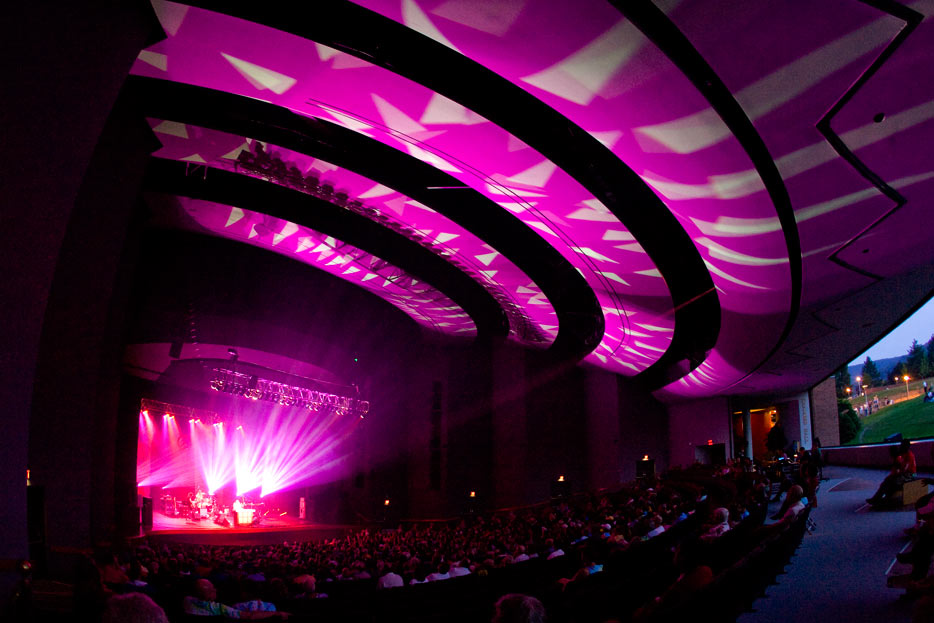
The Anderson Center for the Performing Arts complex has three proscenium stages: Watters Theater, seating 574; the Chamber Hall, seating 450; and the Osterhout Concert Theater, seating 1,170 inside and 1,500 outside. The Osterhout Concert Theater has the ability to become an open-air amphitheater, with its movable, floor-to-ceiling glass windows that open up to a grassy hill.
University Art Museum
The university's art collection is housed at more than one location, but all within the Fine Arts Building. The building's main-level gallery hosts various artifacts which belong to the Permanent Collection, though typically showcases student work on a rotating basis. The Permanent Collection in the basement level of the building displays ancient art from Egypt, China and other locales. Lastly, the Elsie B. Rosefsky Gallery, just off the Grand Corridor, presents special exhibits and portfolios.
University Union
The University Union is divided into two sections, sometimes referred to as the old Union and the new Union, sometimes referred to as Union East and West respectively, yet called "University Union (UU)" and "University Union West (UUW)" by the university itself. The Union houses many student organizations, a food co-op, The MarketPlace food court, a number of meeting spaces, many new classrooms, the University Bookstore and a branch of Visions Federal Credit Union.
On August 23, 2013, President Barack Obama hosted a town hall meeting in the University Union to discuss college affordability with students, faculty, and staff at Binghamton University.
Events Center
The Events Center is one of the area's largest venues for athletics, concerts, fairs and more. Home court to the Binghamton Bearcats basketball teams, the facility seats about 5,300 people for games. For concerts, Commencement and other larger events, the Events Center can hold up to 8,000 people. Home site for the America East Conference Men's Basketball Championships in 2005, 2006, and 2008, the court hosted the women's championships in 2007 and 2015.
Other athletic facilities
In addition to the Events Center, the north end of campus houses the East and West Gyms, which host student recreation and varsity athletics programs. The East Gym underwent a major renovation, completed in winter 2012, and is now called the Recreational Center at the East Gym, and includes the 10,000-sq. ft. FitSpace fitness facility, three new multipurpose rooms, improved pool and court spaces, a new wellness services suite and completely renovated locker rooms. Other varsity facilities include baseball and softball fields, the Bearcats Sports Complex (a soccer and lacrosse stadium) and an outdoor track. With a gift from an anonymous donor, the baseball fields underwent a $2 million facelift including the addition of artificial turf and lights in 2016. Other student recreation features are a series of playing fields used for soccer, football, rugby and ultimate frisbee.
Science Complex
The science complex includes five instructional and office buildings, as well as a four-climate teaching greenhouse and the Science Library. Buildings are named sequentially as Science 1 through 5. They contain faculty offices and classrooms for the biological sciences, anthropology, geological sciences and psychology departments.
Innovative Technologies Complex
More commonly known as the ITC, the Innovative Technologies Complex is a new development intended to advance venture capital research in both the support of the university's activities and that of the local high-technology industry. The complex includes four buildings: the Biotechnology Building, formerly belonging to NYSEG and now extensively renovated; the Engineering and Science Building, opened in 2011; the Center of Excellence Building, which houses the Small Scale Systems Integration and Packaging Center, a New York State Center of Excellence, opened in 2014; and the Smart Energy Building that houses the chemistry and physics departments, opened in 2017. Early talks indicated plans for a six-building complex at its completion.
Nature Preserve
The university's Nature Preserve is 190-acre (0.77 km2) on the southern end of campus. The preserve features approximately 10 miles(16 km) of maintained paths, a six-acre pond, marsh areas, vernal pools, tall hills and a hill-top meadow.
Residential communities
Residence halls at Binghamton are grouped into seven communities. The apartment communities used to house graduate students, but now house undergraduates. Of the residential colleges, Dickinson Community and Newing College are the newest. Dickinson features "flats" of either four single rooms or two double rooms and a single, while Newing features semi-private room styles sharing private bathrooms as well as some common bathrooms. College-in-the-Woods mixes suites and double- and triple-occupancy rooms, and Hinman College and Mountainview College consist of suites, exclusively. Susquehanna Community and Hillside Community contain only apartments.
Newing College, opened in fall 2011, and Dickinson Community, completed in 2013, are part of the university's $375 million East Campus Housing project, which also included a new collegiate center and dining facility. The old Newing community was razed to make room for the new communities. The old Dickinson community was renovated and repurposed for academics, offices and departments. The last of the new Newing and Dickinson residence halls were unveiled in 2013.
Dickinson Community: Named for Daniel S. Dickinson, a U.S. Senator from the surrounding area, important as the "Defender of the Constitution" in the pre-Civil War era. Buildings are named after other prominent local figures, including founders of the university.
Hinman College: Named for New York State Senator Harvey D. Hinman. Buildings are named after former New York State governors, and were constructed between 1967 and 1968.
Newing College: Named for Stuart Newing, a local automobile dealer who was active in the effort to have SUNY purchase Triple Cities College. Buildings are named for Southern Tier towns and counties. Newing College was rebuilt completely, and the new residence halls and student center/dining hall opened in fall 2011.