
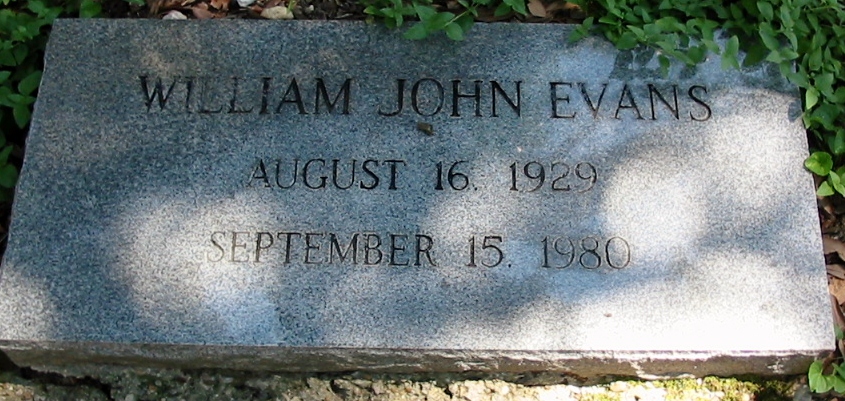
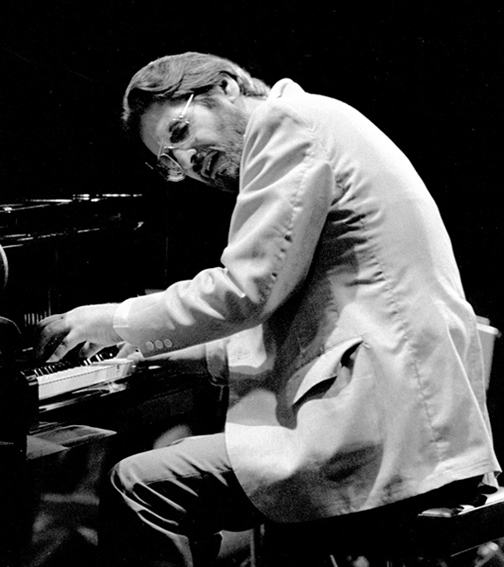
William John Evans (August 16, 1929 – September 15, 1980) was an American jazz pianist and composer who worked primarily as the leader of his trio. His extensive use of impressionist harmony, block chords, innovative chord voicings, and trademark rhythmically independent "singing" melodic lines continue to influence jazz pianists today.
Born in Plainfield, New Jersey, Evans studied classical music at Southeastern Louisiana College and the Mannes School of Music, in New York City, where he majored in composition and received an artist diploma. In 1955, he moved to New York City, where he worked with bandleader and theorist George Russell. In 1958, Evans joined Miles Davis's sextet, which in 1959, then immersed in modal jazz, recorded Kind of Blue, the best-selling jazz album of all time.
In late 1959, Evans left Davis's band and began his career as a leader, forming a trio with bassist Scott LaFaro and drummer Paul Motian, a group now regarded as a seminal modern jazz trio. They recorded two studio albums, Portrait in Jazz and Explorations, and two albums recorded during a 1961 engagement at New York's Village Vanguard jazz club: Sunday at the Village Vanguard and Waltz for Debby. A complete set (on three CDs) of their Vanguard recordings was issued decades later. Ten days after this booking ended, LaFaro died in a car crash. After months without public performances, Evans reemerged with a new trio featuring Chuck Israels on bass. In 1963, Evans recorded the Grammy Award–winning Conversations with Myself, a solo album produced with overdubbing technology. In 1966, he met bassist Eddie Gómez, with whom he worked for the next 11 years. In the mid-1970s, Evans collaborated with the singer Tony Bennett on two critically acclaimed albums: The Tony Bennett/Bill Evans Album (1975) and Together Again (1977).

Many of Evans's compositions, such as "Waltz for Debby" and "Time Remembered", have become standards, played and recorded by many artists. Evans received 31 Grammy nominations and seven awards, and was inducted into the DownBeat Jazz Hall of Fame.
Biography
Early life
Evans grew up in North Plainfield, New Jersey, the son of Harry and Mary Evans (née Soroka). His father was of Welsh descent and ran a golf course; his mother was of Rusyn ancestry and descended from a family of coal miners. The marriage was stormy because of his father's heavy drinking, gambling, and abuse. Bill had a brother, Harry (Harold), two years his senior, to whom he was very close.
Due to Harry Evans Sr.'s destructive behavior, Mary Evans frequently left home with her sons to stay with her sister Justine and the Epps family in nearby Somerville. During this time, Harry began taking piano lessons with a local teacher named Helen Leland between the ages of five and seven. Although Bill was considered too young for lessons at first, he picked up playing by mimicking what he heard during Harry's lessons. Eventually, at the age of six, Bill began formal piano lessons alongside Harry.

Evans remembered Leland with affection for not insisting on a heavy technical approach, with scales and arpeggios. He quickly developed a fluent sight-reading ability, but Leland considered Harry a better pianist. Encouraged by his parents to learn multiple instruments, Bill started violin lessons at the age of seven, and soon added flute and piccolo to his studies. He soon dropped those instruments, but it is believed they influenced his keyboard style. He later named Mozart, Beethoven, and Schubert as composers whose work he often played. During high school, Evans came in contact with 20th-century music like Stravinsky's Petrushka, which he called a "tremendous experience", and Milhaud's Suite provençale, whose bitonal language he said "opened him to new things". Around the same time came his first exposure to jazz; at age 12, he heard Tommy Dorsey's and Harry James's bands on the radio. At 13, Bill stood in for a sick pianist in Buddy Valentino's rehearsal band, where Harry was already playing the trumpet. Soon he began to perform for dances and weddings throughout New Jersey, playing music like boogie-woogie and polkas for $1 per hour. Around this time, he met multi-instrumentalist Don Elliott, with whom he later recorded. Another important influence was bassist George Platt, who introduced Evans to the theory of harmony.
Evans also listened to Earl Hines, Art Tatum, Coleman Hawkins, Bud Powell, George Shearing, Stan Getz, and Nat King Cole. He particularly admired Cole. Evans attended North Plainfield High School, graduating in 1946.
College, army, sabbatical year
After high school, in September 1946, Evans attended Southeastern Louisiana College on a flute scholarship. He studied classical piano interpretation with Louis P. Kohnop, John Venettozzi, and Ronald Stetzel. A key figure in Evans's development was Gretchen Magee, whose methods of teaching left a big imprint on his compositional style.
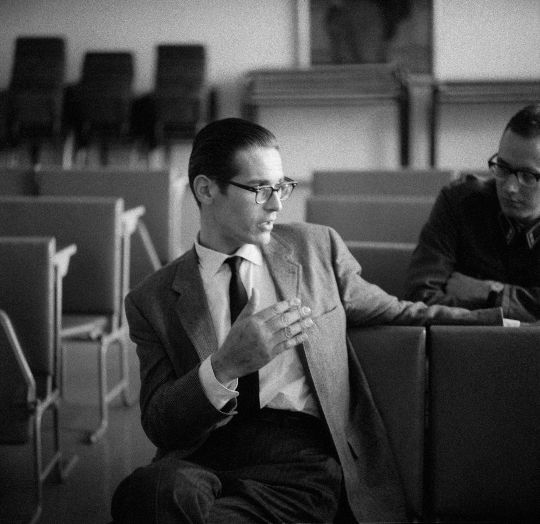
Around his third year in college, Evans composed his first known tune, "Very Early". Also around that time he composed a piece called "Peace Piece". Years later, when asked to play it, he said it was a spontaneous improvisation and didn't know it. He was a founding member of SLU's Delta Omega chapter of Phi Mu Alpha Sinfonia, played quarterback for the fraternity's football team, and played in the college band. In 1950, he performed Beethoven's Piano Concerto No. 3 on his senior recital, graduating with a Bachelor of Music in piano and a bachelor's in music education. Evans regarded his last three years in college as the happiest of his life.
During college, Evans met guitarist Mundell Lowe, and after graduating, they formed a trio with bassist Red Mitchell. The three moved to New York City but could not attract bookings, prompting them to leave for Calumet City, Illinois. In July 1950, Evans joined Herbie Fields's band, based in Chicago. During the summer, the band did a three-month tour backing Billie Holiday, including East Coast appearances at Harlem's Apollo Theater and shows in Philadelphia, Baltimore, and Washington, D.C. The band included trumpeter Jimmy Nottingham, trombonist Frank Rosolino and bassist Jim Aton. Upon its return to Chicago, Evans and Aton worked as a duo in clubs, often backing singer Lurlean Hunter. Shortly thereafter, Evans received his draft notice and entered the U.S. Army.
During his three-year (1951–54) period in the Army, Evans played flute, piccolo, and piano in the Fifth U.S. Army Band at Fort Sheridan. He hosted a jazz program on the camp radio station and occasionally performed in Chicago clubs, where he met singer Lucy Reed, with whom he became friends and later recorded. He met singer and bassist Bill Scott and Chicago jazz pianist Sam Distefano (his bunkmate in their platoon), both of whom became Evans's close friends. But Evans's stay in the Army was traumatic, and it caused him to have nightmares for years. As people criticized his musical conceptions and playing, he lost confidence for the first time. Around 1953, Evans composed his best-known tune, "Waltz for Debby", for his young niece. During this period, he began using recreational drugs, occasionally smoking marijuana.

Evans was discharged from the Army in January 1954, and entered a period of seclusion triggered by the harsh criticism he had received. He took a sabbatical year and lived with his parents, setting up a studio, acquiring a grand piano, and working on his technique, believing he lacked other musicians' natural fluency. He visited his brother, now in Baton Rouge, Louisiana, recently married and working as a conservatory teacher.
Return to New York City
In July 1955, Evans returned to New York City and enrolled in the Mannes College of Music for a three-semester postgraduate course in music composition. He also wrote classical settings of poems by William Blake. Along with his studies, Evans played in low-profile "Tuxedo gigs" at the Friendship Club and the Roseland Ballroom, as well as Jewish weddings, intermission spots, and over 40 dances. Better opportunities also arose, such as playing solo opposite the Modern Jazz Quartet at the Village Vanguard, where one day he saw Miles Davis listening to him. During this period, Evans also met Thelonious Monk.
Evans soon began to perform in Greenwich Village clubs with Don Elliott, Tony Scott, Mundell Lowe, and bandleader Jerry Wald. He may have played on some of Wald's discs, but his first proven Wald recording is Listen to the Music of Jerry Wald, which also featured his future drummer Paul Motian.
In early 1955, singer Lucy Reed moved to New York City to play at the Vanguard and The Blue Angel, and in August she recorded The Singing Reed with a four-piece group that included Evans. During this period, he met two of Reed's friends: manager Helen Keane, who became his agent seven years later, and George Russell, with whom he soon worked. That year, he recorded with guitarist Dick Garcia on A Message from Garcia on the Dawn label. In parallel, Evans kept up his work with Scott, playing in Preview's Modern Jazz Club in Chicago in December 1956 – January 1957, and recording The Complete Tony Scott. After the Complete sessions, Scott took a long overseas tour.
Debut album New Jazz Conceptions
In September 1956, producer Orrin Keepnews was convinced to record the reluctant Evans by a demo tape Mundell Lowe played to him over the phone. The result was his debut album, New Jazz Conceptions, featuring the original versions of "Waltz for Debby" and "Five". Eleven songs were recorded in the first session, including Evans's original composition "Waltz for Debby", which proved to be his most recognized and recorded composition. The album began Evans's relationship with Riverside Records, and also marked the formation of the first Bill Evans trio, with Teddy Kotick (bass) and Paul Motian (drums). AllMusic critic Scott Yanow said about the album: "Bill Evans' debut as a leader found the 27-year-old pianist already sounding much different than the usual Bud Powell-influenced keyboardists of the time ... A strong start to a rather significant career." David Rickert of All About Jazz noted Bud Powell's influence and wrote, "Even at this stage he had the chops to make this a good piano jazz album, but in the end it's not a very good Bill Evans album ... There are glimpses of the later trademarks of Evans' style". Though a critical success that got good reviews in DownBeat and Metronome magazines, New Jazz Conceptions was initially a financial failure, selling only 800 copies the first year. "Five" was for some time Evans's trio farewell tune during performances. After the album's release, Evans spent much time studying J. S. Bach's music to improve his technique.
Work with George Russell
Evans met composer George Russell during his tenure with Lucy Reed. Russell's first impression of Evans was unfavorable ("this is going to be like pulling teeth all day"), but when he secretly heard Evans play, he changed his mind. Russell was then developing his magnum opus, the treatise Lydian Chromatic Concept of Tonal Organization, in which he argued that the Lydian mode was more compatible with tonality than the major scale (Ionian mode) used in most music. This was groundbreaking in jazz, and soon influenced musicians like Miles Davis. Evans, who was already acquainted with these ideas, began to work with Russell in 1956.
By this time, RCA Victor had begun a series of recordings called Jazz Workshop, and soon Russell, through the intervention of Hal McKusick and Jack Lewis, gained his own record date, titled The Jazz Workshop and released in 1957. At that time, Russell assembled trumpeter Art Farmer, guitarist Barry Galbraith, bassist Milt Hinton, and Evans for three recording dates, along with several rehearsal sessions. Initially, for these sessions, only the bassist was given a written part, while the rest were left, and, according to Farmer, "took the parts at home and tried to come to terms with them". The album took a year to make, and was successful enough to enable Russell to escape his penurious lifestyle. Evans performed a significant solo in "Concerto for Billy the Kid".
In 1957, Russell was one of six composers (three jazz, three classical) Brandeis University commissioned to write a piece for its Festival of the Creative Arts in the context of the first experiments in third stream jazz. Russell wrote a suite for orchestra, "All About Rosie", that featured Evans, among other soloists. "All About Rosie" has been cited as one of the few convincing examples of composed polyphony in jazz. A week before the festival, the piece was previewed on TV, and Evans's performance was deemed "legendary" in jazz circles. During the festival performance on June 6, Evans became acquainted with Chuck Israels, who became his bassist years later. Also during the festival, guitarist Joe Puma invited Evans to play on the album Joe Puma/Jazz.
That year, Evans also met bassist Scott LaFaro while auditioning him for a place in an ensemble led by trumpeter Chet Baker, and was impressed. LaFaro joined his trio three years later.
Evans also performed on albums by Charles Mingus, Oliver Nelson, Tony Scott, Eddie Costa, and Art Farmer.
Work with Miles Davis, Everybody Digs Bill Evans, and Kind of Blue
In February 1958, at Miles Davis's urging, Russell drove Evans to the Colony Club in Brooklyn to play with Davis's sextet. At this time, John Coltrane, Cannonball Adderley, Paul Chambers, and Philly Joe Jones were the other members of Davis's group. Red Garland had recently been fired, and Evans knew he was not merely filling in for one night but auditioning to become the group's regular pianist. By the end of the night, Davis told Evans that he would play their next engagement in Philadelphia. The band had been known for playing a mixture of jazz standards and bebop originals, but by the time Evans arrived, Davis had begun his venture into modal jazz, having just released his album Milestones.
Evans formally joined Davis's group in April 1958. The band appeared in radio broadcasts on Saturday nights and, on May 3, the new formation made its first broadcast from Café Bohemia (its usual locale). The live radio appearance broadcast on May 17, 1958, and also released on the album titled Makin' Wax, is the earliest documented evidence of collaboration between Evans and Davis. By mid-May, Jimmy Cobb replaced Philly Joe Jones, with whom Evans had developed a close friendship. On May 26, Evans made his first studio recordings with Davis, which were first issued as part of Jazz Track, and later reissued on 1958 Miles.
A performance of the Ballets Africains from Guinea in 1958 sparked Davis's interest in modal music. This music stayed for long periods of time on a single chord, weaving in and out of consonance and dissonance. Another influence was George Russell's treatise. Both influences coalesced in Davis's conception of modal jazz offering an alternative to chord changes and major/minor key relationships, relying instead on a series of modal scales. He realized that Evans, who had worked with Russell, could follow him into modal music. At the same time, Evans introduced Davis to 20th-century classical composers such as Sergei Rachmaninoff, Maurice Ravel, and Aram Khachaturian.
The band's mostly black followers did not react favorably to the replacement of Garland with a white musician. Davis used to tease him, and Evans's sensitivity perhaps let it get to him. But the band began to find a new, smoother groove, as Adderley recalled: "When he started to use Bill, Miles changed his style from very hard to a softer approach."
In July 1958, Evans appeared as a sideman on Adderley's album Portrait of Cannonball, featuring the first performance of "Nardis", specially written by Davis for the session. While Davis was not very satisfied with the performance, he said that from then on, Evans was the only one to play it in the way he wanted. The piece came to be associated with Evans's future trios, which played it frequently.
By the end of the summer, Davis knew Evans was quickly approaching his full professional development and that he would soon leave Davis's group. That year, Evans won the DownBeat International Critics' Poll for his work with Davis and his album New Jazz Conceptions.
In September 1958, Evans recorded as a sideman in Art Farmer's album Modern Art, also featuring Benny Golson. All three had won the DownBeat poll. Later, Evans deemed this record one of his favorites. During this period, despite all the successes, Evans was visiting a psychiatrist, as he was unsure whether he wanted to continue as a pianist.
Evans left Davis's sextet in November 1958 and stayed with his parents in Florida and his brother in Louisiana. While he was burned out, one of the main reasons for leaving was his father's illness. During this sojourn, the always self-critical Evans suddenly felt his playing had improved. "While I was staying with my brother in Baton Rouge, I remember finding that somehow I had reached a new level of expression in my playing. It had come almost automatically, and I was very anxious about it, afraid I might lose it."
Shortly after, he moved back to New York, and in December Evans recorded the trio album Everybody Digs Bill Evans for Riverside Records with bassist Sam Jones and drummer Philly Joe Jones. This was Evans's second album as a leader, the first since New Jazz Conceptions, recorded two years earlier. While Keepnews had often tried to persuade Evans to make a second trio recording, the pianist felt he had nothing new to say until then. He had also been too busy traveling with Davis to make a record.
One of the pieces to appear on the album was Leonard Bernstein's "Some Other Time". Evans started to play an introduction using an ostinato figure. But, according to Keepnews, who was present, Evans spontaneously started to improvise over that harmonic frame, creating the recording that would be named "Peace Piece". According to Evans: "What happened was that I started to play the introduction, and it started to get so much of its own feeling and identity that I just figured, well, I'll keep going." But Gretchen Magee has said the piece was penned as an exercise during Evans's college years, and Peri Cousins says that Evans often played the piece at home.
Evans returned to the Davis sextet in early 1959, at the trumpeter's request, to record Kind of Blue, often considered the best-selling jazz album of all time.
As usual, during the sessions of Kind of Blue, Davis called for almost no rehearsal and the musicians had little idea what they were to record. Davis had given the band only sketches of scales and melody lines on which to improvise. Once the musicians were assembled, Davis gave brief instructions for each piece and then set about taping the sextet in studio.
During the creative process of Kind of Blue, Davis handed Evans a piece of paper with two chords—G minor and A augmented—and asked "What would you do with that?" Evans spent the next night writing what became "Blue in Green". But when the album came out, the song was attributed exclusively to Davis. When Evans suggested he deserved a share of the royalties, Davis offered him a check for $25. Evans also wrote the liner notes for Kind of Blue, comparing jazz improvisation to Japanese visual art. By the fall of 1959, Evans had started his own trio with Jimmy Garrison and Kenny Dennis, but it was short-lived.
Sometime during the late 1950s, most probably before joining Davis, Evans began using heroin. Philly Joe Jones has been cited as an especially bad influence in this regard. Davis seems to have tried to help Evans kick his addiction, but failed.
Evans's first long-term romance was with a black woman named Peri Cousins (for whom "Peri's Scope" was named), during the second half of the 1950s. The couple had problems booking hotels during Evans's gigs, since most did not allow interracial couples. By the turn of the decade, Evans had met a waitress named Ellaine Schultz, who became his partner for 12 years.
Piano trios featured on commercially released recordings
Trio with Scott LaFaro and Paul Motian
In mid-1959, Evans was performing at Basin Street East and was visited by bassist Scott LaFaro, who was playing with singer and pianist Bobby Scott at a club around the corner. LaFaro expressed interest in forming a trio, and suggested Paul Motian, who had appeared on Evans's album New Jazz Conceptions, as the drummer. The trio with LaFaro and Motian became one of the most celebrated piano trios in jazz. With this group, Evans's focus settled on traditional jazz standards and original compositions, with an added emphasis on interplay among band members. Evans and LaFaro achieved a high level of musical empathy. In December 1959 the band recorded its first album, Portrait in Jazz, for Riverside Records.
In early 1960, the trio began a tour that brought it to Boston, San Francisco (at Jazz Workshop), and Chicago (at the Sutherland Lounge). After returning to New York in February, the band performed at Town Hall on a multi-artist bill, and then began a residency at Birdland. While the trio produced no studio records in 1960, two bootleg recordings from radio broadcasts from April and May were illegally released in the early 1970s, infuriating Evans. They were posthumously issued as The 1960 Birdland Sessions.
In parallel with his trio work, Evans kept working as a backing musician for other leaders. In 1960, he performed on singer Frank Minion's album The Soft Land of Make Believe, featuring versions of the Kind of Blue compositions "Flamenco Sketches" and "So What" with added lyrics. That year, he also recorded The Soul of Jazz Percussion with Philly Joe Jones and Chambers.
In May 1960, the trio performed at one of the Jazz Profiles concerts, a series organized by Charles Schwartz. Around this time, Evans hired Monte Kay as his manager. During one of his concerts at the Jazz Gallery, Evans contracted hepatitis and went to his parents' house in Florida to recuperate. During this period, he also participated in the recordings The Great Kai & J. J. and The Incredible Kai Winding Trombones for Impulse! Records. In May and August 1960, Evans appeared on George Russell's album Jazz in the Space Age. In late 1960, he performed on Jazz Abstractions, an album recorded under the leadership of Gunther Schuller and John Lewis.
In February 1961, Evans's trio with Motian and LaFaro recorded Explorations, the group's second and final studio album. According to Keepnews, the recording sessions' atmosphere was tense, Evans and LaFaro having argued over extra-musical matters. Evans was also having headaches, and LaFaro was playing with a loaned bass. The disc features Evans's first trio version of "Nardis", the Miles Davis piece Evans had recorded with Cannonball Adderley for Portrait of Cannonball in 1958. Apart from "Nardis" and "Elsa", the album consisted of jazz standards. After the recording sessions, Evans was initially unwilling to release the album, believing the trio had played badly. But upon hearing the recording, he changed his mind, and later thought of it very favorably. Just after the Explorations sessions, he appeared as a sideman in Oliver Nelson's The Blues and the Abstract Truth.
In late June 1961, Riverside recorded Evans's trio live at the Village Vanguard, resulting in the albums Sunday at the Village Vanguard and Waltz for Debby. (Further recordings from this performance were issued in 1984 as More From The Vanguard.) Evans later showed special satisfaction with these recordings, seeing them as the culmination of his trio's musical interplay.
After LaFaro's death
The death of 25-year-old LaFaro in a car crash ten days after the Vanguard performances devastated Evans. He did not record or perform in public again for several months.
In October 1961, persuaded by Keepnews, Evans returned to the musical scene on the Mark Murphy album Rah. With new bassist Chuck Israels, in December they recorded a session for Nirvana with flutist Herbie Mann. In April and May 1962, Evans completed the duo album Undercurrent with guitarist Jim Hall.
After Evans re-formed his trio in 1962, two albums, Moon Beams and How My Heart Sings!, resulted. In 1963, at the beginning of his association with Verve, he recorded Conversations with Myself, an album that featured overdubbing, layering up to three tracks of piano for each song. The album won him his first Grammy award.
Evans's heroin addiction worsened after LaFaro's death. His girlfriend Ellaine Schultz was also an addict. Evans habitually borrowed money from friends, and eventually his electricity and telephone services were shut down. He said: "You don't understand. It's like death and transfiguration. Every day you wake in pain like death and then you go out and score, and that is transfiguration. Each day becomes all of life in microcosm."
Evans never allowed heroin to interfere with his musical discipline, according to a 2010 BBC article that contrasts his addiction with Chet Baker's. On one occasion while injecting heroin, Evans hit a nerve and temporarily disabled it, performing a full week's engagement at the Village Vanguard virtually one-handed. During this time, Helen Keane began to have an important influence, as she significantly helped maintain Evans's career despite his self-destructive lifestyle, and the two developed a strong friendship.
In summer 1963, Evans and Schultz left their flat in New York and settled in his parents' home in Florida, where, it seems, they quit the habit for some time. Even though never legally married, Bill and Ellaine were in all other respects husband and wife. At that time, Schultz meant everything to Evans, and was the only person with whom he felt genuine comfort.
Although he recorded many albums for Verve, their artistic quality has typically been viewed as uneven. Despite Israels's fast development and the creativity of new drummer Larry Bunker, the album Bill Evans Trio with Symphony Orchestra, featuring Gabriel Fauré's Pavane and works of other classical composers arranged by Claus Ogerman divided critical opinion. Some recordings in unusual contexts were made, such as a concert recording with a big-band recorded at Town Hall that was never issued owing to Evans's dissatisfaction with it (although the more successful jazz trio portion of the concert was released). Live recordings and bootleg radio broadcasts from this period represent some of the trio's better work.